
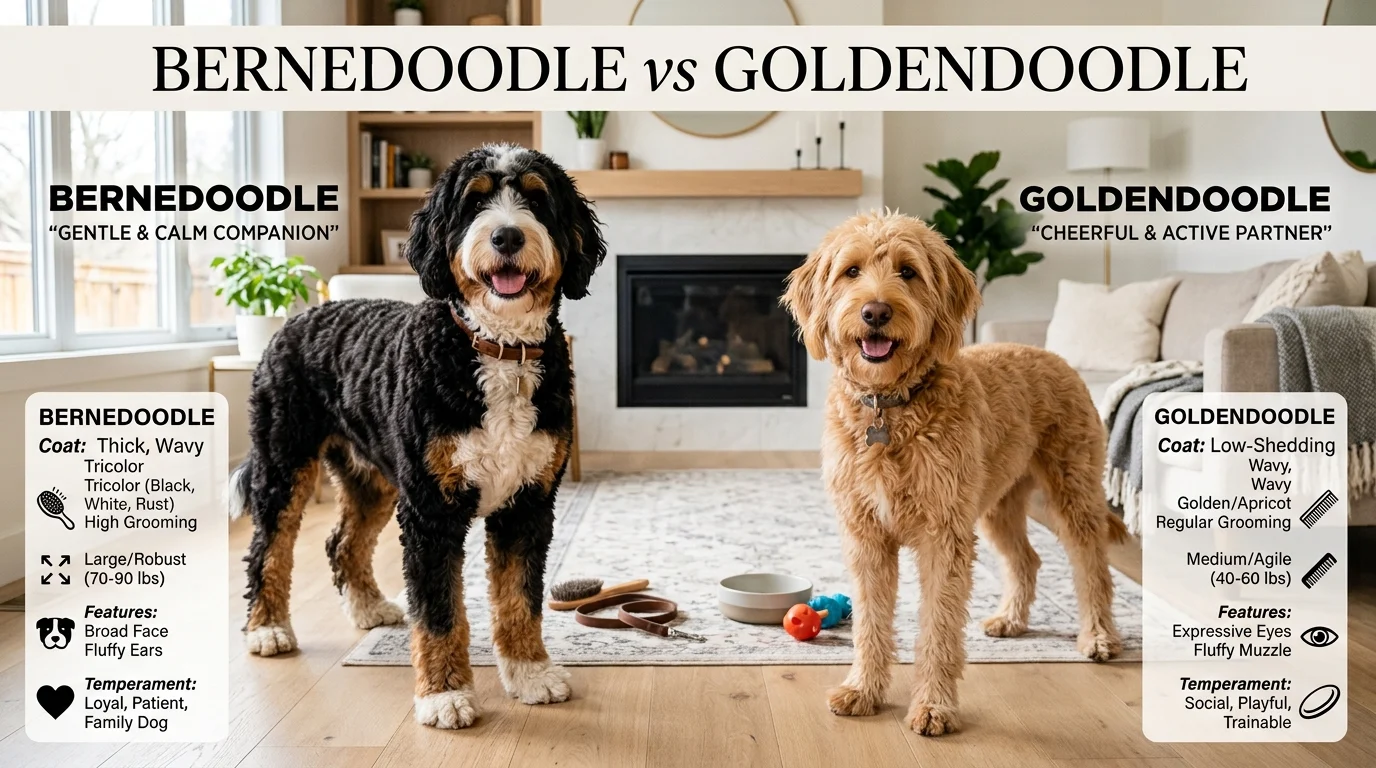
Quick Ans: Bernedoodles are a cross between a Bernese Mountain Dog and a Poodle, while Goldendoodles are a cross between a Golden Retriever and a Poodle. Both are intelligent, social, and commonly described as family friendly dogs, but they can differ in size, temperament, energy level, coat type, and grooming needs.
Bernedoodle vs Goldendoodle is a popular comparison for people choosing between two Poodle mixes. Both dogs combine Poodle traits with those of a larger companion breed, so they can look and behave similarly at first glance. However, their parent breeds give them some important differences.
A Bernedoodle combines the Bernese Mountain Dog with the Poodle. Bernese Mountain Dogs are known for their calm, affectionate nature and strong attachment to their families. Goldendoodles combine Golden Retrievers with Poodles. Golden Retrievers are generally friendly, social, playful, and eager to interact with people.
Both dogs can make wonderful companions, but there isn’t one choice that suits every household. Your lifestyle, available space, activity level, grooming routine, and expectations for temperament all matter.
This guide explains the key differences between Bernedoodles and Goldendoodles in simple terms so you can understand what makes each breed mix unique.
Quick Answer and Key Takeaway
The main difference between a Bernedoodle and a Goldendoodle comes from their non Poodle parent. Bernedoodles combine Bernese Mountain Dog traits with Poodle traits, while Goldendoodles combine Golden Retriever traits with Poodle traits.
| Feature | Bernedoodle | Goldendoodle |
|---|---|---|
| Parent breeds | Bernese Mountain Dog + Poodle | Golden Retriever + Poodle |
| Typical personality | Affectionate, relaxed, playful | Friendly, social, energetic |
| Energy | Moderate to high | Moderate to high |
| Training | Usually intelligent and trainable | Usually highly trainable |
| Grooming | Regular grooming needed | Regular grooming needed |
| Family suitability | Often family oriented | Often family oriented |
Bernedoodle vs Goldendoodle: Definition and Explanation
What Is a Bernedoodle?
A Bernedoodle is a hybrid dog created by crossing a Bernese Mountain Dog with a Poodle.
Bernedoodles can inherit the Bernese Mountain Dog’s affectionate and relaxed personality along with the Poodle’s intelligence. Their size varies depending on the Poodle parent, so standard, miniature, and smaller varieties can differ considerably.
Their coats can also vary. Some have wavy coats, while others have curlier coats.
What Is a Goldendoodle?
A Goldendoodle is a cross between a Golden Retriever and a Poodle.
Goldendoodles are often known for their friendly and social personalities. Like Bernedoodles, their size and coat can vary depending on the parents and generation.
They may have straight, wavy, or curly coats and usually require regular grooming.
Is This a Grammar, Usage, or Vocabulary Issue?
Bernedoodle vs Goldendoodle is not a grammar issue. It is a breed comparison and vocabulary topic.
The two names refer to different Poodle mixes. Bernedoodle comes from Bernese Mountain Dog + Poodle, while Goldendoodle comes from Golden Retriever + Poodle.
Real World Usage Examples
Family Life
Bernedoodles and Goldendoodles are commonly discussed as family companion dogs. However, individual temperament depends on genetics, early socialization, training, and environment.
Recap: Neither breed mix guarantees a particular personality in every individual dog.
Training
Both mixes can inherit strong learning ability from their Poodle parent. Goldendoodles may also inherit the Golden Retriever’s willingness to work with people, while Bernedoodles can sometimes be more independent.
Recap: Consistent positive training is important for both.
Exercise
Both dogs need regular physical activity. Goldendoodles can be particularly energetic and playful, while Bernedoodles may vary from relatively relaxed to highly active.
Recap: Exercise needs depend on the individual dog, size, age, and inherited traits.
Bernedoodle vs Goldendoodle: Key Differences
| Category | Bernedoodle | Goldendoodle |
|---|---|---|
| Size | Can range from small to large | Can range from small to large |
| Activity | Moderate to high | Moderate to high |
| Social behavior | Often affectionate and family focused | Often outgoing and people oriented |
| Coat | Wavy or curly varieties are common | Straight, wavy, or curly varieties |
| Grooming | Regular brushing and professional grooming may be needed | Regular brushing and professional grooming may be needed |
| Shedding | Varies by individual | Varies by individual |
| Training | Intelligent but can be independent | Intelligent and often eager to learn |
| Socialization | Important from an early age | Important from an early age |
Regional or Global Usage Differences
The terms Bernedoodle and Goldendoodle are used internationally, especially in English speaking dog ownership communities. However, breeders can use different labels for size, generation, and coat type.
For example, terms such as F1, F1B, and multigenerational describe breeding generations rather than separate breeds. Buyers should check exactly which parent dogs were used rather than relying only on a marketing label.
When NOT to Choose Based on Breed Name Alone
Don’t choose a Bernedoodle or Goldendoodle only because:
- You expect every dog of that type to have the same personality.
- You assume every Poodle mix is low shedding.
- You expect either dog to be completely hypoallergenic.
- You want a specific adult size without checking the parents.
- You don’t want to provide regular grooming.
- You expect the dog to require very little exercise.
- You assume a friendly breed mix automatically needs little training.
No dog breed or mix can guarantee a completely allergy free experience.
Common Mistakes and Corrections
| Correct Understanding | Incorrect Assumption | Why |
|---|---|---|
| Both mixes can vary in coat type | Every Bernedoodle has a curly coat | Coat traits vary |
| Goldendoodles need training | Friendly dogs need no training | Temperament does not replace training |
| Both may need regular grooming | Poodle mixes never need grooming | Coat maintenance varies |
| Adult size depends on breeding | Every Bernedoodle is huge | Poodle size affects the mix |
| Shedding varies | Every Goldendoodle is non shedding | Individual coats differ |
Easy Decision Rule
Think about the individual dog’s temperament, expected adult size, exercise needs, coat, grooming requirements, and breeder practices instead of choosing solely from the breed name.
Exercises With Answers
Choose Bernedoodle or Goldendoodle.
- This mix combines a Bernese Mountain Dog and a Poodle.
- This mix combines a Golden Retriever and a Poodle.
- This mix may inherit Golden Retriever traits.
- This mix may inherit Bernese Mountain Dog traits.
- Both mixes can have different coat types.
Answers
- Bernedoodle
- Goldendoodle
- Goldendoodle
- Bernedoodle
- Both
Related Concepts and Comparisons
Bernedoodle vs Goldendoodle Temperament
Bernedoodles may inherit the calm and affectionate qualities associated with Bernese Mountain Dogs. Goldendoodles may inherit the outgoing and playful qualities associated with Golden Retrievers. Individual dogs can differ substantially.
Bernedoodle vs Goldendoodle Grooming
Both can require regular brushing and grooming, especially when they inherit longer or curlier coats. Grooming frequency depends on coat type and length.
Bernedoodle vs Goldendoodle Size
Neither mix has one universal size. The size of the Poodle parent can significantly affect the resulting dog’s adult size.
FAQs
Is a Bernedoodle or Goldendoodle calmer?
Bernedoodles may inherit the more relaxed nature associated with Bernese Mountain Dogs, but individual temperament varies. Goldendoodles can also be calm, particularly with appropriate exercise and training.
Which is more energetic, Bernedoodle or Goldendoodle?
Both can be energetic. Goldendoodles may inherit a particularly playful nature from Golden Retrievers, while Bernedoodles can range from moderately active to highly energetic.
Are Bernedoodles bigger than Goldendoodles?
Not necessarily. Both can vary greatly in size depending on the Poodle parent and breeding program.
Do Bernedoodles shed less than Goldendoodles?
Neither mix has a guaranteed shedding level. Coat genetics vary between individual dogs, even within the same litter.
Are Goldendoodles easier to train than Bernedoodles?
Both can be intelligent and trainable. Bernedoodles may sometimes show more independence, while Goldendoodles can inherit the Golden Retriever’s willingness to work with people.
Are Bernedoodles good family dogs?
Many Bernedoodles are affectionate and family oriented. However, temperament varies, so socialization, training, and the individual dog’s personality should be considered.
Are Goldendoodles good for families?
Goldendoodles are often social and people oriented. Their suitability depends on the individual dog and whether the household can meet its exercise, training, and grooming needs.
Do Bernedoodles need a lot of grooming?
They can. Dogs with longer or curlier coats generally need frequent brushing and regular professional grooming to prevent matting.
Are Goldendoodles hypoallergenic?
No dog can be guaranteed to be completely hypoallergenic. Goldendoodles may shed less than some other dogs depending on their coat, but allergy responses vary from person to person.
Conclusion
Bernedoodle vs Goldendoodle comes down to the traits inherited from their different non Poodle parents. A Bernedoodle combines the Bernese Mountain Dog with the Poodle, while a Goldendoodle combines the Golden Retriever with the Poodle.
Both mixes can be intelligent, affectionate, social, and enjoyable companions. At the same time, their size, coat, shedding, energy level, and temperament can vary considerably from one dog to another.
Bernedoodles may appeal to people who like the affectionate and often more relaxed qualities associated with Bernese Mountain Dogs. Goldendoodles may appeal to people who prefer the outgoing and playful qualities commonly associated with Golden Retrievers. These are general tendencies, not guarantees.
If you’re choosing between the two, don’t focus only on appearance. Look at the dog’s expected adult size, parents, temperament, exercise requirements, grooming needs, health screening, and early socialization. The individual dog and your lifestyle should guide your decision more than the label alone.