
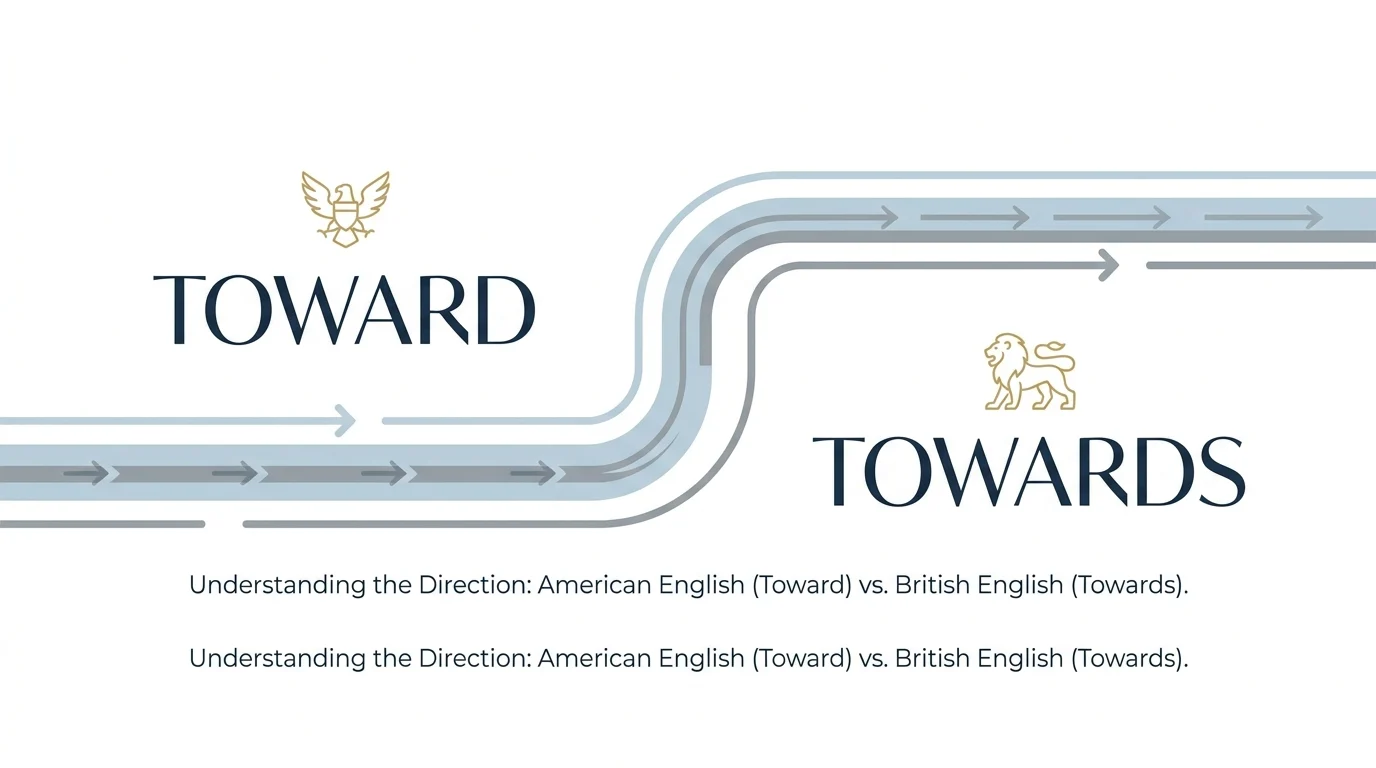
Quick Ans: Toward and towards have the same meaning and are both grammatically correct. The main difference is regional preference. Toward is more common in American English, while towards is more common in British English. Both can describe movement, direction, attitude, or a relationship, so either form can be correct depending on your preferred variety of English.
Toward or towards is a common English usage question because the two words look almost identical and usually mean the same thing. If you’ve seen both forms in books, websites, conversations, and academic writing, you may wonder whether one is incorrect.
The good news is that both toward and towards are correct. The choice usually depends on regional preference rather than grammar. Toward is more common in American English, while towards is more common in British English and several other varieties of English.
Both words can describe physical movement, direction, behavior, feelings, or progress. For example, you can say, “She walked toward the door” or “She walked towards the door.”
Understanding this small difference can help you write more naturally and avoid unnecessary corrections. Once you know the regional pattern, choosing between toward and towards becomes much easier.
Quick Answer and Key Takeaway
Toward and towards are both correct prepositions. They have the same meaning and can usually be used interchangeably.
The main difference is regional preference:
- Toward is more common in American English.
- Towards is more common in British English.
For consistent writing, choose the form preferred by your audience and use it consistently.
Toward vs Towards: Definition and Explanation
What Does Toward Mean?
Toward means in the direction of something or someone. It can also describe movement toward a goal, attitude, or relationship.
Examples:
He walked toward the station.
We are working toward a solution.
What Does Towards Mean?
Towards has the same meaning as toward. It can describe direction, movement, progress, behavior, or attitude.
Examples:
He walked towards the station.
We are working towards a solution.
There is no major difference in meaning between the two forms.
Is This a Grammar, Usage, or Vocabulary Issue?
This is mainly a usage and regional variation issue.
Neither word is grammatically wrong. The difference comes from how different varieties of English tend to use the word.
If you’re writing for an American audience, toward may sound more natural. If you’re writing for a British audience, towards may be more familiar.
The most important point is consistency.
Real World Usage Examples
Everyday Usage
She moved toward the window.
She moved towards the window.
Both sentences are correct.
Recap: Both forms can describe movement in a particular direction.
Academic and Professional Writing
The research is moving toward a clearer conclusion.
The company is working towards its annual goals.
Both forms work in formal writing.
Recap: Neither form is automatically more formal or more correct.
Describing Attitudes
He has always been kind toward his colleagues.
She showed respect towards her teachers.
Both sentences use the word to describe a person’s attitude or behavior.
Recap: Toward and towards can describe relationships and attitudes as well as physical direction.
Regional or Global Usage Differences
Regional preference is the biggest distinction between the two forms.
| Variety of English | Common Preference |
|---|---|
| American English | toward |
| British English | towards |
| Canadian English | Both |
| Australian English | towards is common |
| International English | Both |
These are general patterns rather than strict rules. You may encounter towards in American writing and toward in British writing.
Therefore, regional preference should guide your choice, but it should not be treated as an absolute rule.
When NOT to Use Toward or Towards
Avoid using either word when another preposition or expression is required by the meaning.
For example:
- Use at when describing a specific target of an action: “She looked at me.”
- Use into when describing movement from outside to inside: “He walked into the room.”
- Use through when describing movement across or within something: “They walked through the tunnel.”
- Use for when expressing a purpose or intended recipient where appropriate.
Also, don’t assume that changing toward to towards changes the meaning. In most ordinary sentences, it does not.
Common Mistakes and Corrections
| Correct Sentence | Incorrect Sentence | Why |
|---|---|---|
| She walked toward the door. | She walked toward to the door. | Do not add “to” after toward. |
| We are working towards a solution. | We are working towards to a solution. | Towards already functions as the preposition. |
| He moved toward the exit. | He moved towards the exit and toward to it. | Avoid unnecessary repetition. |
| She showed kindness toward him. | She showed kindness toward to him. | “Toward” does not need another preposition. |
Easy Decision Rule
Remember this:
Toward = Towards
If you’re writing for an American audience, toward may be the better default.
If you’re writing for a British audience, towards may be the more natural choice.
Exercises With Answers
Choose toward or towards.
- She walked ______ the car.
- We are moving ______ a better solution.
- He showed respect ______ his parents.
- The dog ran ______ the gate.
- The project is progressing ______ completion.
Answers
- toward or towards
- toward or towards
- toward or towards
- toward or towards
- toward or towards
Both answers are grammatically correct in every sentence.
Related Concepts and Comparisons
Toward vs Towards in Formal Writing
Both are acceptable in formal writing. The best choice depends on your preferred variety of English and the style guide you’re following.
Toward vs To
Toward describes direction or movement in the direction of something. To often indicates a destination.
Compare:
She walked toward the house.
She walked to the house.
The first emphasizes direction, while the second normally presents the house as the destination.
Toward vs Towards in American and British Writing
The difference is mainly regional. American writers often favor toward, while British writers frequently use towards.
FAQs
Is toward or towards correct?
Both toward and towards are correct. They have the same basic meaning, and the choice usually depends on regional preference.
Is toward more correct than towards?
No. Neither form is inherently more correct. Toward is often preferred in American English, while towards is common in British English.
Should I use toward or towards in academic writing?
Either can work in academic writing. Follow your institution’s style guide and remain consistent throughout your work.
What is the difference between toward and towards?
There is generally no difference in meaning. Both can describe direction, movement, progress, and attitudes.
Is towards British or American English?
Towards is particularly common in British English. However, it can also appear in American English, so it is not exclusively British.
Is toward American English?
Toward is more common in American English. It is also used in other varieties of English.
Can toward and towards be used interchangeably?
Yes. In most contexts, you can replace one with the other without changing the meaning.
Which is better, toward or towards?
Neither is universally better. Choose based on your audience, regional variety, or required style guide.
Conclusion
Toward or towards is not a question of right versus wrong. Both forms are grammatically correct and have the same basic meaning. The main difference is regional preference.
Toward is generally more common in American English, while towards is widely used in British English and some other varieties. Both words can describe physical direction, progress, attitudes, relationships, and movement toward a goal.
The easiest way to choose is to consider your audience. If your writing follows American conventions, toward may be the more natural choice. If you’re following British conventions, towards may fit better.
Most importantly, don’t worry about using one form when the other appears in a sentence. In ordinary usage, they are interchangeable. For polished writing, simply choose the form that matches your preferred variety of English and use it consistently throughout the same piece of writing.
1 thought on “Toward or Towards: Which One Is Correct? Meaning, Rules & Examples”