
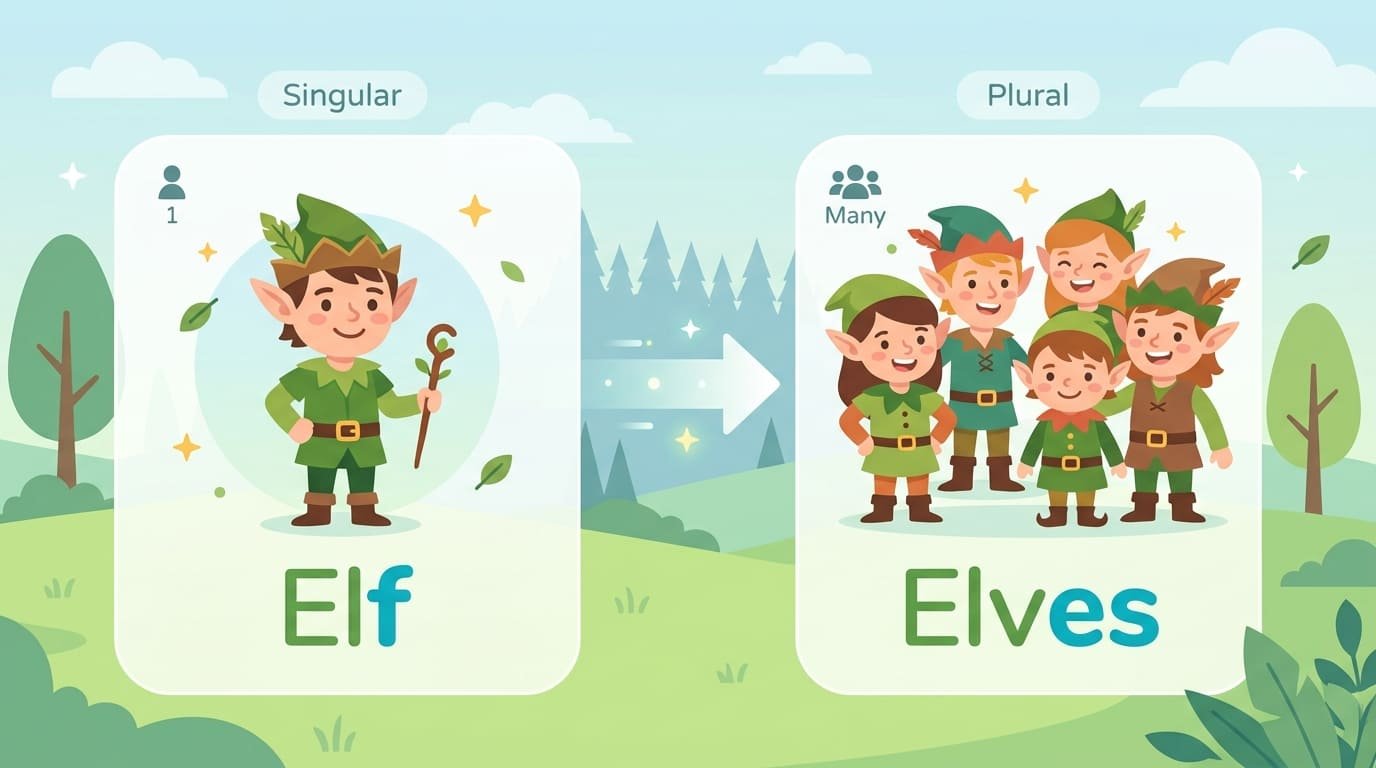
Quick Ans: “Elves” is the standard plural form of “elf” in modern English. Use “elf” for one mythical creature and “elves” for two or more. Although “elfs” can appear in older or specialized sources, “elves” is the normal choice for everyday, academic, and professional writing.
Are you wondering whether to write “elfs or elves”? The correct standard form is “elves.” The word “elf” refers to a mythical or legendary creature found in folklore, fantasy stories, books, films, and Christmas traditions.
At first, “elfs” may seem logical because many English nouns form their plural by adding “s.” However, English has several nouns with irregular plural forms. “Elf” belongs to this group in standard modern usage.
For students, ESL learners, and writers, knowing the correct plural can help avoid a common spelling mistake. You will often see “elves” when reading fantasy stories, discussing folklore, or writing about Christmas traditions.
The easiest rule is simple: one creature is an “elf,” while two or more are “elves.” Once you remember this pair, the spelling becomes much easier.
Quick Answer and Key Takeaway
| Word | Correct? | Meaning |
|---|---|---|
| Elf | Yes | One mythical creature |
| Elves | Yes | More than one elf |
| Elfs | Rare or nonstandard in general use | Variant plural found in some contexts |
The standard plural of “elf” is “elves.” For normal modern English, choose “elves.”
Definition and Explanation
Elf
“Elf” is a singular noun. It refers to a mythical or supernatural creature found in European folklore and modern fantasy.
Example: The story features a mysterious elf.
The word is also strongly connected with Christmas traditions and popular culture.
Elves
“Elves” is the standard plural form of “elf.” It refers to two or more elves.
Example: The fantasy story includes several elves.
The spelling does not simply follow the usual rule of adding “s.” Instead, “elf” has the established plural form “elves.”
| Feature | Elf | Elves |
|---|---|---|
| Number | Singular | Plural |
| Meaning | One elf | More than one elf |
| Example | An elf lives here. | Several elves live here. |
| Standard spelling | Yes | Yes |
The important pair to remember is “elf” and “elves.” Although some nouns ending in “f” form plurals with “ves,” this is not a rule that applies to every word.
Is This a Grammar, Usage, or Vocabulary Issue?
This is mainly a spelling and grammar issue involving an irregular plural form.
English learners often expect “elf” to become “elfs” because regular plurals usually take “s” or “es.” However, “elves” is the established standard form in modern English.
The form “elfs” does occur in some historical, dialectal, or specialized sources. Still, general readers will expect “elves,” so that is the safest choice for standard writing.
Real World Usage Examples
Workplace Example
The company used friendly elves in its Christmas advertising.
Here, “elves” refers to several fictional Christmas characters. Therefore, the plural form is correct.
Academic Example
The researcher examined how elves appear in European folklore.
In this sentence, “elves” refers to multiple mythical beings discussed in a scholarly context.
Everyday Example
The children watched a movie about magical elves.
This is a natural everyday use of the standard plural form.
Regional or Global Usage Differences
“Elves” is the standard plural in both American and British English.
Unlike some English words, there is no major regional spelling difference between the United States and the United Kingdom. Writers in both varieties normally use “elves.”
Moreover, the word is widely recognized around the world because of fantasy literature, films, video games, and Christmas traditions.
When NOT to Use It
Do not normally use “elfs” when writing standard modern English.
Do not assume every noun ending in “f” must change to “ves” either. English plural patterns have many exceptions.
Do not write “elfes.” That is not the standard spelling.
Do not use “elves” when referring to only one creature. The singular form is “elf.”
In formal writing, choose “elves” unless you are specifically discussing an unusual historical or specialized use of “elfs.”
Common Mistakes and Corrections
| Correct Sentence | Incorrect Sentence | Why |
|---|---|---|
| The story has three elves. | The story has three elfs. | “Elves” is the standard plural. |
| The elves live in the forest. | The elfs live in the forest. | Standard English uses “elves.” |
| One elf appeared in the story. | One elves appeared in the story. | “Elf” is singular. |
| The children dressed as elves. | The children dressed as elfs. | “Elves” is the standard plural. |
Decision Rule: Use “elf” for one and “elves” for two or more. In standard modern English, “elves” is the correct plural form.
Exercises With Answers
Choose the correct form.
- One _____ lives in the forest.
- Three _____ appeared in the story.
- Santa is often shown with several _____.
- The children dressed as _____.
- The fantasy book contains many _____.
Answer Key
- elf
- elves
- elves
- elves
- elves
Related Concepts and Comparisons
Readers may also search for elf plural, elves meaning, irregular plural nouns, nouns ending in f, wolf and wolves, leaf and leaves, knife and knives, and common English plural rules.
FAQs
Is elfs or elves correct?
“Elves” is the standard plural form of “elf” in modern English. For normal writing, use “elves” rather than “elfs.”
What is the plural of elf?
The plural of “elf” is “elves.” For example, “The story contains several elves.”
Why does elf become elves?
“Elf” has an established irregular plural form. English developed “elves” as the standard plural instead of simply adding “s” to form “elfs.”
Is elfs ever used in English?
Yes, “elfs” can be found in some historical, dialectal, or specialized contexts. However, “elves” is the standard form for modern general English.
Is elves singular or plural?
“Elves” is plural. The singular form is “elf.” For example, “One elf” becomes “two elves.”
Do American and British English use elves?
Yes. Both American and British English use “elves” as the standard plural of “elf.” Therefore, there is no major regional spelling difference.
What are elves?
Elves are mythical or supernatural creatures found in folklore and fantasy. They are also common characters in Christmas stories and popular culture.
How can ESL learners remember elf and elves?
A simple memory trick is to learn the two forms together: “one elf, two elves.” This helps you remember that the standard plural is “elves.”
Conclusion
When choosing between “elfs or elves,” use “elves” in standard modern English. “Elf” is the singular form, while “elves” is the standard plural form.
For example, you can write, “One elf lives in the forest,” but “Several elves live in the forest.” The plural spelling is established through English usage, so “elfs” should not normally replace it.
Although “elfs” appears occasionally in older, dialectal, or specialized writing, most readers expect “elves.” This applies to American and British English alike.
It is also useful to remember that not every noun ending in “f” follows the same plural pattern. English has several irregular forms, so learning common word pairs is often easier than trying to apply one rule to every noun.
The simplest memory trick is: one elf, two elves. Keep that pair in mind whenever you write about mythical creatures, fantasy characters, or Christmas traditions.