
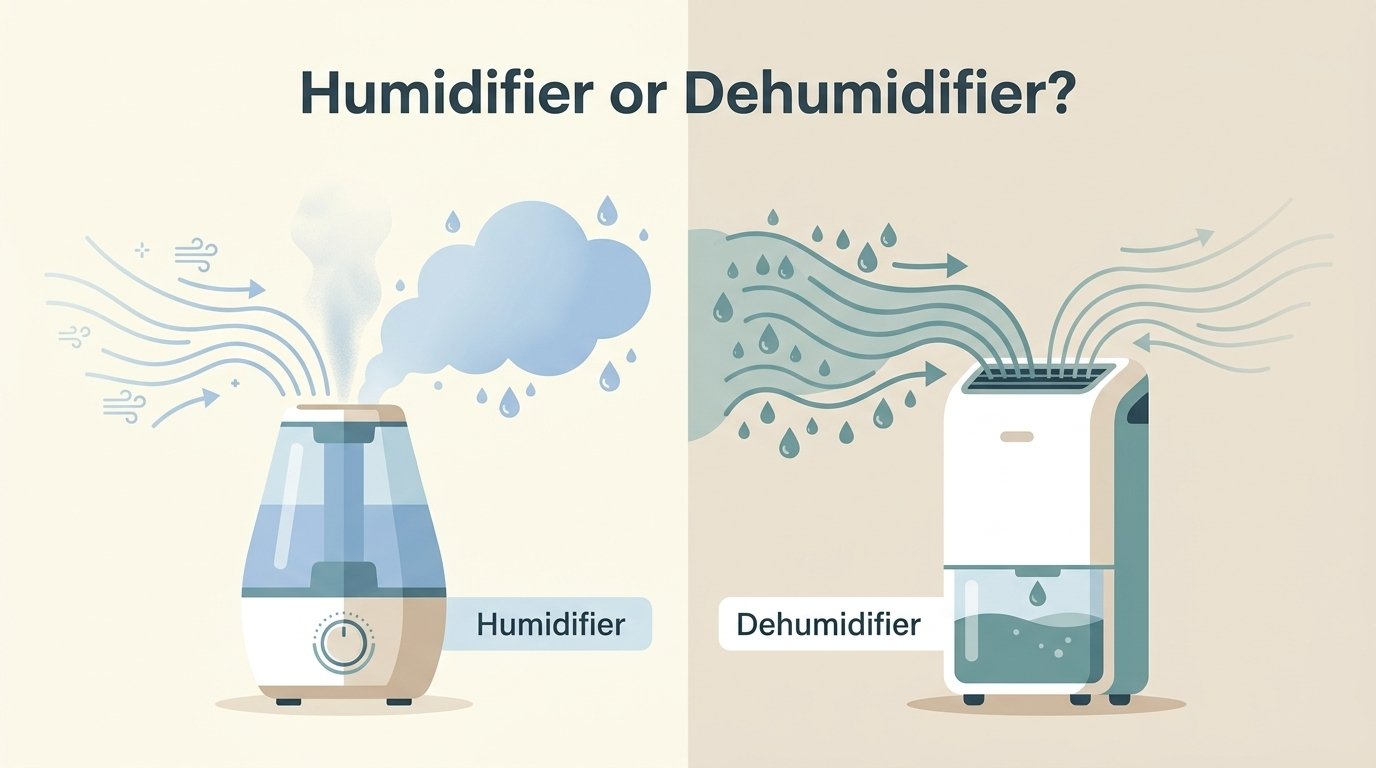
Quick Ans: Humidifier or dehumidifier depends on the moisture level in your room. A humidifier adds moisture to dry air, while a dehumidifier removes excess moisture. Use a humidifier when the air feels too dry. Choose a dehumidifier when you notice dampness, condensation, musty smells, or excessive indoor humidity.
Key Takeaway
If you’re unsure whether you need a humidifier or dehumidifier, check the humidity level first.
| Situation | Better choice | Why |
| Dry, itchy skin or throat | Humidifier | Adds moisture to the air |
| Condensation on windows | Dehumidifier | Removes excess moisture |
| Very dry indoor air | Humidifier | Raises humidity |
| Damp or musty room | Dehumidifier | Lowers humidity |
| Mold risk from high moisture | Dehumidifier | Helps control excess moisture |
| Air feels dry during winter | Humidifier | Adds needed moisture |
The simple rule is clear. Dry air usually calls for a humidifier. Damp air usually calls for a dehumidifier. A hygrometer can help you measure indoor humidity before choosing either device.
Definition and Explanation
The words humidifier and dehumidifier look similar, but they perform opposite jobs.
Humidifier
Humidifier is a noun. It means a device that adds moisture to the air.
For example:
“I’m using a humidifier because my bedroom feels very dry.”
The related verb is humidify, which means to add moisture to air.
Dehumidifier
Dehumidifier is also a noun. It means a device that removes moisture from the air.
For example:
“We need a dehumidifier because the basement feels damp.”
Its related verb is dehumidify, which means to remove moisture from air.
| Term | Part of speech | Meaning | Main function |
| Humidifier | Noun | A device that adds moisture | Increases humidity |
| Dehumidifier | Noun | A device that removes moisture | Decreases humidity |
| Humidify | Verb | To add moisture | Makes air more humid |
| Dehumidify | Verb | To remove moisture | Makes air less humid |
| Humidity | Noun | The amount of moisture in air | Describes moisture level |
In short, humidifier means adding moisture.
Dehumidifier means removing moisture.
They are not interchangeable, even though their names differ by only a few letters.
Is This a Grammar, Usage, or Vocabulary Issue
The question of humidifier or dehumidifier is mainly a vocabulary and usage issue, not a grammar rule.
Both words are standard English nouns. Their meanings are different because the prefixes change the meaning. The prefix “de” often signals removal or reduction.
As a result, saying “I need a humidifier” suggests that the air is too dry. Saying “I need a dehumidifier” suggests that the air contains too much moisture.
In academic writing, technical writing, and workplace communication, these terms should be used precisely. Casual speech follows the same distinction.
For example, a student writing about indoor air quality should not use the two terms as synonyms. Likewise, a homeowner asking for advice needs to choose the correct word so the listener understands the problem.
Real World Usage Examples
Workplace Examples
“Please check whether the office needs a humidifier.”
“The storage room has high humidity, so we installed a dehumidifier.”
“Employees complained that the air was unusually dry.”
In a workplace, precise vocabulary helps describe an environmental problem clearly.
Academic Examples
“The experiment was conducted in a room equipped with a humidifier.”
“Researchers used a dehumidifier to reduce moisture levels.”
“The study examined how indoor humidity affected the environment.”
Academic writing benefits from exact technical terms rather than vague descriptions such as “a machine that changes the air.”
Everyday Examples
“My bedroom gets really dry in winter, so I use a humidifier.”
“The basement smells damp, so we’re thinking about buying a dehumidifier.”
“Water keeps forming on the windows, which may indicate high humidity.”
In everyday English, context usually makes the difference easy to understand.
Regional or Global Usage Differences
The terms humidifier and dehumidifier are widely understood in American English, British English, Canadian English, Australian English, and other major varieties of English.
There is no major US versus UK vocabulary difference for these two devices. The spelling and basic meanings remain the same.
Some surrounding vocabulary can vary. For example, American speakers often say “AC” for air conditioning, while British speakers commonly say “air conditioning” or “air con.” Likewise, people in different countries may use different terms for rooms, heating systems, or weather conditions.
Even so, the distinction between a humidifier and a dehumidifier stays consistent.
When NOT to Use It
Don’t use humidifier when you mean a device that removes moisture. The correct term is dehumidifier.
Don’t use dehumidifier simply because a room feels uncomfortable. First consider whether the air is actually too humid.
Don’t use humidifier as a general synonym for an air purifier. A humidifier changes moisture levels, while an air purifier is designed to remove certain airborne particles.
Don’t call both devices “humidity machines” in formal writing. That phrase is vague and can hide the actual meaning.
Don’t assume cold air always needs a humidifier. Indoor humidity depends on many factors, including heating, ventilation, weather, and building conditions.
Don’t choose a device based only on how the room feels. A hygrometer can provide a more reliable measurement.
Don’t use the two nouns interchangeably in academic or technical writing. Their functions are opposite.
Common Mistakes and Corrections
| Correct Sentence | Incorrect Sentence | Why |
| I need a humidifier because the air is dry. | I need a dehumidifier because the air is dry. | A humidifier adds moisture. |
| The basement needs a dehumidifier. | The basement needs a humidifier. | Damp basements usually have excess moisture. |
| We use a dehumidifier to reduce humidity. | We use a humidifier to reduce humidity. | A humidifier increases humidity. |
| The humidifier adds moisture to the room. | The humidifier removes moisture from the room. | Its function is to add moisture. |
| The dehumidifier removes excess moisture. | The dehumidifier adds excess moisture. | Its function is to remove moisture. |
Decision Rule: If the problem is dry air, think “humidifier.” If the problem is damp air, think “dehumidifier.” Remember that “de” signals removal.
Exercises With Answers
Choose humidifier or dehumidifier for each sentence.
- The bedroom feels extremely dry, so we bought a ______.
- Condensation keeps appearing on the basement windows, so we need a ______.
- The machine removes excess moisture from the room. It is a ______.
- During a very dry winter, some people use a ______ to add moisture.
- The storage area is damp and has a musty smell. A ______ may help control the moisture.
- The air is too dry because the heating system has been running all day. A ______ may improve the humidity level.
Answer Key
- humidifier
- dehumidifier
- dehumidifier
- humidifier
- dehumidifier
- humidifier
A useful way to remember the answers is to focus on the direction of the moisture. Humidifiers add it. Dehumidifiers remove it.
Related Concepts and Comparisons
Readers who search for humidifier or dehumidifier may also encounter several related language and vocabulary topics.
Humidity and Moisture
Humidity refers to moisture present in the air. Moisture is a broader word that can describe water present in air, materials, or surfaces.
Humid and Humidify
Humid is an adjective. Humidify is a verb. For example, “The room is humid” describes a condition, while “The machine humidifies the room” describes an action.
Dry and Damp
Dry means containing little moisture. Damp means slightly wet or moist. These adjectives often provide the context needed to choose between the two devices.
Increase and Decrease
A humidifier increases moisture levels. A dehumidifier decreases them. These verbs are useful when explaining the difference in formal writing.
Affect and Effect
When discussing indoor humidity, writers may also need to distinguish “affect” and “effect.” For example, humidity can affect comfort, while excessive humidity may have an effect on a building.
Less and Fewer
Technical explanations sometimes involve quantity words. “Less moisture” is correct because moisture is normally treated as an uncountable noun.
Advice and Advise
When discussing which device someone should buy, remember that “advice” is a noun and “advise” is a verb.
Similar and Different
Humidifier and dehumidifier are similar in form but different in function. Recognizing this pattern can help English learners understand many words built with prefixes.
FAQs
Is a humidifier or dehumidifier better for a bedroom?
It depends on the bedroom’s humidity level. A humidifier is appropriate when the air is too dry, while a dehumidifier is better when the room is damp. For a humidifier or dehumidifier for bedroom use, measure the humidity before choosing.
What is the main difference between a humidifier and dehumidifier?
A humidifier adds moisture to indoor air. A dehumidifier removes moisture. Therefore, they solve opposite humidity problems.
Should I use a humidifier or dehumidifier in winter?
Winter can produce dry indoor air, especially when heating systems run frequently. In that situation, a humidifier may be useful. However, the correct choice depends on the actual indoor humidity level.
Can a humidifier and dehumidifier be used together?
They can be used in different circumstances, but running both at the same time usually works against itself. One adds moisture while the other removes it. If both seem necessary, check the room’s humidity and operating conditions first.
Which is better for damp rooms, a humidifier or dehumidifier?
A dehumidifier is generally the appropriate choice for a damp room. It removes excess moisture from the air and can help create a less humid indoor environment.
Does a humidifier make a room less dry?
Yes. A humidifier adds moisture to the air, which can make excessively dry indoor air less dry. That’s why humidifiers are commonly discussed when people search for solutions for dry air.
How do I know whether I need a humidifier or dehumidifier?
Start by measuring the room’s humidity with a hygrometer. If the air is too dry, consider a humidifier. If the air is excessively damp, consider a dehumidifier.
Are humidifier and dehumidifier opposites?
Yes, their main functions are opposite. A humidifier increases moisture in the air, while a dehumidifier decreases it.
Is humidifier a noun or a verb?
Humidifier is a noun because it names a device. Humidify is the related verb. For example, “The humidifier humidifies the room.”
What is the difference between humid and humidify?
Humid is an adjective that describes air containing moisture. Humidify is a verb meaning to add moisture to something, especially air. This distinction is useful for English learners studying parts of speech.
Conclusion
Choosing between a humidifier or dehumidifier becomes much easier when you focus on one question: does the air need more moisture or less moisture?
A humidifier adds moisture. It is associated with dry indoor air. A dehumidifier removes moisture and is associated with damp conditions. Although the words look almost identical, they aren’t interchangeable.
From a language perspective, this is primarily a vocabulary and usage distinction. Both terms are correct English nouns, and their meanings remain consistent across major varieties of English. In formal writing, academic work, workplace communication, and everyday conversation, using the right word makes your meaning clear.
Context also helps. Words such as dry, itchy, and low humidity often point toward a humidifier. Words such as damp, musty, condensation, and excessive moisture often point toward a dehumidifier.
The easiest practical tip is to check the humidity before choosing a device. Once you know whether the air is too dry or too damp, the correct word becomes much easier to remember.
3 thoughts on “Humidifier or Dehumidifier: Which One Should You Use?”