
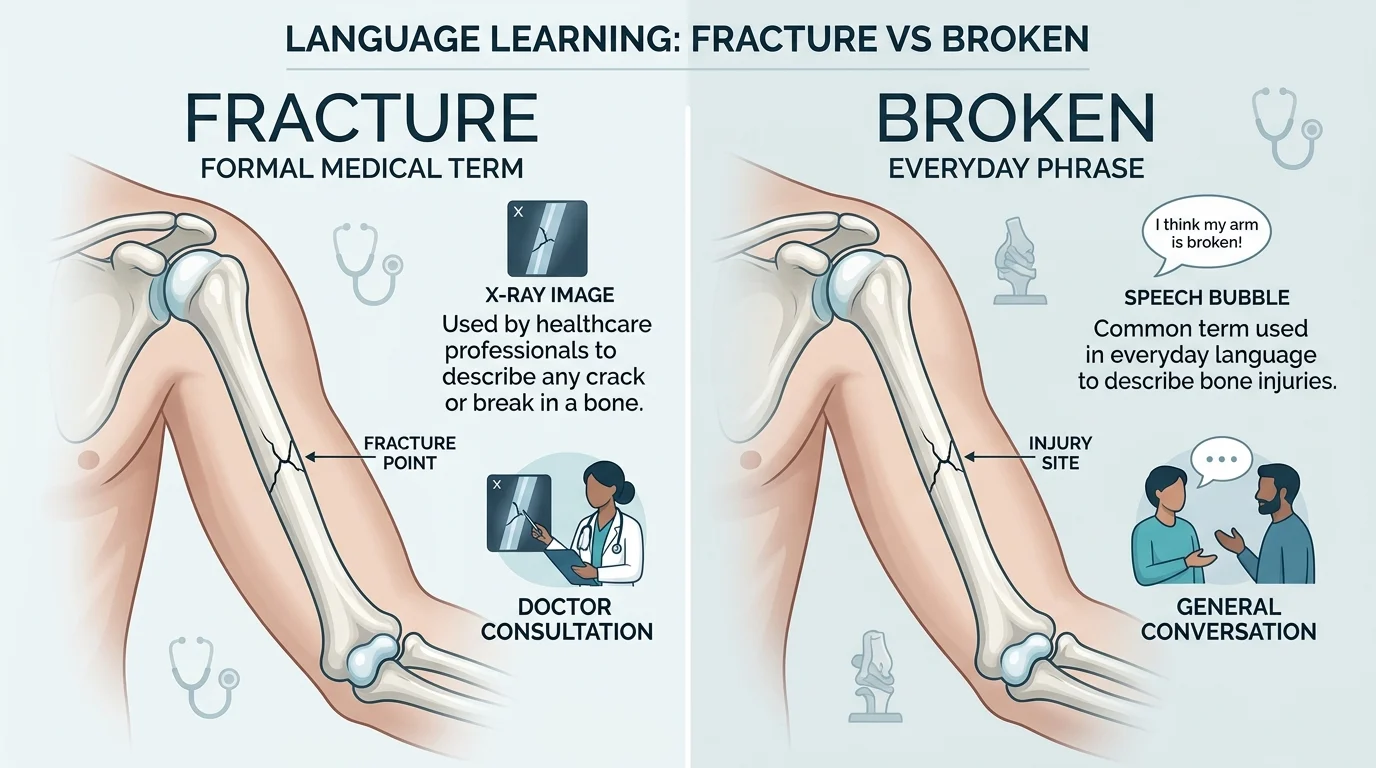
Quick Ans: A fracture and a broken bone generally describe the same basic injury: a crack or break in a bone. “Fracture” is the medical term doctors commonly use, while “broken bone” is everyday language. A fracture can be partial or complete, so not every fracture means the bone has completely separated.
Fracture vs broken is a common comparison because people often hear both terms when discussing bone injuries. You might say that someone has a broken arm, while a doctor may document a fracture of the arm. This can make it seem as though the two words describe different injuries.
In most situations, they refer to the same basic problem. A fracture means there is a break, crack, or disruption in a bone. Broken is the more informal way to describe the same condition.
However, fractures can vary considerably. A bone can have a small crack without being completely separated. More serious injuries can cause the bone to break into multiple pieces or move out of its normal position.
Knowing the difference between the terms can help you understand medical conversations, injury reports, and everyday descriptions more clearly.
Quick Answer and Key Takeaway
Fracture is the medical term for a crack or break in a bone, while broken bone is the common everyday expression. In most contexts, they mean the same thing.
The important point is that a fracture does not always mean the bone has completely separated into two pieces.
Fracture vs Broken: Definition and Explanation
What Does Fracture Mean?
A fracture is a break or crack in a bone. Medical professionals use the word when describing different types of bone injuries.
For example:
The X ray showed a fracture in his wrist.
A fracture can range from a small crack to a complete break.
What Does Broken Mean?
Broken is a general everyday word used to describe something that has been damaged or separated. When talking about bones, “broken bone” commonly means the same thing as a fractured bone.
For example:
She broke her ankle while playing sports.
A doctor could describe the same injury as an ankle fracture.
Is This a Grammar, Usage, or Vocabulary Issue?
Fracture vs broken is mainly a vocabulary and usage comparison.
The words have different grammatical roles. Fracture can function as a noun or verb, while broken is commonly used as an adjective or as part of the verb phrase “has broken.”
Examples:
He has a fracture in his leg.
He fractured his leg.
His leg is broken.
These sentences can describe the same general injury from different perspectives.
Real World Usage Examples
Everyday Conversation
People commonly use “broken” when talking casually about injuries.
I think I broke my finger.
She has a broken arm.
Recap: “Broken” is natural and common in everyday conversation.
Medical Context
Healthcare professionals often use “fracture” when documenting or discussing a bone injury.
The patient has a wrist fracture.
The X ray confirmed a fracture.
Recap: “Fracture” is especially common in medical terminology.
Academic or Educational Writing
“Fracture” is usually more appropriate in formal writing about anatomy, medicine, or injuries.
A bone fracture can vary in severity and location.
Recap: Choose “fracture” when a more precise medical term is appropriate.
Types of Fractures
Fractures can have different patterns and characteristics.
Hairline Fracture
A hairline fracture is a small crack in a bone. It may be difficult to detect without appropriate medical imaging.
Complete Fracture
A complete fracture means the break extends through the entire bone.
Compound Fracture
A compound fracture, also called an open fracture, occurs when the broken bone is associated with an open wound that exposes the fracture area.
Stress Fracture
A stress fracture is a small crack that can develop from repeated stress or overuse.
The exact type of fracture should be determined by a qualified healthcare professional.
Regional or Global Usage Differences
The basic meaning of fracture and broken is broadly consistent across varieties of English.
The main difference is formality rather than geography. “Broken bone” is common in everyday speech, while “fracture” is widely used in medical and formal contexts.
For example, a patient might say:
I broke my wrist.
A medical report might say:
The patient sustained a wrist fracture.
When NOT to Use Them
Avoid using fracture when you are discussing a completely different type of damage that does not involve a bone.
For example:
The glass has a fracture.
Although “fracture” can technically describe cracking in some materials, everyday English usually uses words such as crack, break, or damage for objects.
Also, don’t assume that every bone injury has the same severity. A small crack and a complicated break can both fall under the broad term “fracture.”
Common Mistakes and Corrections
| Correct Sentence | Incorrect Sentence | Why |
|---|---|---|
| He has a fractured wrist. | He has a fracture wrist. | “Fractured” works as the adjective. |
| She broke her arm. | She fracture her arm. | The verb form is “fractured.” |
| He has a bone fracture. | He has a bone broken. | “Broken” needs a suitable grammatical structure. |
| Her leg is broken. | Her leg is fracture. | “Fractured” is the adjective form. |
Easy Decision Rule
Use fracture when you want the medical or formal term.
Use broken when speaking naturally about an injury in everyday conversation.
Both can describe the same underlying bone injury.
Exercises With Answers
Choose the correct word or phrase.
- The doctor confirmed a wrist ______.
- I think I ______ my finger.
- The X ray showed a small bone ______.
- His arm is ______.
- She ______ her ankle during the game.
Answers
- fracture
- broke
- fracture
- broken
- fractured or broke
Related Concepts and Comparisons
Fracture vs Break
In everyday language, “fracture” and “break” can refer to the same bone injury. “Fracture” sounds more medical and formal.
Fractured vs Broken
“Fractured” is commonly used as an adjective or verb, while “broken” is often used as an adjective.
Crack vs Fracture
A crack is a narrow split or opening. When the crack occurs in a bone, medical professionals may classify it as a type of fracture.
FAQs
Is a fracture the same as a broken bone?
Yes. In general usage, a fracture is a break or crack in a bone, so a broken bone is a type of fracture.
Is a fracture worse than a break?
Not necessarily. “Fracture” and “break” usually describe the same basic injury. The severity depends on the type, location, and extent of the fracture.
Why do doctors say fracture instead of broken?
“Fracture” is the standard medical term used to describe a break or crack in a bone.
Can a fracture be a small crack?
Yes. Some fractures are small cracks rather than complete breaks through the bone.
Which is more formal, fracture or broken?
“Fracture” is generally more formal and medical. “Broken” is more common in everyday conversation.
Can you say “I fractured my bone”?
Yes. “Fractured” can be used as a verb, as in “I fractured my wrist.”
Is “broken bone” grammatically correct?
Yes. “Broken bone” is a standard and natural phrase in English.
What is the difference between fracture and broken in medical terms?
There is usually no fundamental difference in the injury being described. “Fracture” is the medical term, while “broken” is everyday language.
Conclusion
Fracture vs broken is easier to understand when you remember that the two terms usually describe the same basic type of bone injury. Fracture is the medical and more formal term, while broken is the everyday word people commonly use.
For example, a doctor might say, “The X ray shows a wrist fracture,” while a patient might simply say, “I broke my wrist.” Both statements can refer to the same injury.
The word fracture can also describe different types of bone breaks, including small cracks and complete breaks. Therefore, a fracture does not automatically mean that a bone has completely separated.
When writing formally or discussing an injury in a medical context, fracture is usually the more precise choice. In casual conversation, broken bone sounds natural and clear.
The easiest rule to remember is simple: fracture is the medical term; broken is the everyday expression.