
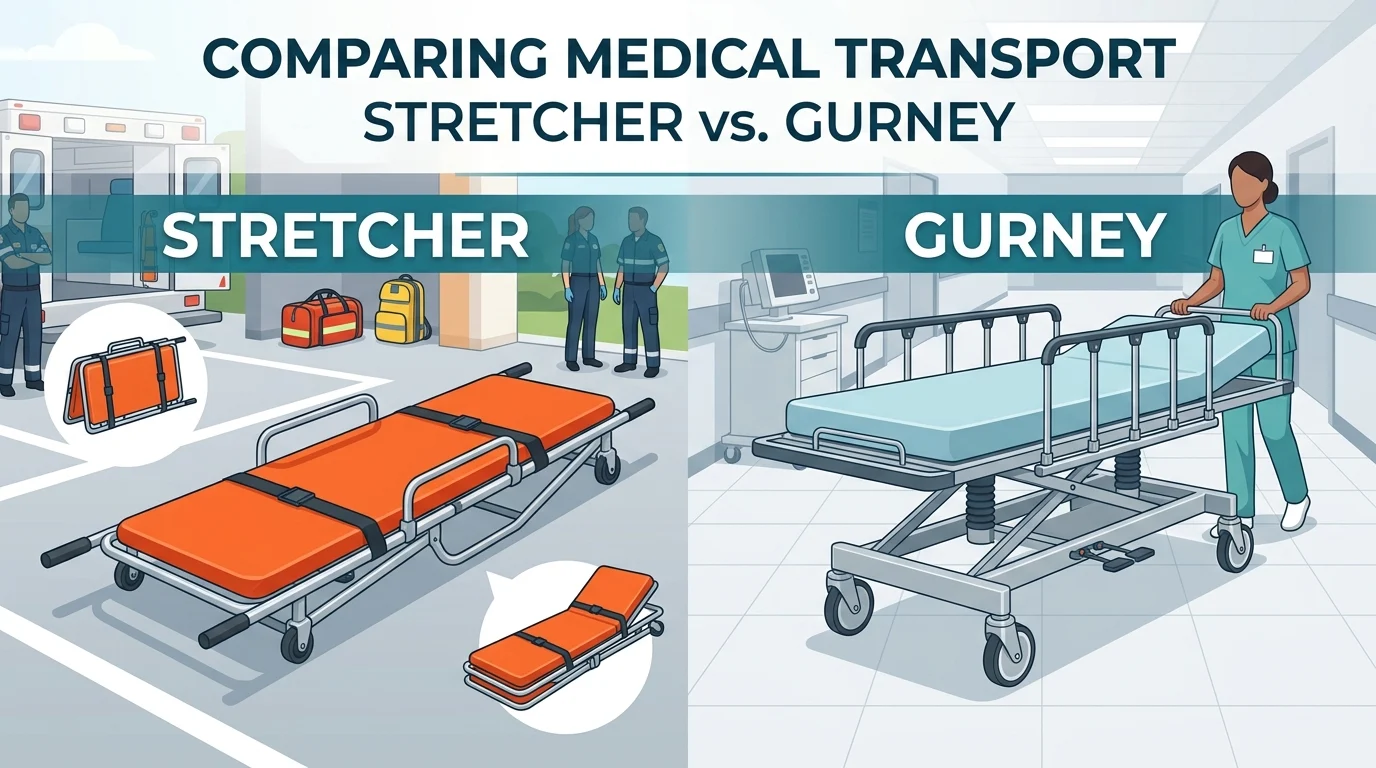
Quick Ans: Stretcher vs gurney usually refers to two terms for equipment used to move patients while lying down. A stretcher is the broader term for a device used to transport or carry a patient. A gurney is commonly a wheeled medical stretcher, especially one used in hospitals, ambulances, and emergency settings.
Stretcher vs gurney can be confusing because both words describe equipment used to transport patients who cannot safely walk. In hospitals, emergency rooms, ambulances, and rescue situations, you may hear healthcare workers use either term.
The main difference is that stretcher is the broader and more general word. It can describe a simple portable frame used to carry someone, as well as more advanced medical equipment. Gurney usually refers to a wheeled stretcher designed to move a patient through a medical facility or emergency setting.
The two words sometimes overlap in everyday speech. However, they aren’t always interchangeable. Knowing the difference can help you understand medical instructions, hospital conversations, and emergency reports more accurately.
Quick Answer and Key Takeaway
| Term | Meaning | Common Use |
|---|---|---|
| Stretcher | A device used to carry or transport a person while lying down | Hospitals, rescue teams, ambulances, emergencies |
| Gurney | Usually a wheeled medical stretcher | Hospitals, emergency rooms, ambulances |
Simple rule: A gurney is generally a type of stretcher, but not every stretcher is a gurney.
Definition and Explanation
What Is a Stretcher?
A stretcher is equipment designed to transport a person who needs to remain lying down. Stretchers can be simple and portable or highly specialized.
For example:
- Rescue workers may carry an injured person on a stretcher.
- An ambulance may have a stretcher for transporting patients.
- A hospital may use a specialized stretcher for emergency treatment.
The word is broad and can describe different designs.
What Is a Gurney?
A gurney is commonly a wheeled stretcher used to move patients. It usually has a raised frame, wheels, and adjustable features that make patient transportation easier.
For example:
- The nurse moved the patient onto a gurney.
- The paramedics placed the injured person on a gurney.
- The patient was taken to the emergency department on a gurney.
In many contexts, gurney specifically suggests a medical stretcher with wheels.
Is This a Grammar, Usage, or Vocabulary Issue?
Stretcher vs gurney is mainly a vocabulary and usage distinction.
Both words are nouns, and both can refer to equipment used to transport patients. The difference comes from how broadly each term is used.
Stretcher is the more general term. Gurney is often used for a particular type of wheeled stretcher.
The exact distinction can vary by region, hospital, profession, and context.
Real World Usage Examples
Workplace
Example: The emergency team moved the patient onto a stretcher.
This works well when the exact design of the equipment isn’t important.
Recap: Use stretcher as the general medical term.
Academic
Example: The researchers examined how ambulance stretchers affect patient safety.
Here, stretcher works because the discussion concerns the equipment generally.
Recap: Use stretcher when discussing the category or equipment broadly.
Everyday
Example: The paramedics placed the injured man on a gurney.
This sounds natural when referring to a wheeled medical stretcher.
Recap: Gurney commonly refers to a wheeled stretcher used in medical settings.
Regional or Global Usage Differences
The word gurney is particularly common in North American medical contexts. In other English speaking regions, healthcare professionals may prefer stretcher, trolley, or another local term.
The word stretcher is widely understood internationally.
Because medical terminology can vary between countries and healthcare systems, context matters. A person may call the same piece of equipment a stretcher, gurney, or trolley depending on where they live or work.
When NOT to Use It
Avoid using gurney when:
- You are talking about a simple rescue stretcher with no wheels.
- You are describing a stretcher in a general sense.
- The type of stretcher isn’t known.
- You are writing for an international audience and want the broadest term.
- You are referring to equipment specifically designed for carrying patients manually.
Avoid using stretcher when a medical context specifically identifies a wheeled hospital stretcher as a gurney and that distinction matters.
Common Mistakes and Corrections
| Correct Sentence | Incorrect or Less Precise Sentence | Why |
|---|---|---|
| The rescue team carried him on a stretcher. | The rescue team carried him on a gurney. | A simple rescue stretcher may not be a gurney. |
| The nurse moved the patient onto a gurney. | The nurse moved the patient onto a rescue stretcher. | A hospital wheeled stretcher is commonly called a gurney. |
| The ambulance has a stretcher. | The ambulance has a gurney. | Both can work, but stretcher is more general. |
Easy Decision Rule
If you mean any equipment used to transport a person while lying down, use stretcher.
If you mean a wheeled medical stretcher, especially in a hospital or emergency setting, gurney may be more specific.
Exercises With Answers
Choose stretcher or gurney.
- The rescue workers carried the climber on a ______.
- The nurse pushed the patient down the hallway on a ______.
- The ambulance crew prepared the ______ for the injured passenger.
- A simple rescue ______ can be carried by several people.
- The emergency room had several patients waiting on ______.
Answers
- stretcher
- gurney
- stretcher
- stretcher
- gurneys
Related Concepts and Comparisons
Stretcher vs gurney: A stretcher is the broader term, while a gurney usually refers to a wheeled medical stretcher.
Gurney vs hospital bed: A gurney is primarily designed for transportation and emergency care. A hospital bed is designed for longer term patient care.
Stretcher vs trolley: In some regions, trolley can refer to wheeled medical equipment used to transport patients. Terminology varies by healthcare system.
FAQs
Is a gurney the same as a stretcher?
Not exactly. A gurney is generally considered a type of stretcher, particularly a wheeled medical stretcher.
Is stretcher or gurney more correct?
Both words are correct. Stretcher is broader, while gurney is often more specific.
What is a hospital stretcher called?
It may be called a stretcher, gurney, or trolley depending on the country, healthcare system, and context.
Can a stretcher have wheels?
Yes. Many modern stretchers have wheels and adjustable features for easier transportation.
What is the difference between a gurney and a hospital bed?
A gurney is mainly intended for transporting patients. A hospital bed is designed for patient care and longer stays.
Is gurney a medical term?
Gurney is a commonly used medical and emergency care term for a wheeled stretcher.
Conclusion
When comparing stretcher vs gurney, remember that stretcher is the broader term. It can describe many types of equipment used to transport someone while they remain lying down. A stretcher may be portable, foldable, wheeled, or specially designed for rescue operations.
Gurney usually refers to a wheeled stretcher used in hospitals, ambulances, and emergency departments. The terms can overlap, which is why people sometimes use them interchangeably.
If you’re unsure which word to choose, stretcher is usually the safer general term. Use gurney when you specifically mean a wheeled medical stretcher or when that terminology fits the context.
The easiest tip is simple: all gurneys can generally be described as stretchers, but not every stretcher is a gurney.
3 thoughts on “Stretcher vs Gurney: What’s the Difference? Easy Guide & Examples”