
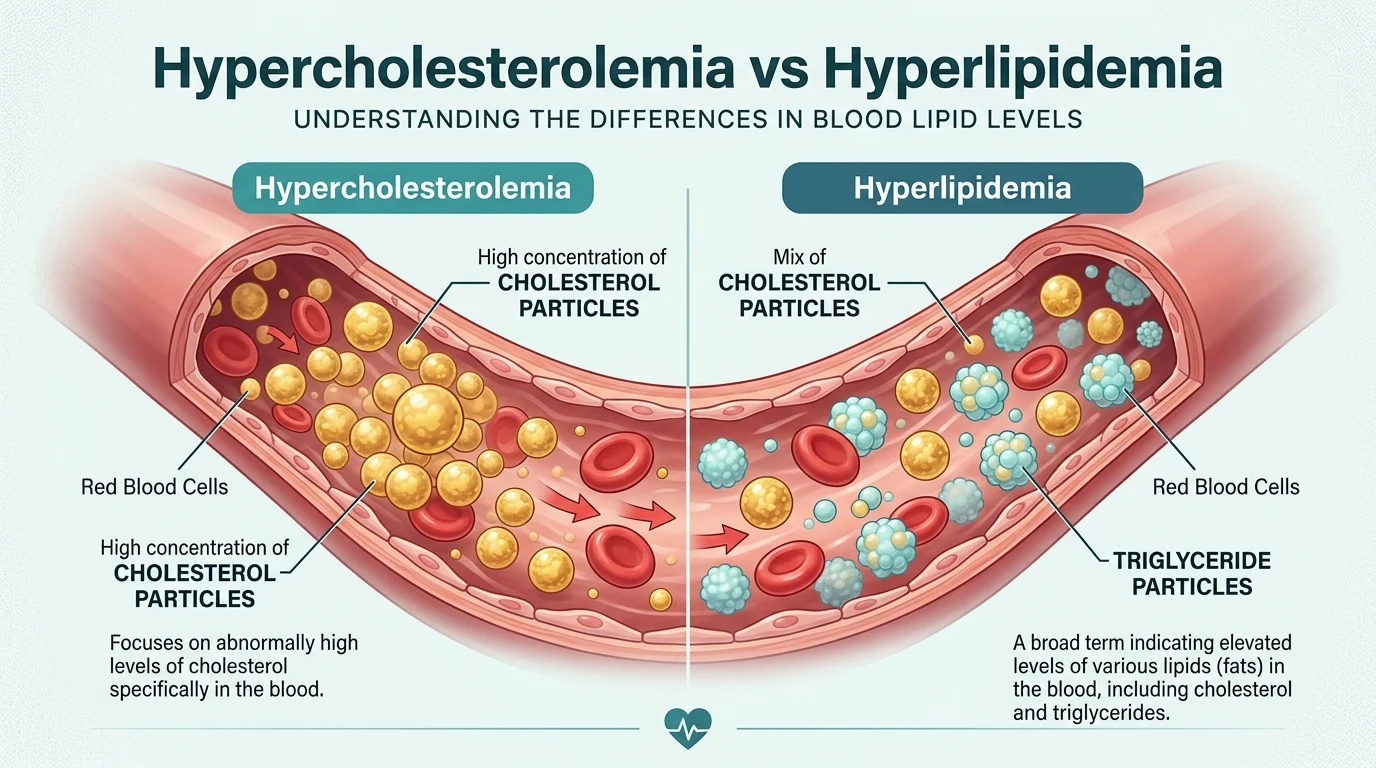
Quick Ans: Hypercholesterolemia means having too much cholesterol in the blood, while hyperlipidemia is a broader term for having elevated lipids or fats in the blood, including cholesterol and triglycerides. Therefore, hypercholesterolemia can be considered a type of lipid disorder within the broader category of hyperlipidemia.
Hypercholesterolemia vs hyperlipidemia can be confusing because the two medical terms are closely related and are sometimes used interchangeably. Both describe abnormal levels of fats or fat related substances in the blood, but they do not always mean exactly the same thing.
The key difference is scope. Hypercholesterolemia specifically refers to elevated cholesterol, while hyperlipidemia is a broader term that can include high cholesterol and other blood lipids, such as triglycerides.
Understanding this distinction is useful when reading medical reports, discussing blood tests, or learning about cholesterol disorders. A lipid panel can measure several important values, including total cholesterol, LDL cholesterol, HDL cholesterol, and triglycerides.
Let’s break down both terms in simple language.
Quick Answer and Key Takeaway
Hypercholesterolemia = high cholesterol.
Hyperlipidemia = high levels of lipids in the blood, which can include cholesterol and triglycerides.
So, hypercholesterolemia focuses specifically on cholesterol, whereas hyperlipidemia covers a wider group of blood lipid abnormalities.
Hypercholesterolemia vs Hyperlipidemia: Definition and Explanation
What Is Hypercholesterolemia?
Hypercholesterolemia means that the level of cholesterol in the blood is higher than the appropriate range for the individual.
Cholesterol is a waxy, fat like substance that the body needs for important functions, including making hormones and vitamin D. However, excess cholesterol can contribute to plaque buildup in arteries.
One specific example is familial hypercholesterolemia, an inherited condition that can cause very high cholesterol levels.
What Is Hyperlipidemia?
Hyperlipidemia refers more broadly to excessive levels of lipids, or fats, in the blood. These can include cholesterol and triglycerides.
For example, someone may have elevated triglycerides along with abnormal cholesterol levels. In that situation, the broader term hyperlipidemia may be appropriate.
Is This a Grammar, Usage, or Vocabulary Issue?
Hypercholesterolemia vs hyperlipidemia is a medical terminology and usage comparison, not a grammar issue.
The terms are related, but their meanings have different levels of specificity.
| Term | Basic Meaning | Scope |
|---|---|---|
| Hypercholesterolemia | High cholesterol | Specific |
| Hyperlipidemia | High blood lipids | Broader |
| Hypertriglyceridemia | High triglycerides | Specific |
Because hyperlipidemia can include abnormalities involving cholesterol and triglycerides, it has a broader meaning than hypercholesterolemia.
Real World Usage Examples
Medical Reports
A doctor may discuss hypercholesterolemia when the main concern is elevated cholesterol, particularly LDL cholesterol.
Example:
The patient was diagnosed with hypercholesterolemia after repeated cholesterol tests showed elevated levels.
Recap: Use hypercholesterolemia when specifically discussing high cholesterol.
Blood Tests
A lipid panel measures several blood fats and related measurements, including total cholesterol, LDL, HDL, and triglycerides.
Example:
The lipid panel showed abnormal lipid levels consistent with hyperlipidemia.
Recap: Hyperlipidemia can describe a broader lipid abnormality.
Everyday Health Discussions
People often say high cholesterol rather than hypercholesterolemia in everyday conversation.
Example:
My doctor said I have high cholesterol.
Recap: Hypercholesterolemia is the more technical medical term for high cholesterol.
Regional or Global Usage Differences
The basic meanings of hypercholesterolemia and hyperlipidemia remain similar in medical English worldwide. However, healthcare professionals may use broader terms such as dyslipidemia depending on the clinical context.
MedlinePlus lists hypercholesterolemia and hyperlipidemia among common medical terms associated with high blood cholesterol.
The exact terminology in a medical report can therefore depend on which lipid measurement is abnormal and how the healthcare professional describes the condition.
When NOT to Use These Terms
Do not automatically use hypercholesterolemia when:
- The abnormal result involves triglycerides rather than cholesterol.
- You are referring to several different lipid abnormalities.
- You do not know which lipid measurement is elevated.
Do not assume hyperlipidemia means only high cholesterol. The term can cover broader lipid abnormalities, including elevated triglycerides.
For a personal medical result, the appropriate interpretation should come from a qualified healthcare professional.
Common Mistakes and Corrections
| Correct Understanding | Incorrect Assumption | Why |
|---|---|---|
| Hypercholesterolemia specifically involves high cholesterol | It means every type of high blood fat | The term specifically concerns cholesterol |
| Hyperlipidemia is broader | It means only high cholesterol | It can include other lipids |
| Triglycerides are lipids | Triglycerides are the same as cholesterol | They are different types of blood fats |
| A lipid panel measures several values | It measures cholesterol only | It can measure cholesterol and triglycerides |
Easy Decision Rule
Remember:
Cholesterol specifically = hypercholesterolemia
Broader blood lipid problem = hyperlipidemia
This simple distinction can help you understand most uses of the two terms.
Exercises With Answers
Choose hypercholesterolemia or hyperlipidemia.
- A condition specifically involving high cholesterol is called ______.
- A broader term covering elevated blood lipids is ______.
- High cholesterol is directly described by ______.
- A condition involving elevated cholesterol and triglycerides may be described as ______.
- ______ is the broader term.
Answers
- hypercholesterolemia
- hyperlipidemia
- hypercholesterolemia
- hyperlipidemia
- hyperlipidemia
Related Concepts and Comparisons
Hypercholesterolemia vs High Cholesterol
These terms are closely related. Hypercholesterolemia is the medical term for having elevated cholesterol in the blood.
Hyperlipidemia vs Dyslipidemia
Hyperlipidemia generally refers to elevated blood lipids. Dyslipidemia is a broader clinical term that can refer to abnormal lipid levels, including levels that are too high or too low.
Hypercholesterolemia vs Hypertriglyceridemia
Hypercholesterolemia focuses on cholesterol, while hypertriglyceridemia specifically refers to elevated triglycerides. Triglycerides and cholesterol are different types of lipids.
FAQs
What is the main difference between hypercholesterolemia and hyperlipidemia?
Hypercholesterolemia specifically means high cholesterol. Hyperlipidemia is a broader term that can include high cholesterol and elevated triglycerides.
Is hypercholesterolemia a type of hyperlipidemia?
In broad clinical usage, hypercholesterolemia can fall within the wider category of lipid abnormalities described by hyperlipidemia.
Does hyperlipidemia mean high cholesterol?
Not necessarily. Hyperlipidemia can refer to elevated cholesterol, triglycerides, or other blood lipids.
Is hypercholesterolemia the same as high cholesterol?
Yes. Hypercholesterolemia is the medical term used to describe elevated cholesterol in the blood.
What is the difference between hyperlipidemia and hypertriglyceridemia?
Hyperlipidemia is a broader term for elevated blood lipids, while hypertriglyceridemia specifically means high triglyceride levels.
Can you have hyperlipidemia without high cholesterol?
Yes. Because hyperlipidemia is broader, an abnormality involving another lipid, such as triglycerides, can fall under this term.
What test checks for hyperlipidemia?
A lipid panel can measure total cholesterol, LDL cholesterol, HDL cholesterol, and triglycerides.
Is hypercholesterolemia always inherited?
No. Some forms are inherited, such as familial hypercholesterolemia, while cholesterol levels can also be influenced by lifestyle, medical conditions, medications, and other factors.
Conclusion
Hypercholesterolemia vs hyperlipidemia becomes much easier to understand when you focus on the scope of each term. Hypercholesterolemia specifically means elevated cholesterol, while hyperlipidemia is a broader term for elevated lipids in the blood.
Cholesterol is one type of lipid, while triglycerides are another. This means a person can have an abnormal lipid profile involving cholesterol, triglycerides, or both. A lipid panel helps healthcare professionals evaluate these measurements.
The easiest way to remember the distinction is simple: hypercholesterolemia focuses on cholesterol, while hyperlipidemia covers a broader group of blood lipid problems.
If you encounter either term in a medical report, don’t rely on the word alone to understand your personal health. Look at the specific lipid values and discuss the results with your healthcare professional. The terminology provides a useful description, but your complete medical context determines what the results mean for you.
2 thoughts on “Hypercholesterolemia vs Hyperlipidemia: What’s the Difference? Simple Guide”