
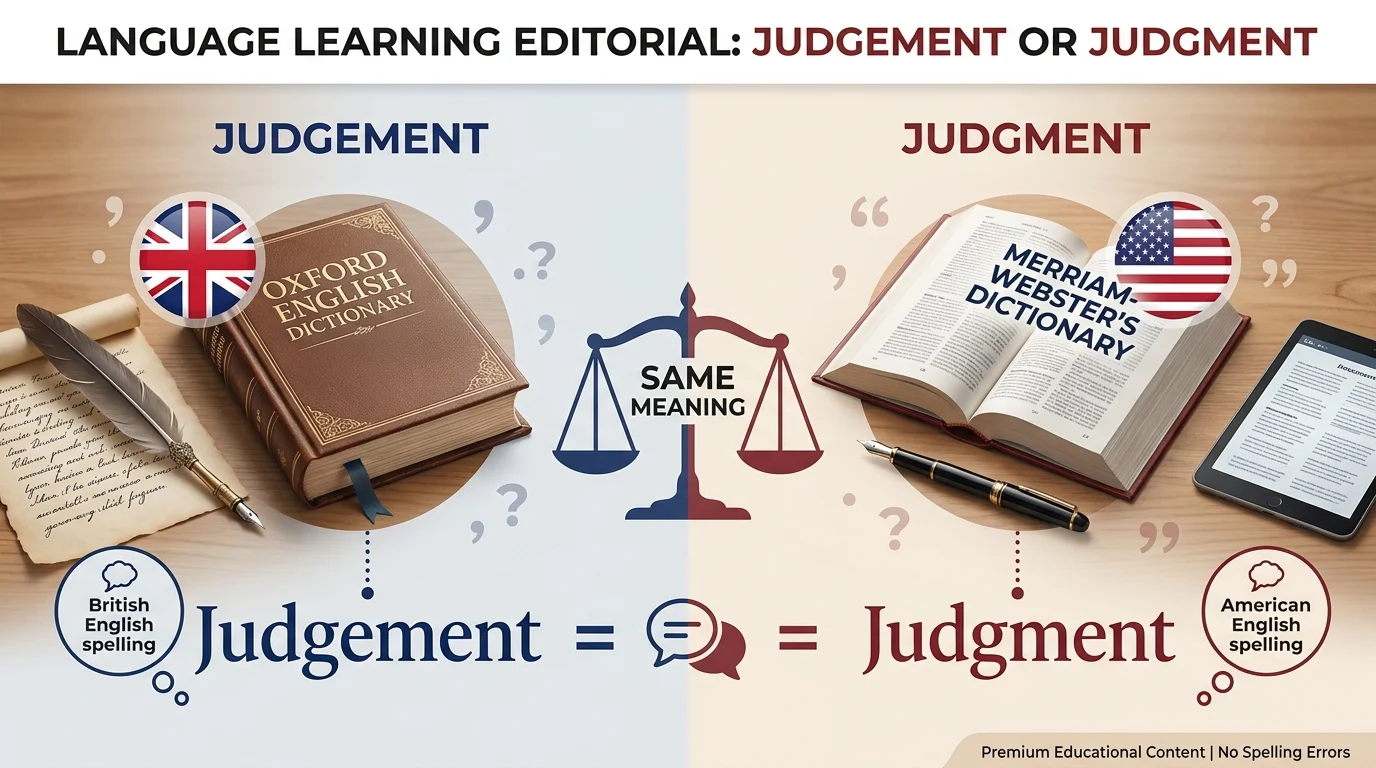
Quick Ans: Judgement and judgment are both accepted spellings of the noun meaning an opinion, decision, or ability to make sensible choices. Judgment is the standard spelling in American English, while judgement is more common in British English. In most writing, use judgment for US audiences and judgement when following British spelling conventions.
Judgement or judgment is a common spelling question because both forms appear in dictionaries, books, newspapers, and professional writing. The difference can be confusing because neither spelling is simply a random mistake.
Both words come from the verb judge and can refer to a decision, opinion, or ability to make a sensible assessment. The main difference is regional spelling preference.
Judgment is the standard form in American English. Judgement is widely used in British English and some other varieties of English. However, judgment is also accepted in British English, especially in legal and formal contexts.
For ESL learners, students, writers, and professionals, knowing which spelling to choose can prevent inconsistent writing. The best choice usually depends on your audience, publication style, or regional English preference.
Quick Answer and Key Takeaway
Both judgement and judgment are correct spellings.
| Spelling | Common Usage |
|---|---|
| judgment | Standard in American English; also used in British English |
| judgement | Common in British English and some other varieties |
Simple rule: If you are writing for a US audience, choose judgment. If you are following British spelling conventions, judgement is often preferred.
Judgement vs Judgment: Definition and Explanation
What Does Judgment Mean?
Judgment means an opinion, decision, or conclusion formed after considering information.
Example:
The judge gave her judgment after reviewing the evidence.
It can also describe a person’s ability to make sensible decisions.
He showed good judgment during the crisis.
What Does Judgement Mean?
Judgement has the same basic meaning as judgment.
Example:
She trusted his judgement when making the decision.
The extra e does not create a different meaning. It mainly reflects a spelling preference.
Is This a Grammar, Usage, or Vocabulary Issue?
This is primarily a spelling and regional usage issue.
The words have the same meaning and function as nouns. The important question is which spelling matches the variety of English you are using.
Unlike some word pairs where the meaning changes, judgement and judgment generally do not have different meanings.
Real World Usage Examples
Everyday Writing
Judgment:
You should use your best judgment before making a decision.
Judgement:
You should use your best judgement before making a decision.
Recap: Both sentences communicate the same idea.
Academic Writing
Good judgment is important when evaluating research evidence.
In academic writing, consistency matters more than choosing one spelling without considering your style guide.
Recap: Follow the spelling system used by your institution or publication.
Workplace Writing
The manager showed excellent judgment when handling the situation.
For US workplaces, judgment is generally the safer choice.
Recap: Match your spelling to your organization’s preferred style.
Regional or Global Usage Differences
The biggest difference between judgement and judgment is regional preference.
American English:
judgment is the standard spelling.
British English:
judgement is common, although judgment is also used.
Canadian, Australian, and other varieties:
Both forms can appear, depending on the style guide and context.
One important exception is legal writing. In British legal contexts, judgment is commonly used for a formal decision delivered by a court.
When NOT to Use It
Avoid switching between judgement and judgment randomly within the same document.
For example, don’t write:
The manager showed good judgment, but her final judgement was questionable.
Choose one spelling and use it consistently unless a quotation or official name requires the original spelling.
You should also avoid assuming that judgement is always wrong simply because judgment is more common in US English.
Common Mistakes and Corrections
| Correct Sentence | Incorrect or Inconsistent Sentence | Why |
|---|---|---|
| Use your best judgment. | Use your best judgement. | Use judgment for standard US spelling. |
| She showed good judgement. | She showed good judgment. | Judgement is acceptable in British usage. |
| The court delivered its judgment. | The court delivered its judgement. | Judgment is common in formal legal contexts. |
| Keep your spelling consistent. | Use both forms randomly. | Regional style should remain consistent. |
Easy Decision Rule
Ask yourself:
Who is going to read my writing?
For a US audience, use judgment.
For legal writing, check the relevant legal or institutional style because judgment may be preferred regardless of general regional spelling.
Exercises With Answers
Choose judgement or judgment.
- Use your best ______ before responding.
- The court issued its final ______.
- She showed excellent ______ under pressure.
- British spelling commonly uses ______.
- American spelling commonly uses ______.
Answers
- judgment
- judgment
- judgment or judgement
- judgement
- judgment
Related Concepts and Comparisons
Judgment vs Judgement in Legal Writing
In legal contexts, judgment is especially common for an official court decision. Always follow the terminology used by the relevant court, jurisdiction, or legal style guide.
Judgment vs Judgement in British English
British English commonly uses judgement, but judgment is also an established spelling. Therefore, it is inaccurate to say that judgment is always wrong in British English.
Judgment vs Judgement in American English
American English generally prefers judgment without the extra e. This is the spelling most appropriate for US websites, school assignments, business documents, and general writing.
FAQs
Is judgement or judgment correct?
Both spellings are correct. Judgment is standard in American English, while judgement is common in British English.
Is judgment the American spelling?
Yes. Judgment is the standard spelling in American English.
Is judgement the British spelling?
Yes, judgement is a common British spelling. However, judgment is also used in British English, particularly in legal contexts.
Why does judgment have no e?
American English commonly uses the shorter spelling judgment. The British spelling judgement retains the extra e.
Is judgment or judgement preferred in legal writing?
Judgment is widely used in legal writing, particularly for a formal court decision. Always follow the terminology of the relevant jurisdiction or legal style guide.
Do judgement and judgment have the same meaning?
Yes. In general usage, both words have the same meaning and can refer to an opinion, decision, or ability to make sensible choices.
Which spelling should I use in a US essay?
Use judgment for a US essay unless your instructor or style guide specifies another form.
Can I use judgement in American English?
You may encounter judgement in American writing, but judgment is the standard spelling and is usually the better choice for US audiences.
Is judgement a spelling mistake?
No. Judgement is an accepted spelling, especially in British English and related varieties. It should not automatically be treated as incorrect.
Conclusion
The choice between judgement or judgment mainly depends on regional spelling and writing style. Both forms refer to the same idea, including an opinion, decision, or ability to make sensible choices.
For most US writing, judgment is the preferred spelling. British English commonly uses judgement, although judgment is also accepted and is particularly common in legal contexts.
The most important rule is consistency. If you’re writing for a US audience, use judgment throughout your article, essay, email, or report. If you’re following British spelling conventions, judgement may be the better choice.
When in doubt, check the style guide required by your school, workplace, publisher, or legal institution. Once you know your audience, the choice becomes simple: judgment for standard US usage, judgement for common British usage.