
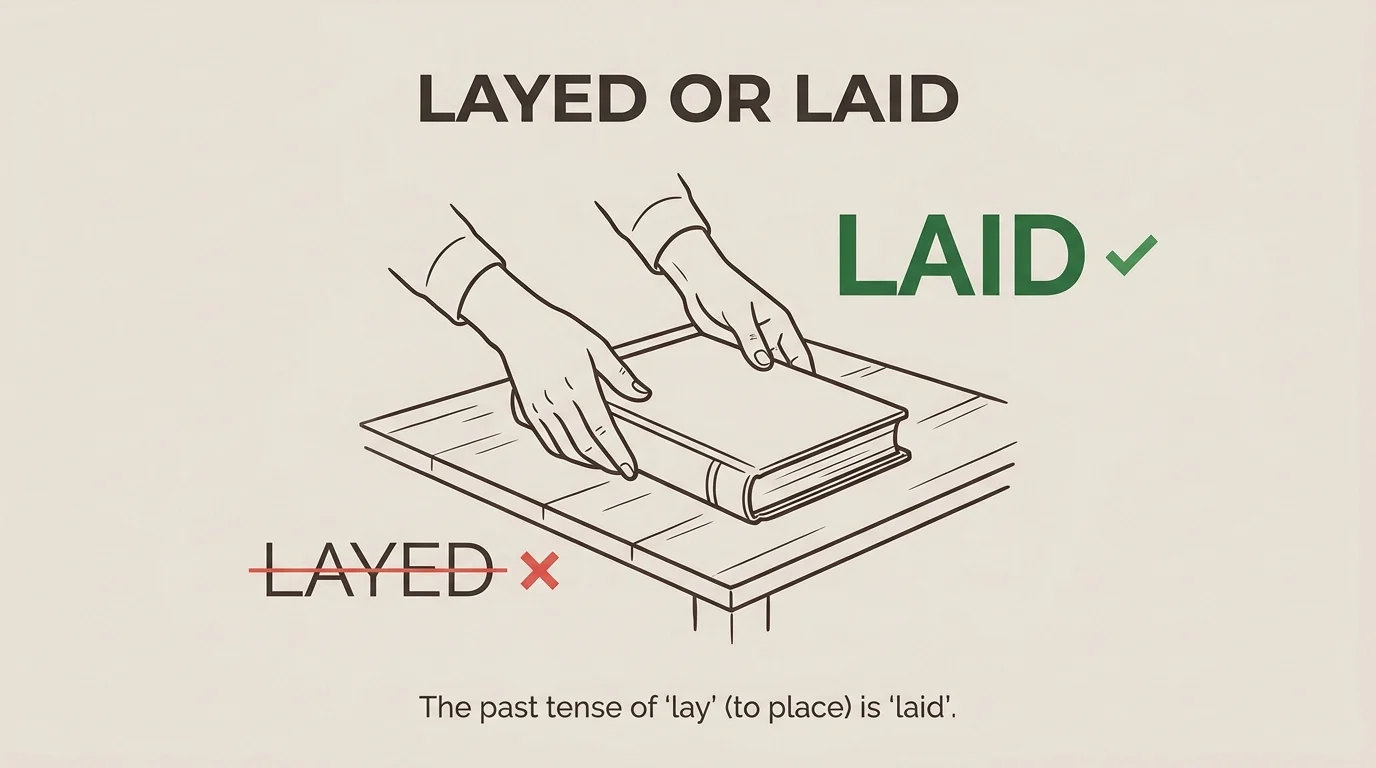
Quick Ans: Laid is the correct standard form of the verb lay. Layed is generally considered incorrect in standard English. Use laid when talking about placing something somewhere, putting something down, or producing something such as an egg. For example, “She laid the book on the table” is correct.
Layed or laid is a common spelling and grammar confusion because lay does not follow the regular verb pattern. Many learners expect to form its past tense by adding ed, just as they do with verbs such as walked, cleaned, or opened. However, lay is an irregular verb, so its past form is laid, not layed.
For example, you can say:
She laid the book on the table.
You should not write:
She layed the book on the table.
The confusion becomes even greater because lie has a different verb pattern. When lie means to recline or rest, its past tense is lay. Therefore, you can correctly say, “I lay on the sofa yesterday” and “I laid the book on the sofa.”
Once you understand these verb forms, the difference becomes much easier to remember. More importantly, you can avoid this common mistake in everyday conversations, school assignments, professional writing, and online content.
Quick Answer and Key Takeaway
Laid is correct. Layed is generally incorrect in standard English.
| Form | Correct? | Example |
|---|---|---|
| lay | Yes | I lay the book here. |
| laid | Yes | I laid the book here yesterday. |
| laying | Yes | She is laying the book down. |
| layed | No | Avoid this form in standard English. |
Simple Rule
Use laid as both the past tense and past participle of lay.
Present: I lay the keys on the desk.
Past: I laid the keys on the desk.
Past participle: I have laid the keys on the desk.
Layed or Laid: Definition and Explanation
What Does Laid Mean?
Laid is the past tense and past participle of lay. The verb lay means to put or place something somewhere.
For example:
She laid the baby on the bed.
He laid his phone on the table.
They laid the documents beside the computer.
The hen laid an egg.
Notice that lay normally takes an object. In other words, someone lays something somewhere.
What Does Layed Mean?
Layed is generally not the standard past tense of lay in modern English. Instead, people sometimes create this form because they assume lay works like a regular verb.
For example:
Incorrect: She layed the book on the desk.
Correct: She laid the book on the desk.
Therefore, when you mean put or place, choose laid.
Is This a Grammar, Usage, or Vocabulary Issue?
This is mainly a grammar and verb form issue. The confusion occurs because lay is an irregular verb.
Unlike regular verbs, it does not simply take ed to form its past tense. Instead, the basic pattern is:
Lay → laid → laid
For comparison:
Walk → walked → walked
So, although “layed” may look logical, standard English uses laid.
Lay vs Lie: The Important Difference
The verb lie creates much of the confusion surrounding laid and lay. However, the two verbs have different meanings.
| Verb | Meaning | Present | Past | Past Participle |
|---|---|---|---|---|
| lay | Put something somewhere | lay | laid | laid |
| lie | Recline or rest | lie | lay | lain |
For example:
Lay:
I laid the book on the table.
Lie:
I lay on the sofa yesterday.
A simple memory trick can help:
Lay means you put something down.
Lie means you rest yourself down.
Real World Usage Examples
Everyday Conversation
I laid my keys on the kitchen counter.
She laid her coat on the chair.
These examples describe something being placed somewhere. Therefore, laid is the correct past form.
Recap: Use laid when someone placed an object somewhere.
Workplace Writing
The manager laid the documents on the conference table.
We laid the materials out before the meeting.
Similarly, professional writing uses laid when describing a completed act of placing something.
Recap: Laid works naturally in both casual and professional communication.
Academic Writing
The researchers laid the samples on a clean surface.
The foundation was laid before construction began.
In academic and technical writing, laid can describe both physical placement and established foundations or plans.
Recap: The same verb form applies in formal contexts.
Regional or Global Usage Differences
There is no major regional difference in the standard form of this verb. Across major varieties of English, laid is the accepted past form of lay.
However, you may occasionally see layed in informal writing, older material, or nonstandard usage. Even so, it is best to use laid in schoolwork, professional communication, websites, and formal documents.
When NOT to Use Layed
Do not use layed when you mean the past tense of lay.
For example, avoid:
- She layed the clothes on the bed.
- He layed the papers on my desk.
- We layed the foundation yesterday.
- The bird layed an egg.
- I layed the phone beside the laptop.
Instead, write:
- She laid the clothes on the bed.
- He laid the papers on my desk.
- We laid the foundation yesterday.
- The bird laid an egg.
- I laid the phone beside the laptop.
Common Mistakes and Corrections
| Correct Sentence | Incorrect Sentence | Why |
|---|---|---|
| She laid the book on the desk. | She layed the book on the desk. | The past form is laid. |
| The bird laid an egg. | The bird layed an egg. | Laid is the standard past form. |
| He laid his jacket on the chair. | He layed his jacket on the chair. | Lay changes to laid in the past. |
| They laid the foundation. | They layed the foundation. | Layed is not the standard form. |
| I have laid the papers here. | I have layed the papers here. | The past participle is laid. |
Easy Decision Rule
Whenever you mean put or place something somewhere, remember this pattern:
Lay → laid → laid
Consequently, never change lay to layed in standard English.
Exercises With Answers
Choose lay, laid, laying, or layed.
- She ______ the keys on the table yesterday.
- I am ______ the clothes on the bed.
- He ______ the book beside the computer every morning.
- The hen ______ an egg yesterday.
- They have ______ the foundation for the building.
Answers
- laid
- laying
- lay
- laid
- laid
Related Concepts and Comparisons
Laid vs Lay
Lay can describe the present action, while laid describes the past.
I lay the book here every day.
I laid the book here yesterday.
Laid vs Lain
Laid comes from lay. In contrast, lain is the past participle of lie.
She has laid the baby down.
She has lain on the bed all afternoon.
Layed vs Laid
Ultimately, laid is the standard choice. Therefore, use laid instead of layed when writing in standard English.
FAQs
Is layed a correct word?
Layed is generally not considered the standard past tense of lay. Therefore, use laid when you mean that someone put or placed something somewhere.
Is it laid or layed down?
The correct expression is laid down when you mean that someone placed something down. For example, “She laid the book down.”
What is the past tense of lay?
The past tense of lay is laid. For example, “He laid the papers on the desk yesterday.”
What is the difference between laid and layed?
Laid is the standard past and past participle form of lay. Layed is generally a nonstandard form and should be avoided in formal writing.
Is it laid or layed an egg?
The correct expression is laid an egg. For example, “The hen laid an egg.”
Is laid the past tense of lie?
No. Laid is the past tense of lay. Meanwhile, the past tense of lie, when it means to recline, is lay.
Why do people say layed instead of laid?
People often use layed because they expect lay to follow the regular ed pattern. However, lay is an irregular verb, so its correct past form is laid.
How do I remember laid vs layed?
Remember the simple pattern lay, laid, laid. If you mean putting or placing something somewhere, use laid for the past tense.
Conclusion
When choosing between layed or laid, remember that laid is the correct standard form. Layed is generally not used as the past tense or past participle of lay in modern standard English.
The easiest way to remember the rule is to learn the three forms together: lay, laid, laid. Use lay for the present and laid for both the past tense and past participle.
At the same time, keep the verb lie separate in your mind. Lay means to put something somewhere, while lie means to recline or rest. Because the past tense of lie is lay, these verbs can easily create confusion.
For example, you can say, “I laid the book on the table,” but “I lay on the sofa yesterday.” Once you understand this difference, choosing the correct form becomes much easier.
So, whenever you mean put or place, choose laid, not layed. If you remember just one rule, remember this: lay, laid, laid.