
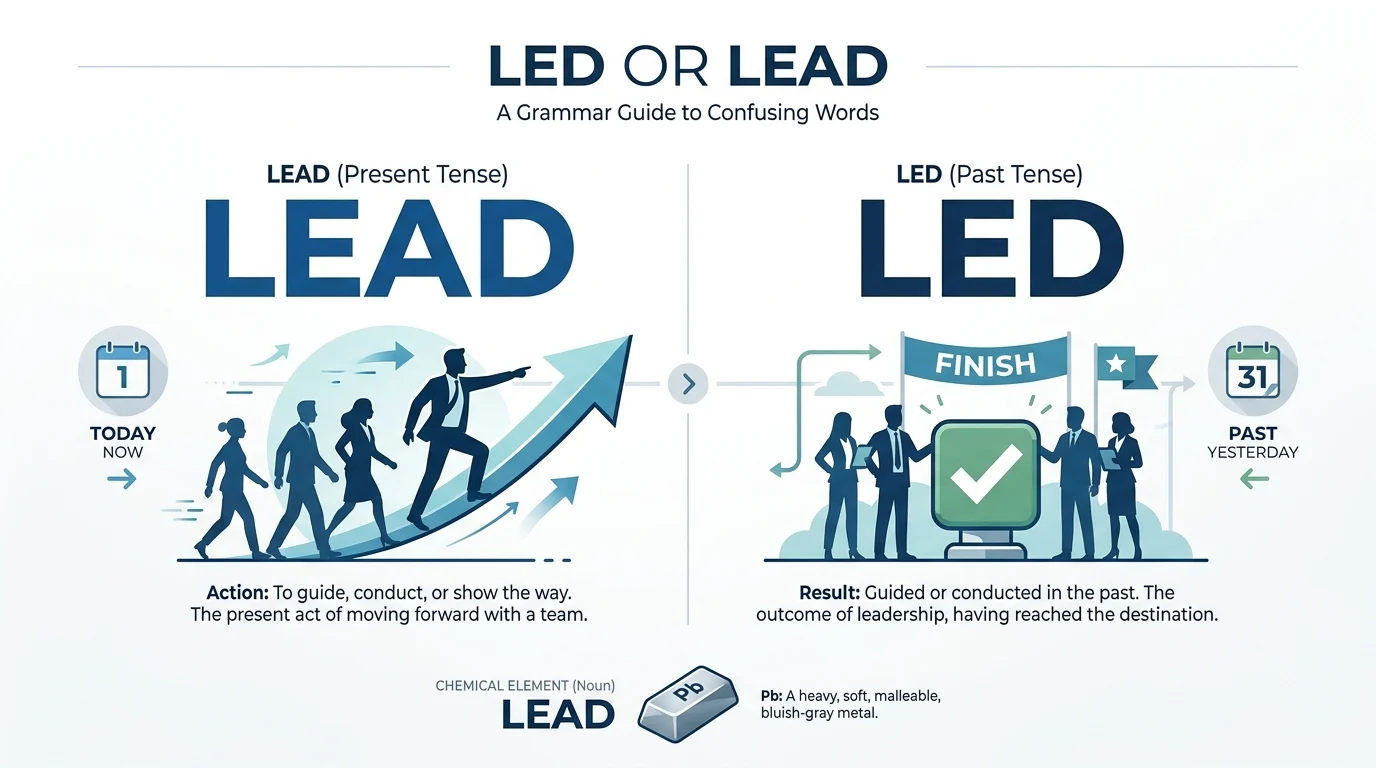
Quick Ans: Led and lead are both correct English words, but they have different meanings and pronunciations. Led is the past tense and past participle of the verb lead. Lead can be pronounced in two ways: “leed” as a verb meaning guide, or “led” as a noun referring to the metal. Context determines which word you need.
Led or lead can be confusing because the two words look almost identical, but they do not always sound the same or have the same meaning. The confusion becomes especially common when writing about past events.
The key rule is simple: led is the past tense of lead when lead means to guide, direct, or be in front. For example, “She led the team to victory.” Here, led describes something that already happened.
The word lead has several meanings. As a verb, it usually means to guide or direct someone. In this use, it is pronounced like “leed.” As a noun, lead can also refer to a heavy metal, pronounced like “led.”
Learning the difference between these words will help you avoid a common spelling mistake in emails, essays, reports, articles, and everyday writing.
Quick Answer and Key Takeaway
Use led when talking about the past form of the verb lead.
Use lead when talking about guiding or directing someone in the present or future.
Lead: “She will lead the meeting.”
Led: “She led the meeting yesterday.”
Lead: “They lead the company.”
Led: “They led the company last year.”
Led or Lead: Definition and Explanation
What Does Lead Mean?
Lead is a verb meaning to guide, direct, manage, or go in front of someone.
Examples:
- She leads the marketing team.
- He will lead the project.
- They lead the group every weekend.
When used as a verb meaning to guide, lead is pronounced “leed.”
What Does Led Mean?
Led is the past tense and past participle of lead.
Examples:
- She led the team last year.
- He led us through the building.
- The manager led the discussion.
Unlike the verb lead, led is pronounced exactly like the word “red” with an L.
What Does Lead Mean as a Noun?
Lead can also mean a type of metal. In this meaning, it is pronounced “led.”
For example:
The old paint contained lead.
This meaning is different from the verb lead.
Is This a Grammar, Usage, or Vocabulary Issue?
This is mainly a grammar and spelling issue involving an irregular verb.
The verb lead does not form its past tense by simply adding “ed.” Its past form is led.
| Present | Past | Meaning |
|---|---|---|
| lead | led | guide or direct |
| lead | led | manage or be in front |
| lead | led | cause or influence |
A common mistake is writing lead when you need the past tense led.
Real World Usage Examples
Workplace
Present:
Sarah will lead the meeting tomorrow.
Past:
Sarah led the meeting yesterday.
Recap: Use lead for present or future situations and led for completed actions.
Academic Writing
The researcher led the study for three years.
Here, led is correct because the action happened in the past.
Recap: Past actions require led when lead means guide or direct.
Everyday Conversation
Who will lead the group?
James led the group during the trip.
Recap: The tense determines whether you need lead or led.
Regional or Global Usage Differences
The spelling and basic grammar rules for lead and led remain the same across major varieties of English.
The biggest source of confusion is pronunciation. When lead is a verb meaning guide, it sounds like “leed.” When lead refers to the metal, it sounds like “led.”
This pronunciation difference does not change the spelling.
When NOT to Use It
Do not use lead when:
- You are describing a completed action of guiding someone.
- You mean the past tense of the verb lead.
- Your sentence describes something that already happened and lead means direct or guide.
Do not use led when:
- You are describing a present action.
- You are talking about a future action.
- You need the base form of the verb lead.
Compare:
Correct: She led the team last year.
Incorrect: She lead the team last year.
Correct: She will lead the team next year.
Incorrect: She will led the team next year.
Common Mistakes and Corrections
| Correct Sentence | Incorrect Sentence | Why |
|---|---|---|
| He led the team yesterday. | He lead the team yesterday. | Led is the past tense. |
| She will lead the project. | She will led the project. | After will, use the base verb lead. |
| They lead the department. | They led the department. | Lead is correct for the present. |
| The manager led the meeting. | The manager lead the meeting. | The meeting already happened. |
| Lead can be a metal. | Led can be a metal. | The metal is spelled lead. |
Easy Decision Rule
Ask yourself:
Is the action happening now or in the future?
Use lead.
Did the action already happen?
Use led.
Remember:
Today: lead
Yesterday: led
Exercises With Answers
Choose lead or led.
- She will ___ the team tomorrow.
- He ___ the group during the trip.
- They ___ the company today.
- Maria ___ the project last year.
- Who will ___ the discussion?
- The old pipes contained ___.
Answers
- lead
- led
- lead
- led
- lead
- lead
Related Concepts and Comparisons
Lead vs Led
Lead is the base form of the verb, while led is its past tense and past participle.
Led vs Leaded
Led is the correct past tense of the verb lead. Leaded is not normally used as the past tense of lead in standard English.
FAQs
Is led the past tense of lead?
Yes. Led is the past tense and past participle of lead when lead means guide or direct.
Should I use lead or led for past tense?
Use led for the past tense. For example, “She led the team yesterday.”
Is lead pronounced like led?
Sometimes. When lead means the metal, it is pronounced like “led.” When it is a verb meaning guide, it is pronounced “leed.”
Why is the past tense of lead led?
Lead is an irregular verb, so its past form is led rather than “leaded.”
Is it lead the team or led the team?
Both can be correct depending on the tense. Use “lead the team” for present or future contexts and “led the team” for a completed past action.
Is leaded a word?
Leaded exists in specialized contexts, but it is not the normal past tense of the verb lead. For ordinary writing, use led.
How do you remember lead vs led?
A simple trick is to connect led with past actions. If the action already happened, led is usually the correct choice.
What is the difference between lead and lead?
The spelling is identical, but pronunciation and meaning can differ. The verb meaning guide is pronounced “leed,” while the metal is pronounced “led.”
Conclusion
The difference between led or lead becomes much easier once you focus on verb tense. Lead is the present or base form of the verb meaning to guide, direct, or manage. Led is its past tense and past participle.
For example, you might say, “She will lead the team tomorrow,” but “She led the team yesterday.” The word lead can also refer to a metal, and in that meaning it is pronounced like led.
The most useful rule is simple: if you are talking about something that already happened, use led when you mean guided or directed. If the action is happening now or will happen later, use lead.
When proofreading your writing, look for words such as yesterday, last year, earlier, or previously. These often signal that you need the past form led. With this quick check, you can avoid one of the most common spelling and grammar mistakes in English.