
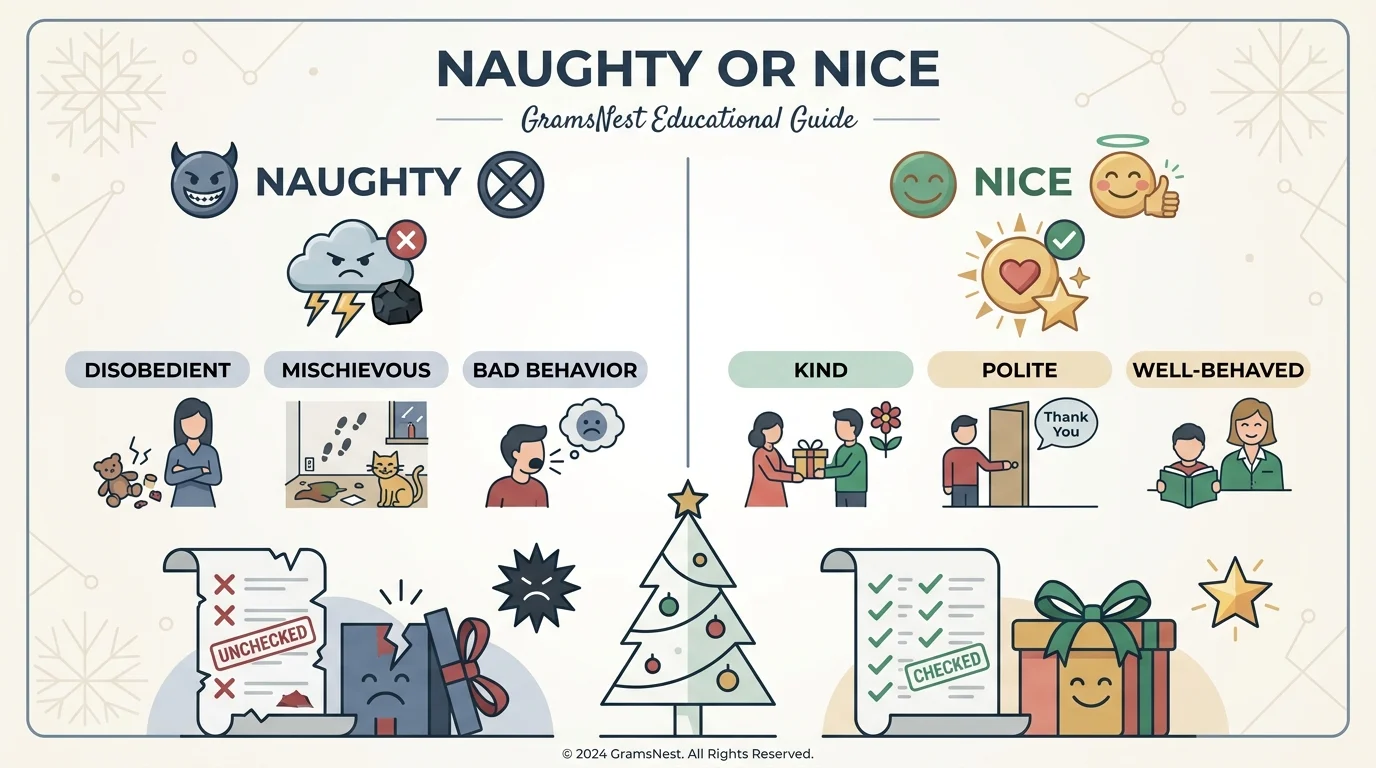
Quick Ans: “Naughty or nice” describes whether someone has behaved badly or well. Naughty means behaving in a disobedient, mischievous, or inappropriate way, while nice means being kind, well behaved, or pleasant. The phrase is especially associated with Santa Claus and the Christmas tradition of deciding who belongs on the naughty or nice list.
Naughty or nice is a familiar phrase that many people hear around Christmas. It is traditionally connected with Santa Claus, who is said to keep a list of children based on their behavior throughout the year. Good behavior earns a place on the “nice” list, while bad or mischievous behavior can put someone on the “naughty” list.
However, these two words have meanings beyond Christmas. Naughty can describe someone who behaves badly, disobeys rules, or causes harmless trouble. Nice usually describes someone who is kind, friendly, polite, or pleasant.
The phrase can also be used playfully among adults, friends, families, and coworkers. Understanding the difference between naughty and nice helps you recognize both their literal meanings and their common cultural use.
Quick Answer and Key Takeaway
Naughty means badly behaved, disobedient, mischievous, or sometimes sexually suggestive depending on context. Nice means kind, pleasant, polite, or well behaved.
In the traditional Christmas expression:
Naughty = bad behavior
Nice = good behavior
Naughty or Nice: Definition and Explanation
What Does Naughty Mean?
Naughty is an adjective used to describe someone who behaves badly or disobeys rules.
For children, it often describes minor misbehavior rather than something seriously wrong.
Examples:
The naughty child hid his sister’s toys.
Stop being naughty and listen to your teacher.
The word can also have a more adult meaning in certain contexts, where “naughty” may suggest sexually suggestive behavior. Context determines the intended meaning.
What Does Nice Mean?
Nice is a broad adjective with several meanings. It can describe someone who is kind, friendly, polite, or pleasant.
Examples:
She is always nice to her classmates.
That was a nice thing to do.
Nice can also describe things that are enjoyable or attractive:
We had a nice evening.
Is This a Grammar, Usage, or Vocabulary Issue?
Naughty or nice is primarily a vocabulary and usage comparison.
Both words are adjectives, but they describe contrasting behavior or qualities.
Naughty generally suggests negative behavior, while nice generally suggests positive behavior.
The meaning can change slightly depending on context, especially when naughty is used humorously or among adults.
Real World Usage Examples
Christmas Usage
Santa checks his naughty and nice list every Christmas.
I hope Santa puts me on the nice list this year.
Recap: In Christmas traditions, naughty represents bad behavior and nice represents good behavior.
Everyday Usage
The puppy was naughty and chewed my shoes.
Our neighbor was nice enough to help us.
Recap: Outside Christmas, the words commonly describe behavior and personality.
Playful Usage
Are you being naughty or nice today?
The kids were mostly nice, but they had a few naughty moments.
Recap: The phrase is often used jokingly to describe someone’s behavior.
Naughty vs Nice: Key Differences
| Feature | Naughty | Nice |
|---|---|---|
| General meaning | Badly behaved or mischievous | Kind, pleasant, or well behaved |
| Tone | Usually negative or playful | Usually positive |
| Common subject | Children, pets, behavior | People, behavior, experiences |
| Christmas meaning | Bad behavior | Good behavior |
| Example | He was naughty at school. | She was nice to everyone. |
Regional or Global Usage Differences
The basic meanings of naughty and nice are widely understood in English speaking countries. However, their cultural association with Santa’s list is particularly strong during Christmas.
“Naughty or nice” is also commonly used in Christmas advertisements, songs, decorations, children’s activities, and holiday conversations.
In everyday English, nice has a much broader range of uses than naughty. Nice can describe people, places, experiences, objects, weather, and events.
When NOT to Use These Words
Avoid using naughty when:
- You mean someone is simply unfriendly.
- You want to describe serious criminal behavior.
- The context requires a precise description of wrongdoing.
- The word could create an unintended adult meaning.
Avoid using nice when:
- You need to describe a specific positive quality.
- You mean professionally skilled or highly competent.
- You are discussing a serious moral judgment where “nice” is too vague.
For example, “She is nice at mathematics” is incorrect. Use good at mathematics instead.
Common Mistakes and Corrections
| Correct Sentence | Incorrect Sentence | Why |
|---|---|---|
| The child was naughty. | The child was nice. | The intended meaning is misbehavior. |
| She was nice to everyone. | She was naughty to everyone. | Kind behavior requires nice. |
| Santa has a naughty list. | Santa has a nice list for bad children. | Naughty traditionally represents bad behavior. |
| He is nice at math. | He is naughty at math. | Neither describes ability correctly. Use “good at math.” |
Easy Decision Rule
Use naughty when someone is behaving badly, mischievously, or inappropriately.
Use nice when someone is kind, pleasant, friendly, or well behaved.
For Christmas, remember:
Naughty = bad
Nice = good
Exercises With Answers
Choose naughty or nice.
- The puppy was ______ and knocked over the plant.
- Sarah was ______ enough to help her friend.
- Santa’s ______ list contains names of children who misbehaved.
- We had a ______ conversation.
- The children were surprisingly ______ during the trip.
Answers
- naughty
- nice
- naughty
- nice
- nice
Related Concepts and Comparisons
Naughty vs Bad
Naughty usually suggests minor, playful, or childish misbehavior. Bad is broader and can describe anything from poor behavior to something morally wrong or harmful.
Nice vs Kind
Nice is a broad word meaning pleasant or agreeable. Kind specifically emphasizes caring about others and treating them well.
Naughty or Nice Christmas Meaning
During Christmas, the phrase refers to the traditional idea that Santa rewards children who behave well and leaves less desirable consequences for those who behave badly.
FAQs
What does naughty or nice mean?
The phrase asks whether someone has behaved badly or well. Naughty suggests bad or mischievous behavior, while nice suggests kind or well behaved conduct.
Why does Santa have a naughty and nice list?
In Christmas folklore, Santa uses the lists to distinguish children who behaved well from those who behaved badly during the year.
Is naughty a bad word?
Not necessarily. Naughty is usually a mild word for bad or mischievous behavior, although its meaning can become sexually suggestive in some adult contexts.
Is nice the opposite of naughty?
In the Christmas expression, yes. Naughty represents bad behavior, while nice represents good behavior.
What is the difference between naughty and nice?
Naughty describes bad, disobedient, or mischievous behavior. Nice describes someone or something kind, pleasant, friendly, or agreeable.
Can adults use naughty or nice?
Yes. Adults often use the phrase playfully, especially around Christmas. However, “naughty” can have an additional suggestive meaning depending on the context.
Is nice always a compliment?
Usually, but not always. Because nice is a very broad word, its meaning depends on context and tone.
What is a synonym for naughty?
Depending on the context, synonyms include mischievous, disobedient, troublesome, cheeky, or badly behaved.
What is a synonym for nice?
Common synonyms include kind, pleasant, friendly, polite, thoughtful, agreeable, and pleasant.
Conclusion
Naughty or nice is a simple phrase with a strong connection to Christmas traditions, but both words are useful in everyday English. Naughty generally describes someone who behaves badly, disobeys rules, or acts mischievously. Nice usually describes someone who is kind, friendly, pleasant, or well behaved.
The phrase becomes especially recognizable during the holiday season because of the traditional idea of Santa’s naughty and nice list. However, you can use the words in many other situations. A child can be naughty, a puppy can be naughty, and a person can be nice to others.
The easiest way to remember the difference is simple: naughty means bad behavior, while nice means good or pleasant behavior. When using naughty with adults, pay attention to context because the word can sometimes carry a suggestive meaning.
For everyday writing and conversation, choose the word that best matches the behavior or quality you want to describe.