
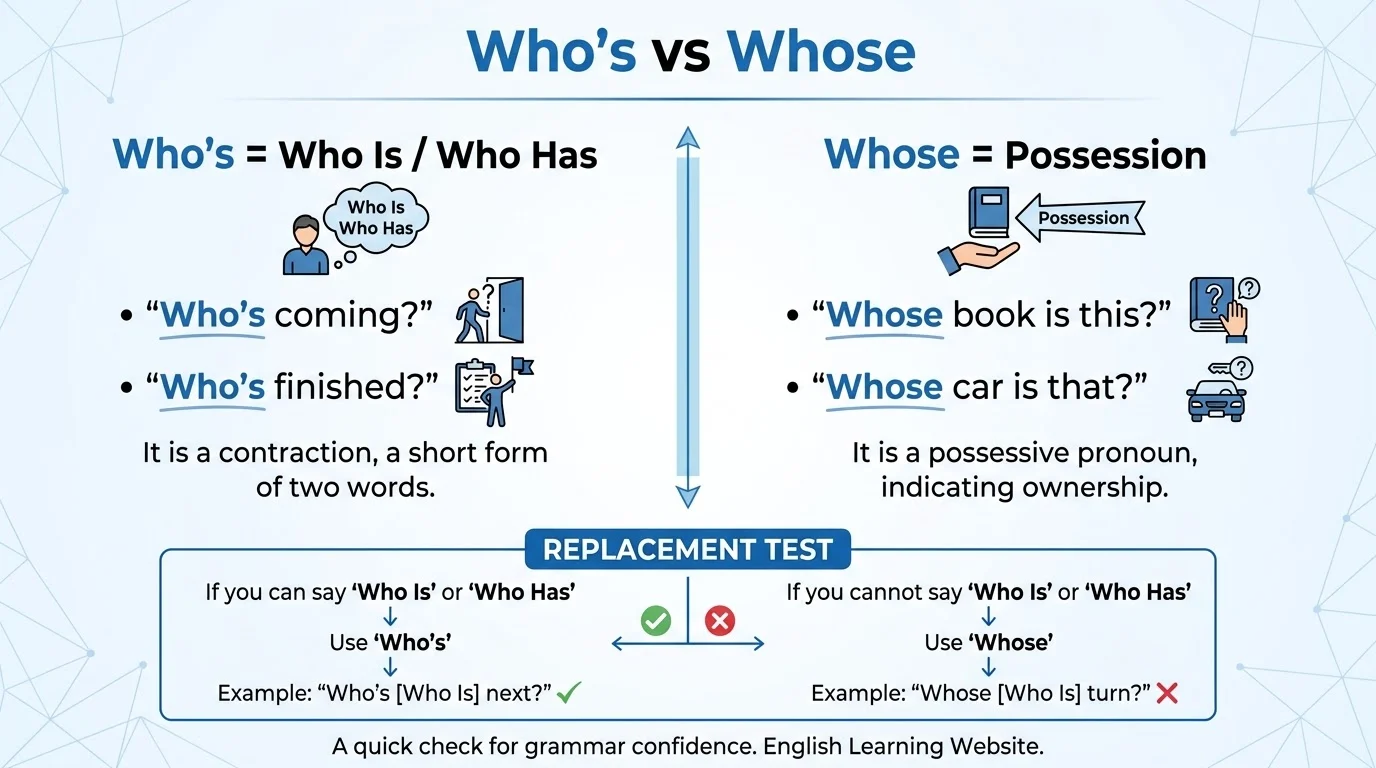
Quick Ans: Who’s and whose sound alike but have different meanings. Who’s is a contraction of “who is” or “who has,” while whose shows possession or ownership. Use “who’s” when you can replace it with “who is” or “who has.” Use “whose” when you are asking or telling who something belongs to.
Who’s or whose is a common English confusion because both words sound the same in most varieties of spoken English. However, their meanings and grammatical functions are completely different.
The easiest way to remember the difference is to look at what the word is doing in the sentence. Who’s is a contraction. It combines “who is” or “who has.” Whose is a possessive word used to ask or explain who owns something or who something belongs to.
For example, “Who’s coming to dinner?” means “Who is coming to dinner?” On the other hand, “Whose jacket is this?” asks who the jacket belongs to.
Knowing when to use who’s or whose can improve your grammar and make your writing clearer. The good news is that one simple replacement test can help you choose the correct word almost every time.
Quick Answer and Key Takeaway
The difference is simple:
Who’s = who is or who has
Whose = shows possession
For example:
Who’s at the door?
Who is at the door?
Whose phone is ringing?
Who does the phone belong to?
If “who is” or “who has” fits the sentence, use who’s. If the sentence asks about ownership or possession, use whose.
Who’s or Whose: Definition and Explanation
What Does Who’s Mean?
Who’s is a contraction of either who is or who has.
Examples:
Who’s your new teacher?
This means:
Who is your new teacher?
Another example:
Who’s finished the assignment?
This means:
Who has finished the assignment?
The apostrophe in who’s indicates that letters have been omitted from the longer expression.
What Does Whose Mean?
Whose is a possessive word. It asks or tells who something belongs to.
Examples:
Whose backpack is this?
I know whose car is parked outside.
Unlike who’s, whose does not mean “who is” or “who has.”
Is This a Grammar, Usage, or Vocabulary Issue?
Who’s or whose is primarily a grammar and usage issue.
The two words sound alike, which makes them easy to confuse in speech. In writing, however, the apostrophe changes the meaning.
A useful trick is to expand the contraction:
Who’s → who is / who has
If neither version makes sense, you probably need whose.
Real World Usage Examples
Everyday Conversation
Who’s calling you?
Whose keys are these?
Recap: Use who’s for “who is” or “who has,” and whose for possession.
Workplace Writing
Who’s responsible for this report?
Whose approval do we need?
Recap: Both words can appear in professional writing, but they serve different grammatical purposes.
Academic Writing
Who’s conducting the research?
Whose theory does this argument support?
Recap: Check the meaning carefully before choosing between the two words.
Who’s vs Whose Comparison
| Feature | Who’s | Whose |
|---|---|---|
| Meaning | Who is or who has | Belonging to whom |
| Grammar | Contraction | Possessive word |
| Apostrophe | Yes | No |
| Example | Who’s coming? | Whose bag is this? |
| Main use | Describes or asks about a person | Shows possession |
Regional or Global Usage Differences
There is no major difference in the basic meaning of who’s and whose across standard varieties of English. Both forms are widely recognized and used in English speaking countries.
The main challenge comes from pronunciation. Who’s and whose are pronounced alike or very similarly, so the distinction becomes especially important in written English.
When NOT to Use Who’s or Whose
Do not use who’s when you mean possession.
Incorrect:
Who’s phone is this?
Correct:
Whose phone is this?
Do not use whose when you mean “who is.”
Incorrect:
Whose coming to the party?
Correct:
Who’s coming to the party?
Also avoid choosing the word based only on how it sounds. Since they sound alike, check the meaning instead.
Common Mistakes and Corrections
| Correct Sentence | Incorrect Sentence | Why |
|---|---|---|
| Who’s coming with us? | Whose coming with us? | “Who’s” means “who is.” |
| Whose coat is this? | Who’s coat is this? | “Whose” shows possession. |
| Who’s finished the project? | Whose finished the project? | “Who’s” can mean “who has.” |
| Whose idea was it? | Who’s idea was it? | The question asks about ownership or association. |
| Who’s responsible for the mistake? | Whose responsible for the mistake? | “Who’s” means “who is.” |
Exercises With Answers
Choose who’s or whose.
- ______ coming to the meeting?
- ______ laptop is on the desk?
- ______ already finished the book?
- ______ jacket did you borrow?
- ______ responsible for this project?
- Do you know ______ dog this is?
Answers
- Who’s
- Whose
- Who’s
- Whose
- Who’s
- Whose
Related Concepts and Comparisons
Who’s vs Who
Who is a pronoun used to refer to a person. Who’s is a contraction of “who is” or “who has.”
Who called you?
Who’s calling you?
Whose vs Who
Whose asks about possession, while who generally asks about a person.
Who is your manager?
Whose office is this?
Its vs It’s
This is another common apostrophe confusion. It’s means “it is” or “it has,” while its shows possession.
The same basic idea can help you remember that apostrophes in contractions do not automatically indicate possession.
FAQs
What is the difference between who’s and whose?
Who’s means “who is” or “who has.” Whose is a possessive word used to ask or explain who something belongs to.
Is who’s possessive?
No. Who’s is a contraction of “who is” or “who has.” Whose is the possessive form.
Is whose a contraction?
No. Whose is not a contraction. It is used to indicate possession or ask about ownership.
How do I remember who’s vs whose?
Try replacing who’s with “who is” or “who has.” If the replacement works, use who’s. If the sentence concerns ownership, use whose.
Who’s coming or whose coming?
The correct form is “Who’s coming?” because it means “Who is coming?”
Whose car is this or who’s car is this?
The correct sentence is “Whose car is this?” because the question asks who the car belongs to.
Can who’s mean who has?
Yes. Who’s can mean either “who is” or “who has,” depending on the sentence.
Why do who’s and whose sound the same?
In most standard English pronunciation, who’s and whose are pronounced the same or almost the same. Their different meanings are therefore easier to identify in writing.
Which is correct, who’s idea or whose idea?
The correct phrase is “whose idea” because it asks who the idea belongs to or who suggested it.
Conclusion
Understanding who’s or whose becomes much easier when you focus on meaning instead of pronunciation. Who’s is always a contraction of “who is” or “who has,” while whose is used to show possession or ask who something belongs to.
For example, “Who’s waiting outside?” means “Who is waiting outside?” In contrast, “Whose bag is this?” asks who the bag belongs to.
The most useful rule is the replacement test. Whenever you see who’s, try replacing it with “who is” or “who has.” If the sentence still makes sense, who’s is correct. If you are talking about ownership, use whose.
Remember: Who’s = who is or who has. Whose = possession. Apply this simple rule whenever you write, and you will avoid one of the most common English grammar mistakes.