
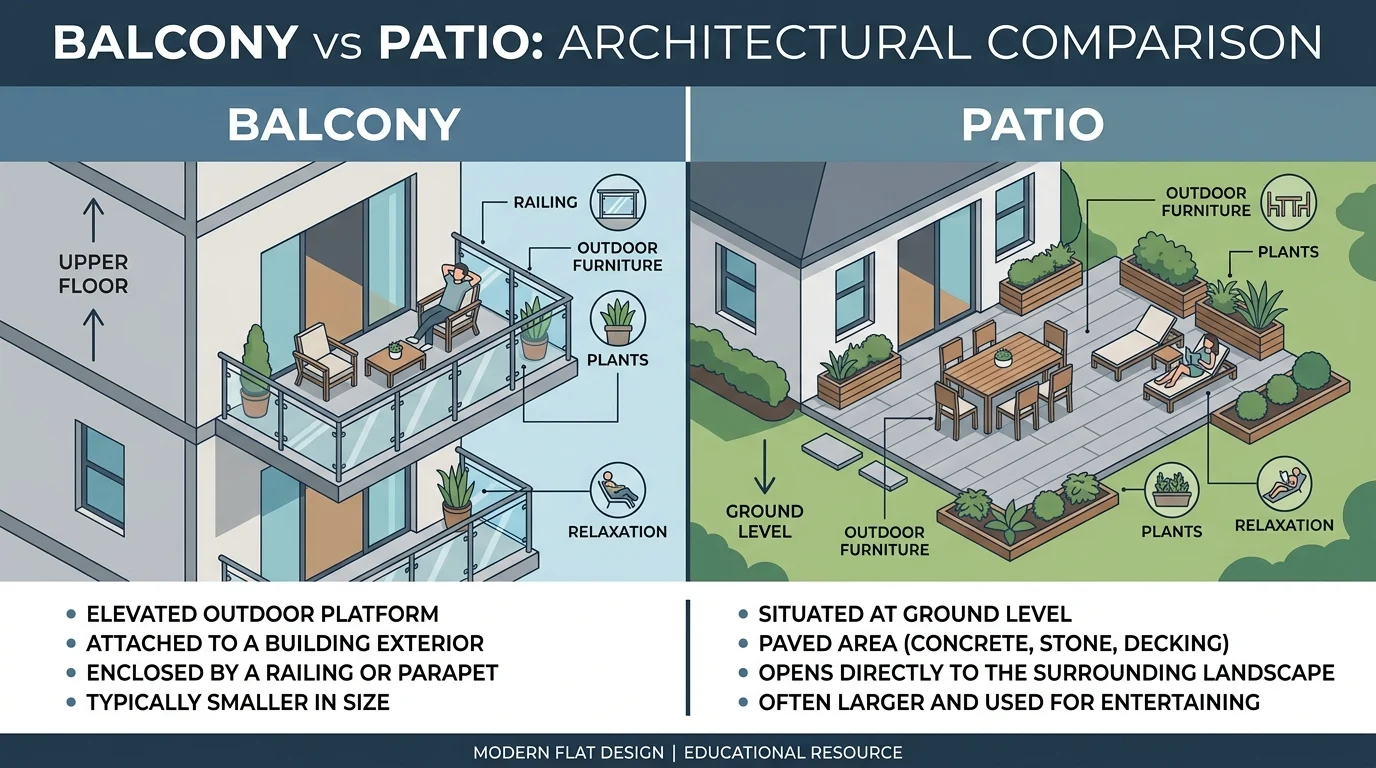
Quick Ans: A balcony and a patio are both outdoor spaces, but they differ mainly in location and structure. A balcony is an elevated platform attached to a building, while a patio is usually a ground level outdoor area next to a house. Both can provide space for relaxing, dining, plants, and entertaining guests.
Balcony vs patio is a common comparison for people describing outdoor spaces around a home, apartment, or building. Although both provide an area to enjoy fresh air, they are not the same type of space.
A balcony is usually an elevated platform that extends from a building. It may be attached to an upper floor and typically has a railing or protective barrier around its edges. Balconies are common in apartments, hotels, and multi story homes.
A patio, on the other hand, is generally located at ground level. It is often placed beside or behind a house and can be made from materials such as concrete, stone, brick, or paving slabs.
Understanding the difference between a balcony and a patio helps you use these words correctly when describing homes, buildings, and outdoor living spaces.
Quick Answer and Key Takeaway
The main difference between a balcony and a patio is their position. A balcony is an elevated outdoor platform attached to a building, while a patio is usually a ground level outdoor area next to a house or building.
In simple terms:
Balcony = elevated outdoor space
Patio = ground level outdoor space
Balcony vs Patio: Definition and Explanation
What Is a Balcony?
A balcony is a platform that projects from the side of a building. It is usually located above ground level and has a railing, wall, or other protective barrier.
For example:
We had breakfast on the balcony while enjoying the view.
Balconies are particularly common in apartments because they provide outdoor space without requiring a large area of land.
What Is a Patio?
A patio is an outdoor area that is usually built directly on the ground. It may be connected to a house and can be used for outdoor dining, relaxing, entertaining, or gardening.
For example:
We put a table and chairs on the patio.
Patios can be small or large and are often designed as extensions of a home’s living space.
Is This a Grammar, Usage, or Vocabulary Issue?
Balcony vs patio is primarily a vocabulary and usage comparison.
Both words describe outdoor spaces, but they refer to different structures. Using the wrong word can create confusion about where the space is located.
If the outdoor space is elevated and attached to a building, balcony is usually the correct word.
If it is a ground level area beside or behind a building, patio is usually more appropriate.
Real World Usage Examples
Everyday Usage
Balcony:
She sat on the balcony with her morning coffee.
Patio:
They enjoyed dinner on the patio.
Recap: A balcony is elevated, while a patio is generally at ground level.
Workplace or Hospitality
Balcony:
The hotel room has a private balcony overlooking the city.
Patio:
The restaurant has a large outdoor patio.
Recap: Hotels commonly advertise balconies, while restaurants often describe outdoor seating areas as patios.
Home and Property Descriptions
Balcony:
The apartment includes a spacious balcony.
Patio:
The house has a covered patio in the backyard.
Recap: Property descriptions use both terms to identify different types of outdoor living areas.
Balcony vs Patio: Key Differences
| Feature | Balcony | Patio |
|---|---|---|
| Location | Usually above ground | Usually at ground level |
| Structure | Attached to a building | Usually built beside a building |
| Common in | Apartments and upper floors | Houses and ground level properties |
| Barrier | Usually has a railing or wall | Usually does not need a railing |
| Access | Usually through an upper floor | Usually through a ground floor |
| Typical use | Relaxing, views, plants | Dining, entertaining, relaxing |
Regional or Global Usage Differences
The basic distinction between balcony and patio remains similar in different varieties of English. However, homes and buildings can use different terms depending on local architecture.
Some outdoor spaces may have features of both. For example, a raised outdoor platform may sometimes be described using other architectural terms depending on its design.
When NOT to Use These Words
Avoid using balcony when:
- The outdoor space is entirely at ground level.
- You are describing a paved backyard area.
- There is no elevated platform attached to the building.
Avoid using patio when:
- You specifically mean an upper floor platform.
- The space extends from an apartment or upper level.
- You are talking about a traditional elevated outdoor platform with a railing.
Common Mistakes and Corrections
| Correct Sentence | Incorrect Sentence | Why |
|---|---|---|
| We sat on the balcony. | We sat on the patio. | The space was elevated. |
| They built a patio behind the house. | They built a balcony behind the house. | The area is at ground level. |
| The apartment has a balcony. | The apartment has a patio. | The outdoor platform is elevated. |
| We had dinner on the patio. | We had dinner on the balcony. | The described space is ground level. |
Easy Decision Rule
Ask one simple question:
If yes, balcony is usually the right word.
If it is directly on the ground, patio is usually the right word.
Exercises With Answers
Choose balcony or patio.
- We planted flowers on our apartment ______.
- The house has a large ______ beside the backyard.
- She stepped onto the second floor ______.
- We placed a grill on the ______.
- The hotel room has a private ______.
Answers
- balcony
- patio
- balcony
- patio
- balcony
FAQs
What is the main difference between a balcony and a patio?
A balcony is usually an elevated platform attached to a building. A patio is generally a ground level outdoor area beside or behind a building.
Is a patio always on the ground?
A patio is normally a ground level outdoor space. However, architectural designs can vary, so the exact structure may depend on the property.
Can a house have both a balcony and a patio?
Yes. A house can have a balcony on an upper floor and a patio at ground level.
Which is bigger, a balcony or a patio?
There is no fixed size rule. Patios often have more available space because they occupy ground level areas, but balconies can also vary considerably in size.
What is the difference between a balcony and a patio in a house?
A balcony is usually elevated and connected to an upper floor. A patio is generally located on the ground beside or behind the house.
Is a deck the same as a patio?
No. A patio is generally a ground level outdoor area, while a deck is commonly raised above the ground.
Is a terrace the same as a balcony?
Not always. A balcony is usually a projecting platform attached to a building, while a terrace can be a larger outdoor space located on a roof, upper level, or ground level.
Conclusion
Balcony vs patio becomes easy to understand once you focus on location. A balcony is typically an elevated outdoor platform attached to a building, while a patio is usually a ground level outdoor area beside or behind a home.
Balconies are especially common in apartments and upper floor rooms because they provide outdoor space without taking up additional ground area. Patios are more commonly associated with houses, gardens, backyards, restaurants, and other ground level settings.
Both spaces can serve similar purposes. People use them for relaxing, dining, entertaining guests, growing plants, and enjoying the outdoors. The important difference is their structure and position.
When you’re unsure which word to use, remember this simple rule: a balcony is usually up, while a patio is usually down on the ground. This quick distinction will help you use both words accurately in everyday conversations and writing.