
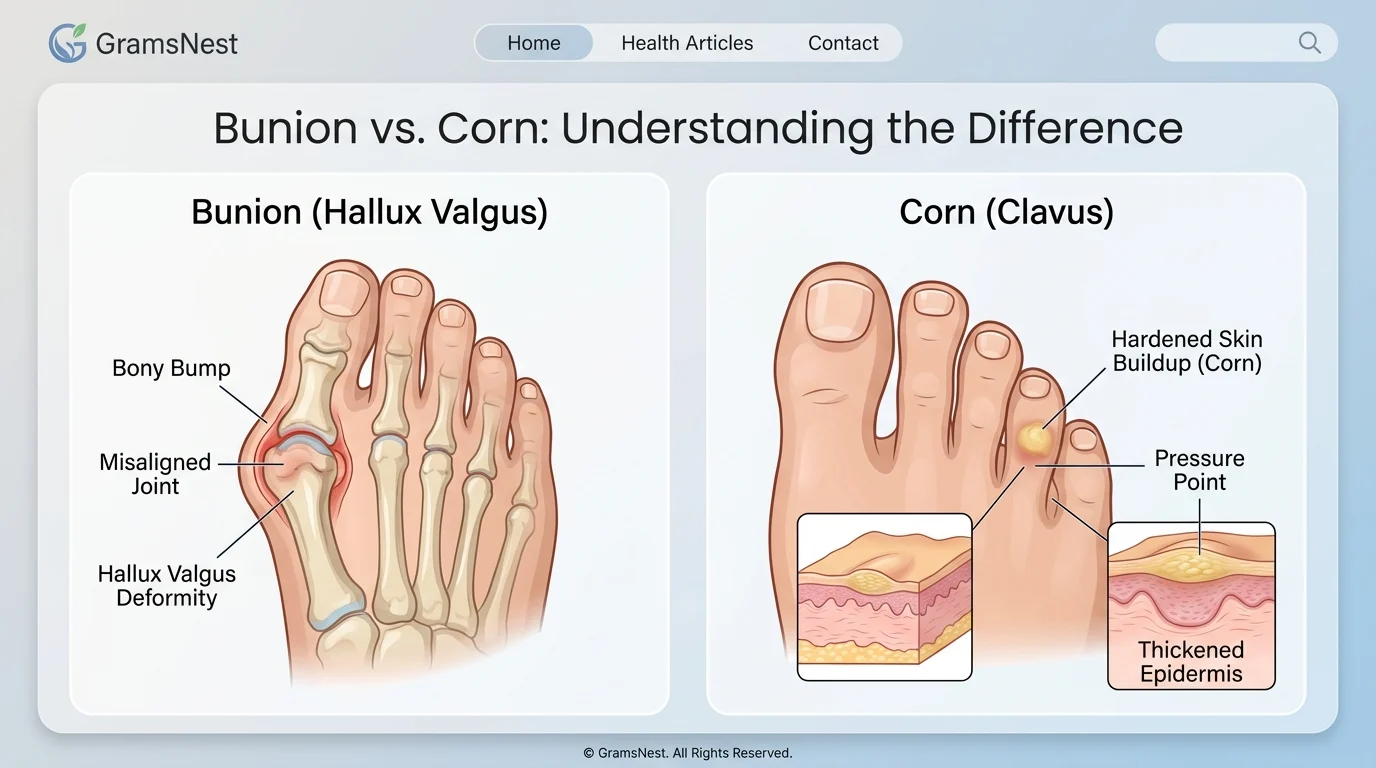
Quick Ans: A bunion is a bony or structural change that develops at the base of the big toe and can cause the toe to angle toward the other toes. A corn is a small, hardened area of thick skin caused by repeated pressure or friction. Both can hurt, but they are different foot problems.
Bunion vs corn is a common comparison because both conditions can cause pain, tenderness, and uncomfortable pressure around the toes and feet. They can also become more noticeable when wearing tight or poorly fitting shoes. However, a bunion and a corn are not the same thing.
A bunion affects the structure and alignment of the foot. It usually develops at the joint where the big toe meets the foot and may create a visible bump on the side of the foot.
A corn is different. It is a thickened area of skin that develops because of repeated pressure or friction. Corns commonly appear on or between the toes and may feel hard or tender.
Knowing the difference can help you describe your symptoms more accurately and understand what type of foot problem you may be dealing with.
Quick Answer and Key Takeaway
The main difference between a bunion and a corn is that a bunion is a structural foot deformity, while a corn is a thickened area of skin caused by pressure or friction.
Bunion: affects the joint and alignment of the toe.
Corn: affects the skin.
Bunion vs Corn: Definition and Explanation
What Is a Bunion?
A bunion is a deformity that develops at the base of the big toe. The big toe gradually moves toward the other toes while the joint at its base becomes more prominent.
According to the American Academy of Orthopaedic Surgeons, bunions can cause pain, swelling, redness, and difficulty wearing shoes.
A bunion may become more noticeable over time and can affect how comfortably you walk.
What Is a Corn?
A corn is a small area of thickened skin that develops because of repeated pressure or friction. Corns commonly occur on the toes or other areas where the skin experiences rubbing.
The Mayo Clinic notes that corns are usually caused by pressure or friction from footwear or other sources.
Unlike a bunion, a corn primarily affects the outer layer of the skin.
Is This a Grammar, Usage, or Vocabulary Issue?
Bunion vs corn is not a grammar issue. It is a medical vocabulary comparison.
The words describe two different foot conditions. Using the correct term matters because a visible bump, thickened skin, or painful area can have different causes.
Bunion vs Corn: Key Differences
| Feature | Bunion | Corn |
|---|---|---|
| Main problem | Structural foot change | Thickened skin |
| Common location | Base of the big toe | Toes or pressure points |
| Appearance | Bony or prominent bump | Small, hardened patch |
| Main cause | Foot structure and several contributing factors | Pressure and friction |
| Affects | Joint and toe alignment | Skin |
| Can cause pain | Yes | Yes |
| Related to footwear | Tight shoes can aggravate symptoms | Tight shoes can contribute to formation |
Common Signs and Symptoms
Bunion Symptoms
A bunion may cause:
- A prominent bump at the base of the big toe
- Big toe movement toward the other toes
- Pain or tenderness
- Swelling or redness
- Difficulty finding comfortable shoes
Corn Symptoms
A corn may cause:
- A small hardened area of skin
- Rough or thickened skin
- Tenderness when pressure is applied
- Pain when walking or wearing certain shoes
Corns may be hard, soft, or occur between the toes depending on their location and moisture exposure.
Real World Examples
Everyday Example
If a person notices a hard bump developing beside the big toe joint, a bunion may be involved.
If someone notices a small, painful patch of thickened skin on a toe where a shoe repeatedly rubs, it may be a corn.
Recap: Look at whether the problem appears to involve the joint structure or mainly the skin.
Footwear Example
Tight shoes can aggravate bunion discomfort and can also create the pressure and friction that contribute to corns.
Recap: Poorly fitting footwear can make both problems more uncomfortable, but they develop differently.
When NOT to Use These Terms
Do not automatically call every painful bump on the foot a bunion.
Similarly, do not assume every hard area of skin is a corn. Other foot conditions can produce similar symptoms.
Seek professional medical advice if the area is very painful, keeps returning, becomes inflamed, develops a wound, or does not improve with basic measures.
People with diabetes or circulation problems should be particularly careful with foot problems and seek appropriate medical guidance rather than attempting to remove thickened skin themselves.
Common Mistakes and Corrections
| Correct Understanding | Incorrect Assumption | Why |
|---|---|---|
| A bunion affects the big toe joint | Every foot bump is a bunion | Different conditions can cause bumps |
| A corn is thickened skin | A corn is a bone deformity | Corns develop in the skin |
| Pressure can contribute to corns | Corns are always caused by bones | Friction and pressure are common causes |
| Tight shoes can aggravate bunions | Shoes are the only cause of bunions | Bunions have multiple contributing factors |
Easy Decision Rule
Ask: Is the problem mainly a change in the toe joint or a thickened patch of skin?
If it involves the joint and changes the position of the big toe, it may be a bunion.
If it is a small, hardened area of skin caused by pressure or friction, it may be a corn.
Exercises With Answers
Choose bunion or corn.
- A painful hardened patch develops where a shoe rubs against a toe.
- A prominent bump appears at the base of the big toe.
- The big toe begins moving toward the neighboring toes.
- A small area of thickened skin develops between the toes.
Answers
- Corn
- Bunion
- Bunion
- Corn
Related Concepts and Comparisons
Bunion vs Callus
Both can be associated with pressure from footwear, but a bunion affects foot structure while a callus is an area of thickened skin.
Corn vs Callus
Corns are generally smaller and more concentrated than calluses. Both involve thickened skin caused by repeated pressure or friction.
Bunion vs Hammertoe
A bunion affects the joint at the base of the big toe. Hammertoe involves an abnormal bend in one of the smaller toes.
FAQs
What is the main difference between a bunion and a corn?
A bunion is a structural change involving the foot and big toe joint. A corn is a small area of thickened skin caused by repeated pressure or friction.
Can a bunion cause a corn?
Yes. Changes in foot structure can alter pressure points and cause certain areas of the foot to experience more friction. This can contribute to corns.
Are bunions and corns painful?
Both can cause pain or tenderness. The amount of discomfort varies depending on the individual and the severity of the problem.
How can you tell if you have a bunion or corn?
A visible bump at the base of the big toe suggests a bunion, while a small hardened patch of skin on a pressure point is more typical of a corn. A healthcare professional can help identify the cause when the diagnosis is unclear.
Can tight shoes cause corns?
Tight or poorly fitting shoes can create pressure and friction that contribute to corns. Choosing properly fitting footwear can reduce repeated pressure.
Can you have a bunion and a corn at the same time?
Yes. A bunion can change how pressure is distributed across the foot, and this may contribute to corns in areas exposed to extra friction.
Is a corn a bone problem?
No. A corn is a thickened area of skin. It is different from a structural problem involving a bone or joint.
When should you see a doctor about a bunion or corn?
Consider medical advice when pain is persistent, symptoms worsen, the area becomes inflamed or wounded, or normal walking becomes difficult. People with diabetes or circulation problems should seek professional advice for foot concerns.
Conclusion
Bunion vs corn is easier to understand when you focus on what each condition affects. A bunion involves the structure and alignment of the foot, particularly the joint at the base of the big toe. A corn is a localized area of thickened skin that develops because of repeated pressure or friction.
Both problems can become uncomfortable, especially when footwear puts additional pressure on the affected area. However, their appearance and underlying causes are different.
A visible bump around the big toe joint is more consistent with a bunion, while a small, hardened patch of skin on a pressure point is more typical of a corn. Still, other foot conditions can look similar, so persistent or severe symptoms deserve professional evaluation.
The easiest way to remember the distinction is simple: bunion means structure, while corn means skin. If you are unsure what is causing your foot pain, avoid self diagnosis and seek advice from a qualified healthcare professional.