
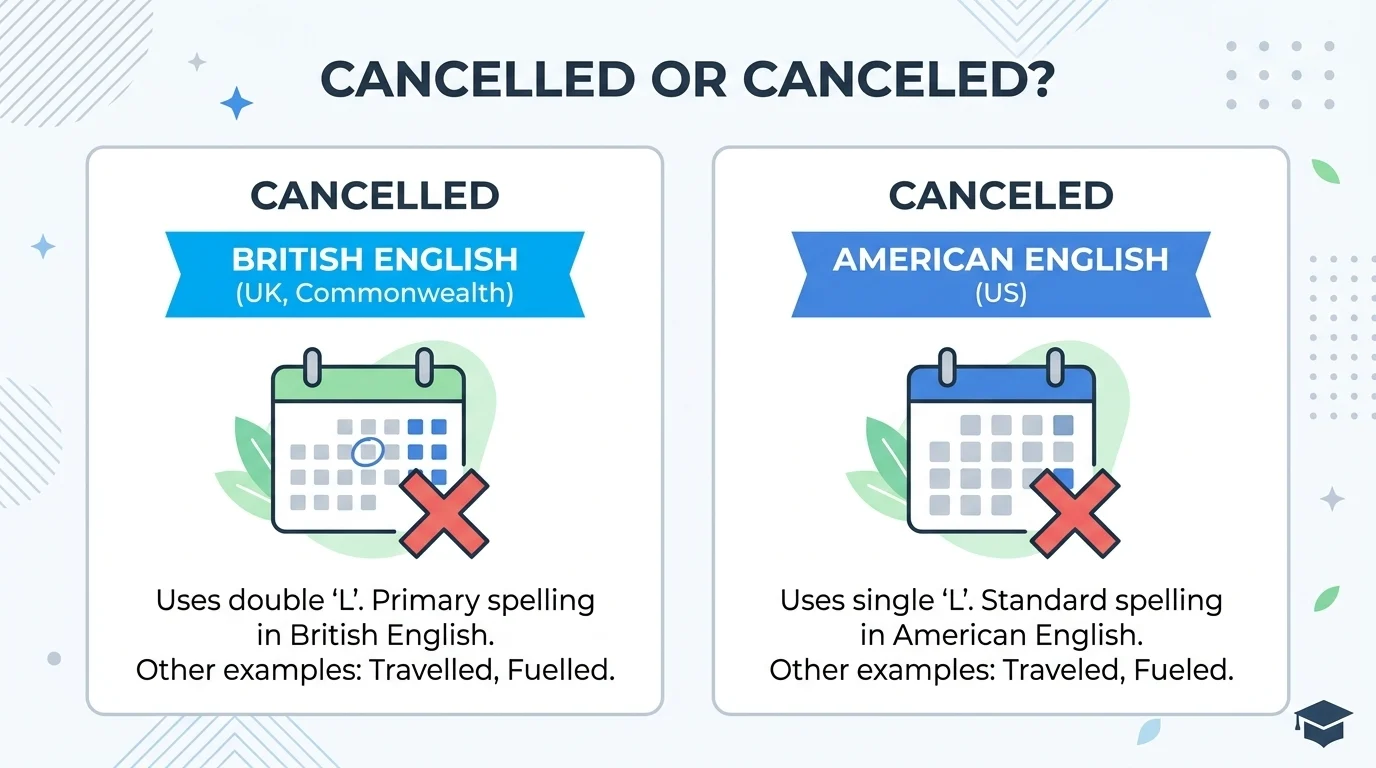
Quick Ans: “Cancelled” and “canceled” are both correct spellings of the past tense of “cancel.” The main difference is regional. “Cancelled” is more common in British English, while “canceled” is the standard spelling in American English. Both mean that something was stopped, called off, or no longer planned.
Are you confused about whether to write “cancelled or canceled”? You are not alone. Both spellings are correct, but English speakers in different regions usually prefer different forms.
The difference comes from a simple spelling rule. British English normally keeps the double “l” when adding “ed” to “cancel.” American English usually keeps only one “l.” As a result, British writers use “cancelled,” while American writers use “canceled.”
You may see both forms in emails, school assignments, news articles, business documents, and websites. Neither spelling is a mistake when it follows the appropriate English variety.
For students and ESL learners, the most useful thing is to remember the regional pattern. If you are writing for an American audience, choose “canceled.” If you are following British English, choose “cancelled.” Most importantly, stay consistent throughout the same piece of writing.
Quick Answer and Key Takeaway
| Spelling | Common Usage | Example |
|---|---|---|
| Cancelled | British English | The meeting was cancelled. |
| Canceled | American English | The meeting was canceled. |
Both spellings are correct. British English usually uses “cancelled,” while American English usually uses “canceled.”
Definition and Explanation
Cancelled
“Cancelled” is the past tense and past participle of “cancel” in British English and many other varieties that follow British spelling.
Example: The flight was cancelled because of bad weather.
It means that an event, plan, service, or arrangement was stopped or called off.
Canceled
“Canceled” has the same meaning and grammatical function. American English generally uses this spelling.
Example: The flight was canceled because of bad weather.
The difference is spelling, not meaning.
| Feature | Cancelled | Canceled |
|---|---|---|
| Meaning | Stopped or called off | Stopped or called off |
| Common variety | British English | American English |
| Number of “l” letters | Two | One |
| Example | The event was cancelled. | The event was canceled. |
So, neither form is universally “wrong.” Your choice depends mainly on the variety of English you are using.
Is This a Grammar, Usage, or Vocabulary Issue?
This is primarily a spelling and regional usage issue. The meaning and grammatical role remain exactly the same.
British English generally doubles the final “l” before adding endings such as “ed” and “ing” in words such as “cancelled” and “cancelling.”
American English usually does not double the “l” in these forms, giving us “canceled” and “canceling.”
Therefore, you should not switch between the two forms without a reason. If your article follows British English, use “cancelled” throughout. If it follows American English, use “canceled.”
Real World Usage Examples
Workplace Example
“The client cancelled the meeting.”
This spelling fits British English.
For an American business audience, write:
“The client canceled the meeting.”
Recap: Choose the spelling that matches your audience and workplace style.
Academic Example
“The experiment was cancelled because the equipment failed.”
A British English academic paper can use “cancelled,” while an American paper can use “canceled.”
Recap: Academic writing should follow the spelling convention required by your institution or publication.
Everyday Example
“Sorry, the concert was canceled.”
This form is common in American English.
A British speaker would normally write:
“Sorry, the concert was cancelled.”
Recap: The meaning stays the same even though the spelling changes.
Regional or Global Usage Differences
The biggest difference is between British and American English.
British English uses “cancelled.” American English uses “canceled.”
Canadian English can use both forms, although “cancelled” is common because Canadian spelling often follows British conventions in some areas.
Australian and New Zealand English generally prefer “cancelled.”
Other English varieties may also follow British or American spelling depending on local conventions.
The important point is consistency. If you start an article with “cancelled,” do not change to “canceled” later unless you are discussing the difference itself.
When NOT to Use It
Do not treat “cancelled” and “canceled” as different words with different meanings.
Do not call “cancelled” incorrect simply because American English uses “canceled.”
Likewise, do not call “canceled” incorrect when discussing American English.
Avoid mixing British and American spelling randomly within one article.
Do not use “cancelled” in American writing if your chosen style guide requires American spelling.
Similarly, avoid “canceled” in British writing when your publication follows British spelling.
Common Mistakes and Corrections
| Correct Sentence | Incorrect Sentence | Why |
|---|---|---|
| The flight was cancelled. | The flight was canceled. | “Cancelled” is preferred in British English. |
| The meeting was canceled. | The meeting was cancelled. | “Canceled” is preferred in American English. |
| The event has been cancelled. | The event has been cancel. | “Cancelled” is the correct past participle in British English. |
| The order was canceled yesterday. | The order was cancled yesterday. | “Canceled” is the correct American spelling. |
Decision Rule: Writing in British English? Use “cancelled.” Writing in American English? Use “canceled.” Both forms have the same meaning.
Exercises With Answers
Choose the spelling that fits the specified variety.
- British English: The flight was _____.
- American English: The meeting was _____.
- British English: The concert was _____.
- American English: The event was _____.
- Which spelling has two “l” letters?
- Which spelling is standard in American English?
Answer Key
- cancelled
- canceled
- cancelled
- canceled
- cancelled
- canceled
Related Concepts and Comparisons
Readers may also search for canceling or cancelling, canceled vs cancelled, American vs British spelling, travelling vs traveling, labelled vs labeled, modeling vs modelling, enrolment vs enrollment, and doubled consonant spelling rules.
FAQs
Is cancelled or canceled correct?
Both spellings are correct. “Cancelled” is standard in British English, while “canceled” is standard in American English.
Which is correct in British English, cancelled or canceled?
British English normally uses “cancelled” with two “l” letters. For example, “The appointment was cancelled.”
Which is correct in American English, canceled or cancelled?
American English normally uses “canceled” with one “l.” For example, “The flight was canceled.”
Why does cancelled have two Ls?
British English generally doubles the final “l” when forming “cancelled.” American English usually keeps one “l,” producing “canceled.”
Does British English spell it “cancelled”?
Yes. “Canceled” is the standard American spelling. The meaning is exactly the same as “cancelled.”
Does British English spell it “cancelled”?
Yes. “Cancelled” is the standard spelling in British English and is also common in Australian and New Zealand English.
What is the difference between canceled and cancelled?
There is no difference in meaning. The difference is mainly regional spelling, with “canceled” preferred in American English and “cancelled” preferred in British English.
Should I use canceled or cancelled in an essay?
Follow the English variety required by your school, university, publisher, or style guide. If no specific requirement exists, choose one variety and use it consistently.
Is canceling or cancelling correct?
Both forms are correct in the same regional pattern. American English usually uses “canceling,” while British English normally uses “cancelling.”
Conclusion
The choice between “cancelled or canceled” depends on the variety of English you are using. Both forms have the same meaning and grammatical function, so neither is inherently wrong.
British English normally uses “cancelled” with two “l” letters. American English generally uses “canceled” with one “l.” Other English speaking countries, including Australia and New Zealand, commonly follow the British spelling.
The same pattern appears in related forms. British English generally uses “cancelling,” while American English uses “canceling.”
For students, writers, and ESL learners, consistency is more important than choosing one form universally. If your audience expects British English, use “cancelled.” If your audience expects American English, use “canceled.”
Practical tip: decide which English variety you are using before you start writing. Then check your document for consistency so you do not mix “cancelled” and “canceled” unnecessarily.