
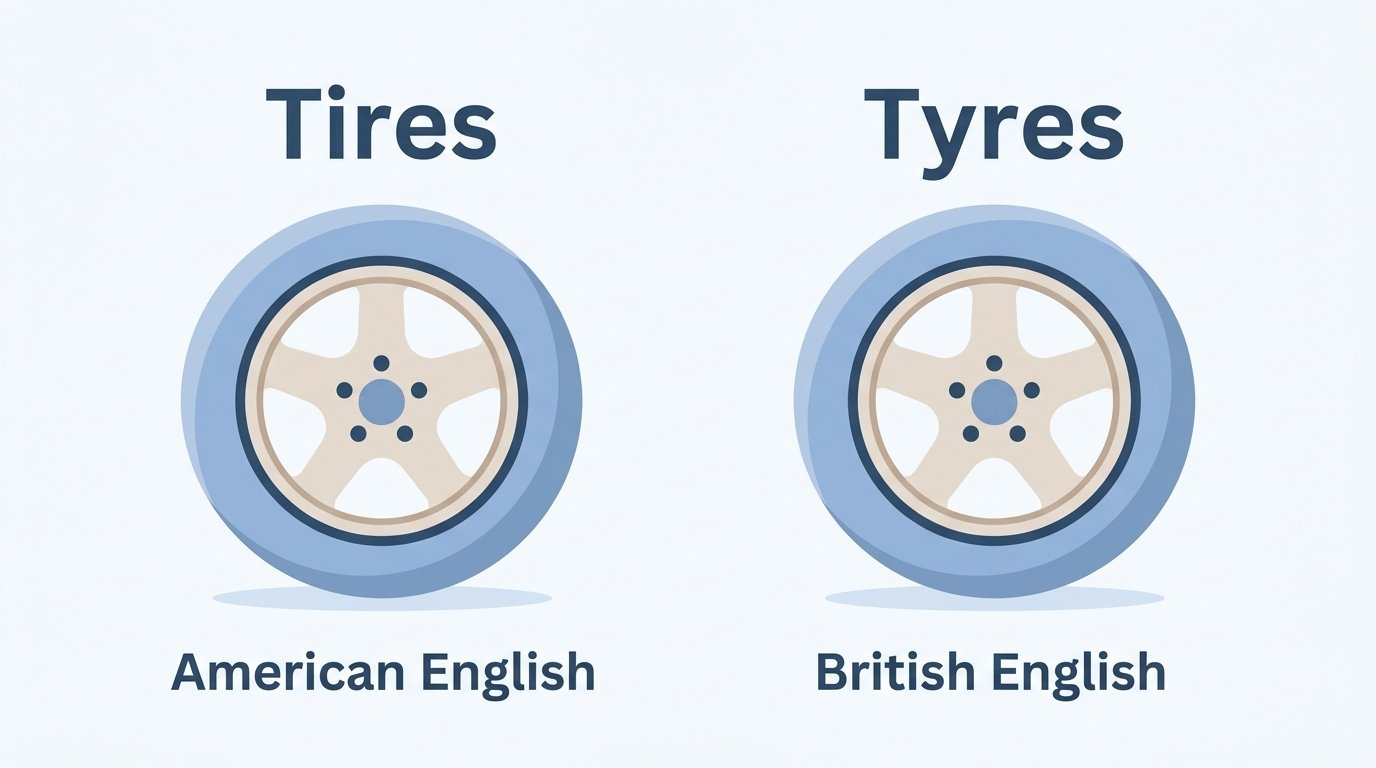
Quick Ans: Tyres or tires are both correct spellings, but they belong to different varieties of English. “Tires” is used in American English, while “tyres” is standard in British English. Both words have the same meaning, so your choice depends on your audience and the type of English you are using.
Have you ever wondered whether to write “tyres or tires”? The answer is simple, but the difference can matter in writing.
Both words refer to the rubber covering around a vehicle wheel. The meaning does not change. Only the spelling changes between regional forms of English.
American English normally uses “tires.” British English uses “tyres.” You will also find “tyres” in countries such as Australia and New Zealand.
For students, ESL learners, bloggers, and professional writers, knowing this difference helps avoid inconsistent spelling. It also matters when writing for a specific country. A US website should normally follow American spelling, while a UK website should follow British spelling.
Neither form is wrong. The important thing is to know your audience and use one spelling consistently.
Quick Answer and Key Takeaway
| Spelling | English Variety | Example |
|---|---|---|
| Tires | American English | I need new tires. |
| Tyres | British English | I need new tyres. |
The main rule is easy: use “tires” for American English and “tyres” for British English.
Definition and Explanation
Tires
“Tires” is the plural noun used in American English for the rubber coverings fitted around vehicle wheels.
Example: The mechanic replaced the tires.
Tyres
“Tyres” is the British English spelling of the same noun.
Example: The mechanic replaced the tyres.
| Feature | Tires | Tyres |
|---|---|---|
| Meaning | Vehicle wheel covering | Vehicle wheel covering |
| Singular | Tire | Tyre |
| Plural | Tires | Tyres |
| Common usage | US English | UK English |
Both forms mean exactly the same thing. The difference is spelling, not meaning. Choose the form that matches your target variety of English.
Is This a Grammar, Usage, or Vocabulary Issue?
This is mainly a spelling and usage difference. Both words are nouns when they refer to vehicle wheels.
In American English, “tire” and “tires” are standard. In British English, “tyre” and “tyres” are standard.
The terms are interchangeable in meaning, but they should not be mixed randomly. Consistent spelling makes your writing look more professional.
Real World Usage Examples
Workplace Example
The company needs to replace the truck tires before winter.
In British English, the sentence would use “tyres.”
Academic Example
The study examined how tire pressure affects fuel efficiency.
A British academic paper would normally use “tyre pressure.”
Everyday Example
I need to buy new tires before my road trip.
A British speaker would usually say, “I need to buy new tyres.”
Regional or Global Usage Differences
American English uses “tire” and “tires.” British English uses “tyre” and “tyres.”
Australian and New Zealand English generally follow British spelling and use “tyre.” Canadian English commonly uses “tire,” although usage can vary.
Therefore, always consider your audience. If you are writing for Americans, “tires” is the safer choice. For British, Australian, or New Zealand readers, “tyres” is generally preferred.
When NOT to Use It
Do not use “tyres” if your document follows standard American English.
Do not use “tires” in British English writing when your chosen style requires British spelling.
Avoid using both forms in the same article without a clear reason.
Do not assume “tyres” and “tires” have different meanings.
When quoting someone, do not change their original regional spelling.
Common Mistakes and Corrections
| Correct Sentence | Incorrect Sentence | Why |
|---|---|---|
| The car needs new tires. | The car needs new tyres. | Use “tires” in US English. |
| The car needs new tyres. | The car needs new tires. | Use “tyres” in UK English. |
| Check your tire pressure. | Check your tyre pressure. | “Tire” is standard in US English. |
| Check your tyre pressure. | Check your tire pressure. | “Tyre” is standard in UK English. |
Decision Rule: US audience means “tires.” UK audience means “tyres.” Pick one and stay consistent.
Exercises With Answers
Choose the correct spelling.
- US English: My car needs new _____.
- UK English: Check your _____ before driving.
- US English: Low _____ pressure can be dangerous.
- UK English: These _____ are designed for wet roads.
- US English: The mechanic checked all four _____.
Answer Key
- tires
- tyres
- tire
- tyres
- tires
Related Concepts and Comparisons
You may also want to learn about American vs British English, color vs colour, center vs centre, realize vs realise, traveled vs travelled, practice vs practise, and other regional spelling differences.
FAQs
Are tyres and tires the same thing?
Yes. They have the same meaning when they refer to vehicle wheels. The difference is regional spelling.
Which is correct in American English, tyres or tires?
“Tires” is the standard American English spelling. Use it when writing for a US audience.
Which spelling is correct in British English?
“Tyres” is the standard British English spelling. It is also common in Australian and New Zealand English.
Is tyre British or American English?
“Tyre” is mainly used in British English. American English normally uses “tire.”
Is tire correct in British English?
British readers understand “tire,” but “tyre” is the standard spelling for the vehicle related meaning.
Do Australia and New Zealand use tyres or tires?
They generally use “tyres,” following British English spelling conventions.
Why do Americans spell tyre as tire?
American English developed its own spelling conventions over time. “Tire” became the standard American spelling for this word.
Should ESL learners use tyres or tires?
Use the spelling required by the English variety you are learning. If you study American English, choose “tires.” For British English, choose “tyres.”
Conclusion
The choice between “tyres or tires” is mainly a regional spelling difference. Both words refer to the same part of a vehicle, and neither is grammatically wrong.
American English uses “tires,” while British English uses “tyres.” Australian and New Zealand English generally use “tyres,” while Canadian English commonly uses “tires.”
For students and ESL learners, the easiest approach is to identify your target audience first. Then use the appropriate spelling throughout your writing.
Consistency is the key. Mixing American and British spelling can make an article look careless, even when every individual word is understandable.
Practical tip: before publishing your next article, search for both “tire” and “tyre.” If your audience is American, keep “tire.” If your audience is British, keep “tyre.”
3 thoughts on “Tyres or Tires: Which Spelling Is Correct?”