
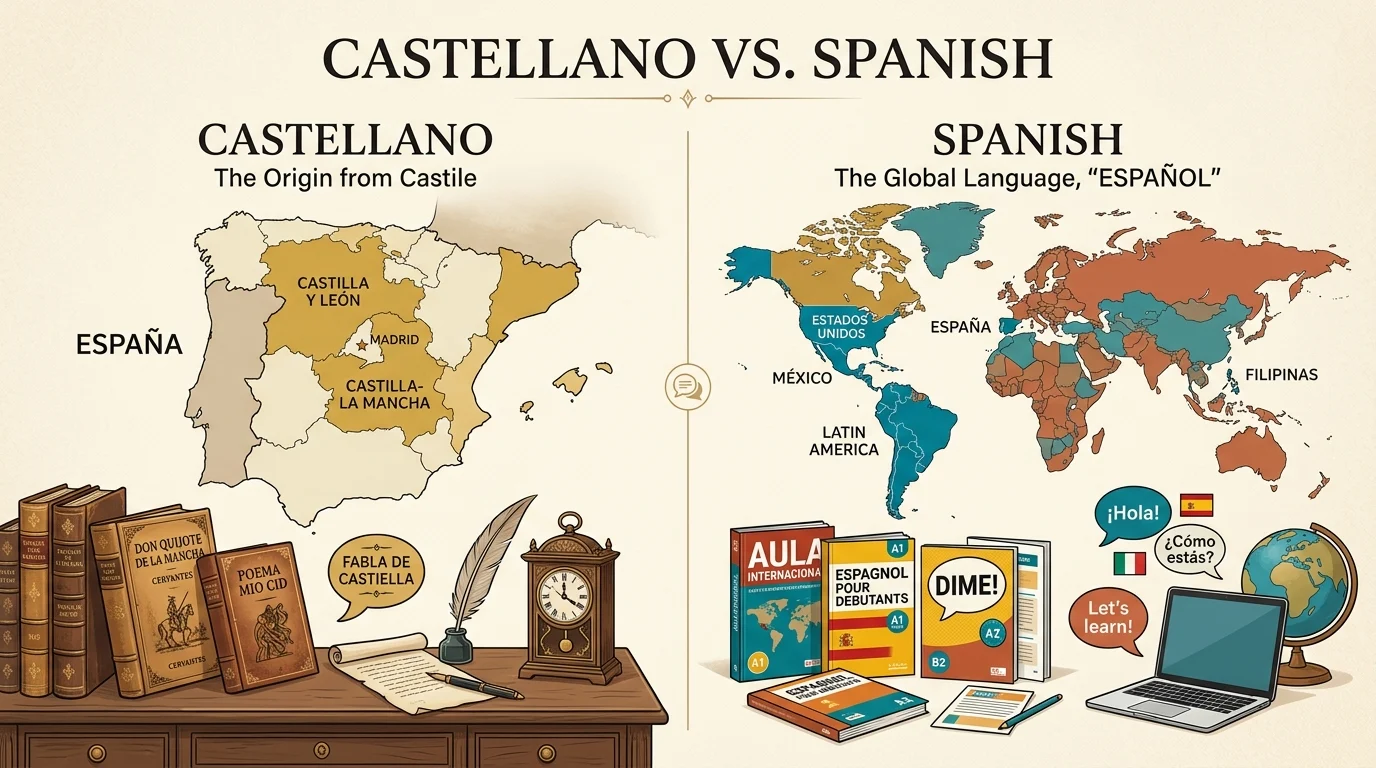
Quick Ans: Castellano and Spanish generally refer to the same language, but the terms can carry different meanings depending on context. Castellano is often used to refer to the language that developed in the Castile region of Spain, while Spanish is the broader international name for the language. Both terms can refer to modern Spanish.
Castellano vs Spanish is a common question for Spanish learners who encounter both terms in books, courses, dictionaries, and conversations. At first, the two words may seem to describe completely different languages. In most contexts, however, they refer to the same language.
The difference mainly comes from history, geography, and naming preferences. Castellano comes from Castilla, the historical region of Castile in Spain. The variety associated with Castile developed into what is now commonly called Spanish.
The word Spanish, meanwhile, is the name most commonly used internationally for the language spoken in Spain and throughout much of Latin America. However, speakers in Spain may use castellano when discussing the language, especially when distinguishing it from other languages spoken in Spain.
Understanding this distinction can make conversations about Spanish much easier and can help you understand why different speakers use different names for the same language.
Quick Answer and Key Takeaway
Castellano and Spanish usually refer to the same language. The main difference is how the terms are used. Castellano emphasizes the language’s Castilian historical origin, while Spanish is the common international name. In Spain, castellano can also be used to distinguish Spanish from languages such as Catalan, Basque, and Galician.
Castellano vs Spanish: Definition and Explanation
What Does Castellano Mean?
Castellano literally relates to Castile. Historically, it referred to the Romance variety that developed in the Kingdom of Castile.
Today, Spanish speakers may use castellano as another name for Spanish.
For example:
¿Hablas castellano?
This can simply mean:
Do you speak Spanish?
The term is particularly common in Spain and in some Spanish speaking communities outside Spain.
What Does Spanish Mean?
Spanish is the English name for the language. In Spanish, the corresponding word is español.
For example:
Do you speak Spanish?
means:
¿Hablas español?
In international contexts, Spanish is usually the easiest and most widely understood term.
Is This a Grammar, Usage, or Vocabulary Issue?
Castellano vs Spanish is primarily a vocabulary and usage distinction.
The two terms don’t normally represent two separate modern languages. Instead, they reflect different naming traditions and contexts.
There can also be regional differences in how people prefer to name the language. In Spain, castellano is widely used, while español is also common. In many other countries, español is the normal Spanish term.
Real World Usage Examples
Everyday Conversation
Spanish:
I am learning Spanish.
Castellano:
Estoy aprendiendo castellano.
Both can communicate essentially the same idea.
Recap: The preferred term can depend on the speaker and region.
Education
You may see courses described as:
Spanish language course
or:
Curso de castellano
Both can refer to learning Spanish.
Recap: Educational materials may use either term depending on their audience and location.
Travel and Communication
A traveler in Spain might hear someone say:
Aquí hablamos castellano.
This means that Spanish is spoken there, but the choice of castellano can also reflect Spain’s multilingual environment.
Recap: In Spain, the term can help distinguish Spanish from other languages spoken in the country.
Castellano vs Spanish: Key Differences
| Feature | Castellano | Spanish |
|---|---|---|
| Basic meaning | Related historically to Castile | International name for the language |
| Modern language | Usually Spanish | Spanish |
| Common in Spain | Yes | Yes |
| Common internationally | Less common in English | Very common |
| Historical connection | Strong connection to Castile | Broader modern name |
| Spanish equivalent | Castellano | Español |
The terms can overlap significantly. Context is important when interpreting them.
Regional or Global Usage Differences
The biggest difference appears in how speakers name the language.
In Spain, castellano is commonly used alongside español. Spain is multilingual, with languages such as Catalan, Basque, and Galician also spoken in different regions. Because of this, some speakers use castellano to specifically identify Spanish as opposed to another language of Spain.
In much of Latin America, español is generally the more familiar term, although castellano is also understood and used in some countries and contexts.
In English, Spanish is overwhelmingly the standard term.
When NOT to Use Castellano or Spanish
Avoid assuming that the two terms always have exactly the same intended meaning in every discussion.
- Don’t automatically interpret castellano as meaning only the Spanish spoken in modern Castile.
- Don’t assume everyone in Spain prefers one term.
- Don’t use Spanish when someone is specifically discussing historical varieties or linguistic development without considering the context.
- Don’t assume that all Spanish varieties are identical.
- Don’t treat Spanish spoken in Spain and Latin America as completely separate languages.
The language has many regional varieties, accents, vocabulary choices, and pronunciation differences.
Common Mistakes and Corrections
| Correct Sentence | Incorrect Assumption | Why |
|---|---|---|
| Castellano can mean Spanish. | Castellano is always a different language. | The terms commonly overlap. |
| Spanish is spoken throughout Latin America. | Only Spain speaks Spanish. | Spanish is spoken across many countries. |
| People in Spain may say castellano. | Everyone in Spain uses only español. | Both terms are used. |
| Spanish has regional varieties. | Every Spanish speaker uses identical vocabulary. | Regional differences exist. |
Easy Decision Rule
When speaking English, use Spanish because it is the standard and most widely understood term.
When discussing Spanish terminology in Spain, you’ll often encounter castellano and español. The correct interpretation depends on the context.
Exercises With Answers
Choose Castellano or Spanish for each situation.
- The most common English name for the language.
- A term strongly associated with Castile.
- A word you may commonly hear in Spain.
- The language name most familiar to international English speakers.
- A term that can refer to the same modern language as Spanish.
Answers
- Spanish
- Castellano
- Castellano
- Spanish
- Castellano
Related Concepts and Comparisons
Castellano vs Español
Castellano and español can both refer to Spanish. The preferred term varies by region, context, and speaker.
Spanish vs Latin American Spanish
Latin American Spanish isn’t one single variety. Spanish differs across countries in pronunciation, vocabulary, grammar, and everyday expressions.
Castilian Spanish vs Spanish
In some English contexts, Castilian Spanish can refer to varieties associated with Spain, particularly central or northern Spain. However, Castilian can have different meanings depending on the linguistic context.
FAQs
Is Castellano the same as Spanish?
In most modern contexts, yes. Castellano is commonly used as another name for Spanish, especially in Spain.
Why do Spaniards say Castellano instead of Spanish?
Some people in Spain use castellano because it refers historically to Castile and can distinguish Spanish from other languages spoken in Spain.
Is Castellano Spanish from Spain?
The term has historical roots in Castile and is commonly used in Spain for the Spanish language. However, castellano does not necessarily mean every variety of Spanish spoken in Spain.
Which is correct, Castellano or Spanish?
Both can be correct. Spanish is the standard English name, while castellano is widely used in Spanish, particularly in Spain.
Is Castellano spoken in Latin America?
Yes. The term castellano is used in some Latin American countries and contexts, although español is also widely used.
Does Castellano mean European Spanish?
Not necessarily. The word has a historical connection to Castile, but modern usage can simply mean Spanish.
Is Castellano a different language from Spanish?
Generally, no. The two terms commonly refer to the same language, although linguistic discussions may use Castilian more specifically when discussing particular varieties or historical development.
Why are Spanish and Castellano both used?
The names developed from different historical and cultural contexts. Castellano highlights the Castilian origin of the language, while Spanish refers more broadly to the national and international language.
Conclusion
Castellano vs Spanish is mainly a question of language naming rather than two completely different languages. In modern usage, castellano and Spanish commonly refer to the same language.
The important difference is context. Castellano has a strong historical connection to Castile and is widely used in Spain. It can also help distinguish Spanish from other languages spoken within Spain. Spanish, meanwhile, is the standard English term and is widely recognized around the world.
You may also encounter español, which is the Spanish word commonly translated as “Spanish.” Both español and castellano can refer to the language, although individual speakers and regions may have different preferences.
For everyday English writing, the simplest choice is Spanish. If you’re discussing Spanish terminology, Spanish history, or language use in Spain, knowing the word castellano will help you understand what native speakers mean.
The practical tip is simple: Spanish is the safest international term, while castellano is an important alternative name you’ll frequently encounter in Spanish speaking contexts.
2 thoughts on “Castellano vs Spanish: What’s the Difference? Simple Guide & Examples”