
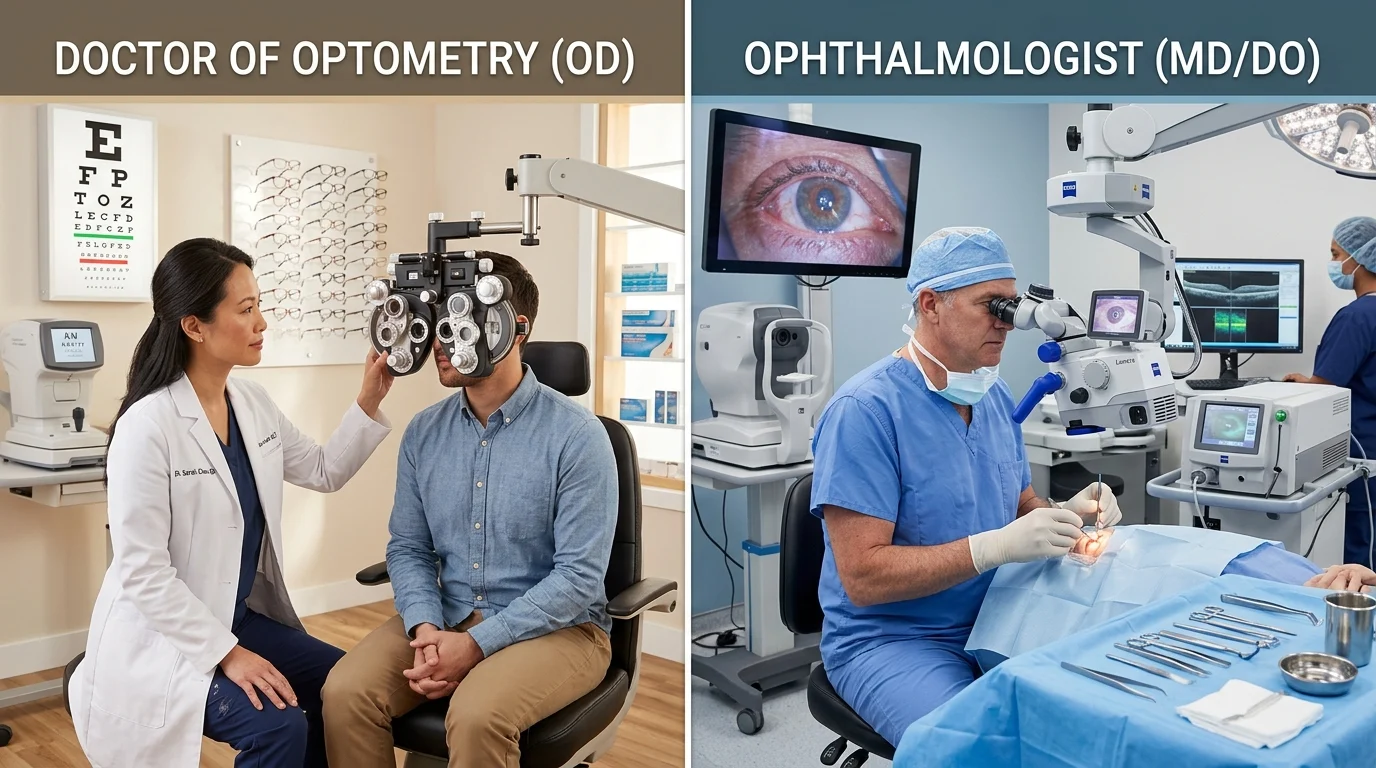
Quick Ans: OD and ophthalmologist are related eye care terms, but they are not exactly the same. OD usually refers to a Doctor of Optometry, a professional who provides vision care, eye exams, and treats many common eye conditions. An ophthalmologist is a medical doctor who can provide eye care, perform surgery, and treat complex eye diseases.
OD vs ophthalmologist can be confusing because both professionals work with eye health and vision. However, their education, training, and scope of practice are different.
An OD, or Doctor of Optometry, is a licensed eye care professional who examines eyes, checks vision, prescribes glasses and contact lenses, and diagnoses and manages many eye conditions. Optometrists can also provide treatment for certain eye diseases depending on local laws.
An ophthalmologist is a medical doctor who specializes in eye care. In addition to examining and treating eyes, ophthalmologists can perform eye surgery and manage complex medical conditions affecting the eyes.
Knowing the difference can help you understand which type of eye care professional may be appropriate for a particular situation. The exact scope of practice can vary by location, so patients should also check local regulations and provider qualifications.
Quick Answer and Key Takeaway
The main difference is medical training and scope of practice.
| OD | Ophthalmologist |
|---|---|
| Doctor of Optometry | Medical doctor specializing in eye care |
| Performs eye exams | Performs comprehensive eye exams |
| Prescribes glasses and contacts | Prescribes glasses and contacts |
| Treats many eye conditions | Treats eye diseases and complex conditions |
| Does not generally perform eye surgery | Can perform eye surgery |
| Focuses heavily on vision and eye care | Provides medical and surgical eye care |
In simple terms, an OD focuses on vision and primary eye care, while an ophthalmologist provides medical and surgical eye care.
OD vs Ophthalmologist: Definition and Explanation
What Does OD Mean?
OD stands for Doctor of Optometry. An OD is a healthcare professional who completes professional optometry education and training.
Optometrists commonly perform eye examinations, evaluate vision, prescribe corrective lenses, and diagnose and manage many eye conditions.
Depending on the jurisdiction, an OD may also prescribe medications for certain eye conditions.
What Is an Ophthalmologist?
An ophthalmologist is a medical doctor who specializes in eye and vision care.
Ophthalmologists can diagnose and treat eye diseases, prescribe medications, provide vision correction, and perform surgical procedures involving the eyes.
Some ophthalmologists also complete additional fellowship training in areas such as retina, glaucoma, cornea, pediatric ophthalmology, or oculoplastic surgery.
Is This a Grammar, Usage, or Vocabulary Issue?
OD vs ophthalmologist is primarily a medical terminology comparison.
The confusion often comes from the fact that both professionals can perform eye examinations and provide treatment. However, their professional training and scope of practice are different.
Also, OD is an abbreviation, while ophthalmologist is the name of a medical specialty and profession.
Real World Usage Examples
Routine Eye Exam
I scheduled an appointment with an OD for a routine eye examination.
An OD commonly provides routine vision and eye care.
Recap: An OD can be an appropriate provider for routine eye care.
Eye Disease
The patient was referred to an ophthalmologist for further evaluation of an eye condition.
Ophthalmologists manage many medical eye conditions, including complex cases.
Recap: More complicated eye conditions may require an ophthalmologist.
Eye Surgery
She saw an ophthalmologist before having cataract surgery.
Ophthalmologists are trained to perform eye surgery.
Recap: Eye surgery is a major distinction between the two professions.
Regional or Global Usage Differences
The terms OD and ophthalmologist are widely used, but their exact roles and prescribing or treatment rights can vary by country and jurisdiction.
In the United States, optometrists are Doctors of Optometry, while ophthalmologists are medical doctors. State laws determine the specific scope of optometric practice.
Other countries may use different professional titles, training systems, and licensing requirements. Therefore, the exact duties of an OD should always be checked according to the relevant local regulations.
When NOT to Use Each Term
Do not automatically use OD when:
- You specifically mean a medical doctor specializing in ophthalmology.
- You are describing an eye surgeon.
- You are referring to a specialist treating a complex surgical eye condition.
Do not automatically use ophthalmologist when:
- You simply mean an optometrist.
- You are describing a routine vision examination performed by an OD.
- The professional you are referring to is specifically licensed as an optometrist.
The terms describe different professional roles.
Common Mistakes and Corrections
| Correct Sentence | Incorrect Sentence | Why |
|---|---|---|
| I visited an OD for a routine eye exam. | I visited an ophthalmologist for every routine vision check. | An OD commonly provides routine eye care. |
| The ophthalmologist performed eye surgery. | The OD performed the surgery. | Ophthalmologists are trained as eye surgeons. |
| My OD prescribed contact lenses. | My ophthalmologist is the only professional who can prescribe contacts. | Both may prescribe corrective lenses. |
| The patient was referred to an ophthalmologist for complex treatment. | Every eye problem requires an ophthalmologist. | Many routine issues can be managed by an OD. |
Easy Decision Rule
Think of the difference this way:
OD = optometry and primary vision care
Ophthalmologist = medical and surgical eye care
For a specific medical problem, the appropriate provider depends on the condition, local regulations, and the provider’s qualifications.
Exercises With Answers
Choose OD or ophthalmologist.
- A patient needs a routine vision examination.
- A patient needs cataract surgery.
- A patient wants a new contact lens prescription.
- A patient needs specialized surgical treatment for an eye disease.
- A patient wants a professional to check their general vision.
Answers
- OD
- Ophthalmologist
- OD
- Ophthalmologist
- OD
Related Concepts and Comparisons
OD vs Optometrist
An OD is a Doctor of Optometry, so the terms commonly refer to the same professional. Optometrist describes the profession, while OD identifies the professional degree.
Optometrist vs Ophthalmologist
An optometrist primarily provides vision and eye care, while an ophthalmologist is a medical doctor who can provide medical and surgical eye care.
Ophthalmologist vs Optician
An ophthalmologist diagnoses and treats eye conditions. An optician generally helps fit and dispense eyeglasses and other corrective eyewear based on prescriptions.
FAQs
Is an OD the same as an ophthalmologist?
No. OD usually means Doctor of Optometry, while an ophthalmologist is a medical doctor specializing in eye care. Their training and scope of practice differ.
What is the difference between an OD and an ophthalmologist?
An OD provides optometric and vision care, while an ophthalmologist provides medical and surgical eye care. Both can perform eye examinations and prescribe corrective lenses.
Can an OD perform eye surgery?
Generally, optometrists do not perform the types of eye surgery performed by ophthalmologists. Specific scope of practice depends on local laws and regulations.
Should I see an OD or ophthalmologist for glasses?
An OD can perform an eye examination and prescribe glasses or contact lenses. An ophthalmologist can also provide vision prescriptions.
Is an OD a medical doctor?
OD stands for Doctor of Optometry. It is a professional doctorate in optometry, but it is different from an MD degree held by an ophthalmologist.
Can an ophthalmologist prescribe glasses?
Yes. Ophthalmologists can prescribe glasses and contact lenses when appropriate, in addition to providing medical and surgical eye care.
Who treats complex eye diseases, an OD or ophthalmologist?
Both professionals can manage certain eye conditions, but ophthalmologists have medical and surgical training for complex eye diseases. Referral may depend on the specific condition.
What does OD mean after an eye doctor’s name?
OD means Doctor of Optometry. It indicates that the professional holds a degree in optometry.
Conclusion
OD vs ophthalmologist becomes much easier to understand when you focus on professional training and scope of practice. An OD, or Doctor of Optometry, primarily provides vision care, eye examinations, corrective lens prescriptions, and management of many common eye conditions.
An ophthalmologist is a medical doctor who specializes in eye care and can diagnose eye diseases, prescribe treatment, and perform eye surgery. Both professionals play important roles in maintaining eye health, and their services can overlap in several areas.
The right professional depends on what type of care you need. Routine vision care may often be handled by an OD, while complex medical or surgical problems may require an ophthalmologist. However, licensing rules and professional responsibilities vary by location.
When choosing an eye care provider, check the professional’s qualifications, the type of care you need, and the regulations that apply where you live. That approach will help you understand whether an OD or ophthalmologist is the appropriate point of care.