
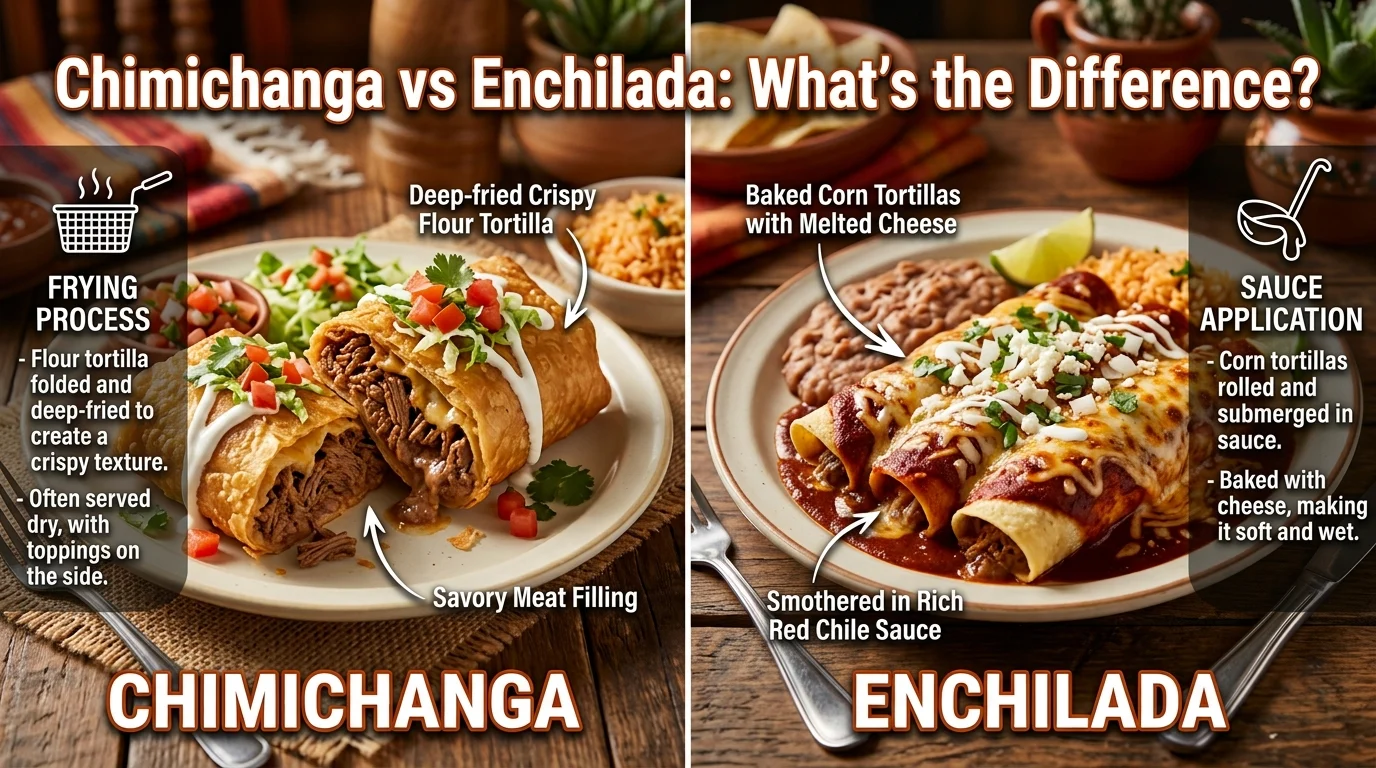
Quick Ans: A chimichanga and an enchilada are both popular Mexican and Mexican American dishes, but they differ mainly in preparation. A chimichanga usually contains a filling wrapped in a flour tortilla and deep fried until crispy. An enchilada usually uses a corn tortilla, rolls around a filling, and gets covered with chili based sauce.
Chimichanga vs enchilada can be confusing because both dishes may contain similar ingredients. You can find chicken, beef, beans, cheese, and vegetables in either one. However, their preparation creates a clear difference.
A chimichanga usually starts with a flour tortilla. The cook fills and folds the tortilla, then deep fries it until the outside becomes golden and crispy. Restaurants often serve it with cheese, salsa, sour cream, guacamole, or other toppings.
An enchilada usually uses a corn tortilla. The cook fills and rolls the tortilla before covering it with chili based sauce. The dish then gets baked or heated until everything comes together.
Therefore, the biggest difference isn’t the filling. Instead, look at the tortilla, cooking method, texture, and sauce. These features make the two dishes easier to recognize.
Quick Answer and Key Takeaway
| Feature | Chimichanga | Enchilada |
|---|---|---|
| Tortilla | Usually flour | Usually corn |
| Preparation | Usually deep fried | Usually baked or heated with sauce |
| Texture | Crispy | Soft and saucy |
| Sauce | Often added as a topping or served separately | Usually covers the tortilla |
| Common fillings | Meat, beans, cheese, rice | Meat, beans, cheese, vegetables |
Key takeaway: Think crispy and fried when you see a chimichanga. Think soft, rolled, and saucy when you see an enchilada.
Definition and Explanation
What Is a Chimichanga?
A chimichanga is a filled tortilla that the cook folds and deep fries. The dish commonly appears in Mexican American cuisine, especially in the Southwestern United States.
Common fillings include seasoned beef, chicken, beans, rice, and cheese. After frying, restaurants may add salsa, sour cream, guacamole, or cheese.
Most importantly, the crispy fried exterior gives a chimichanga its distinctive character.
What Is an Enchilada?
An enchilada consists of a filled tortilla that gets rolled and covered with sauce. Traditional versions commonly use corn tortillas.
The filling can include meat, cheese, beans, vegetables, or several ingredients together. Meanwhile, the sauce often contains chili peppers and other seasonings.
Unlike a chimichanga, an enchilada usually has a soft tortilla and a generous layer of sauce.
Is This a Grammar, Usage, or Vocabulary Issue?
This comparison involves food vocabulary, not grammar.
The words chimichanga and enchilada identify different dishes. You may see both terms on restaurant menus, recipes, food blogs, and cooking websites.
Although the dishes can share ingredients, their names aren’t interchangeable. Knowing the difference helps you understand menus and describe food more accurately.
Real World Usage Examples
Restaurant Menus
A restaurant might describe a chimichanga as a crispy fried flour tortilla filled with chicken, beans, and cheese.
By contrast, an enchilada may appear as a rolled corn tortilla filled with beef and covered in red or green sauce.
Recap: Menu descriptions often emphasize the chimichanga’s crisp exterior and the enchilada’s sauce.
Everyday Conversations
Someone might say, “I ordered a chicken chimichanga because I wanted something crispy.”
Meanwhile, another person might say, “I chose enchiladas because I wanted something soft and saucy.”
Recap: Texture often helps people explain why they prefer one dish over the other.
Cooking
When making a chimichanga, the cook fills and folds the tortilla before frying it.
When making enchiladas, the cook prepares the filling and sauce, rolls the tortillas, and then covers them with sauce.
Recap: The cooking methods differ even when both dishes contain similar fillings.
Regional or Global Usage Differences
Recipes can vary considerably by region and restaurant.
Chimichangas have strong associations with Mexican American and Southwestern cuisine. Restaurants may use different fillings, tortillas, toppings, and frying methods.
Enchiladas have a much longer and broader history within Mexican cuisine. Different regions use their own combinations of tortillas, sauces, fillings, and cooking techniques.
As a result, you shouldn’t expect every chimichanga or enchilada to look exactly the same.
When NOT to Use It
Keep these points in mind:
- Don’t assume every filled fried tortilla qualifies as an enchilada.
- Don’t assume every enchilada uses red sauce.
- Don’t assume every chimichanga contains the same filling.
- Don’t use the two names interchangeably on a menu.
- Don’t assume enchiladas must contain meat.
- Don’t assume chimichangas always use identical toppings.
- Don’t identify a dish only by its filling. Preparation matters too.
Common Mistakes and Corrections
| Correct Sentence | Incorrect Sentence | Why |
|---|---|---|
| I ordered a crispy chicken chimichanga. | I ordered a crispy chicken enchilada. | The crispy fried tortilla suggests a chimichanga. |
| She covered the enchiladas with sauce. | She covered the chimichangas with sauce before frying them. | Sauce plays a central role in typical enchilada preparation. |
| The chimichanga was deep fried. | The chimichanga was simply rolled and baked. | Deep frying creates its characteristic crispy exterior. |
| The enchilada was soft and covered in sauce. | The enchilada was crispy from deep frying. | A typical enchilada has a soft, saucy texture. |
Simple Decision Rule
If the filled tortilla is fried until crispy, think chimichanga. If it’s rolled, covered with chili based sauce, and heated or baked, think enchilada.
Exercises With Answers
Identify the dish described below.
- A filled flour tortilla that gets deep fried.
- A rolled tortilla covered with chili based sauce.
- A dish known for its crispy exterior.
- A dish commonly made with a corn tortilla and sauce.
- A filled tortilla that may receive guacamole and sour cream after frying.
Answers
- Chimichanga
- Enchilada
- Chimichanga
- Enchilada
- Chimichanga
Related Concepts and Comparisons
Chimichangas and enchiladas belong to a larger group of tortilla based dishes. Because they can share ingredients, people sometimes confuse them with burritos and tacos as well.
A burrito generally contains a filling wrapped inside a tortilla. However, cooks don’t normally deep fry a standard burrito.
A taco usually contains a filling inside a folded tortilla and remains open or partially open. Therefore, its structure differs from both dishes.
Overall, focus on four clues: tortilla type, preparation, texture, and sauce.
FAQs
Is a chimichanga the same as an enchilada?
No. A chimichanga usually contains a filled tortilla that gets deep fried, while an enchilada usually contains a rolled tortilla covered with sauce.
Which is healthier, a chimichanga or enchilada?
That depends on the recipe, portion size, fillings, cheese, and sauces. However, deep frying can add more fat and calories than cooking methods that don’t involve deep frying.
Are chimichangas fried burritos?
A chimichanga resembles a fried burrito because both can contain a wrapped filling. However, restaurant recipes and definitions can vary.
Are enchiladas always made with corn tortillas?
Traditional enchiladas commonly use corn tortillas. However, some restaurants and modern recipes use flour tortillas instead.
What is usually inside a chimichanga?
Common fillings include chicken, beef, beans, rice, and cheese. The exact ingredients depend on the restaurant or recipe.
What is usually inside an enchilada?
An enchilada can contain meat, cheese, beans, vegetables, or a combination of ingredients. The cook then covers it with sauce.
Why is a chimichanga crispy?
The cook usually deep fries the filled tortilla. This process creates the golden and crispy exterior associated with chimichangas.
Why are enchiladas covered in sauce?
Sauce forms an important part of traditional enchilada preparation. It adds moisture, flavor, and seasoning to the rolled tortillas.
Conclusion
The main difference in chimichanga vs enchilada comes down to preparation, tortilla type, texture, and sauce. A chimichanga usually contains a filled flour tortilla that gets folded and deep fried. As a result, it develops a crispy and golden exterior.
An enchilada, on the other hand, usually starts with a corn tortilla. The cook fills and rolls it before covering it with chili based sauce and baking or heating the dish.
Both dishes can contain similar ingredients, including chicken, beef, beans, and cheese. Therefore, the filling alone doesn’t tell you which dish you’re eating.
The easiest way to remember the difference is to focus on texture. Crispy and fried usually points to a chimichanga. Soft, rolled, and saucy usually points to an enchilada.
Practical tip: When you’re unsure, check how the tortilla was prepared. That simple clue usually makes the difference clear.