
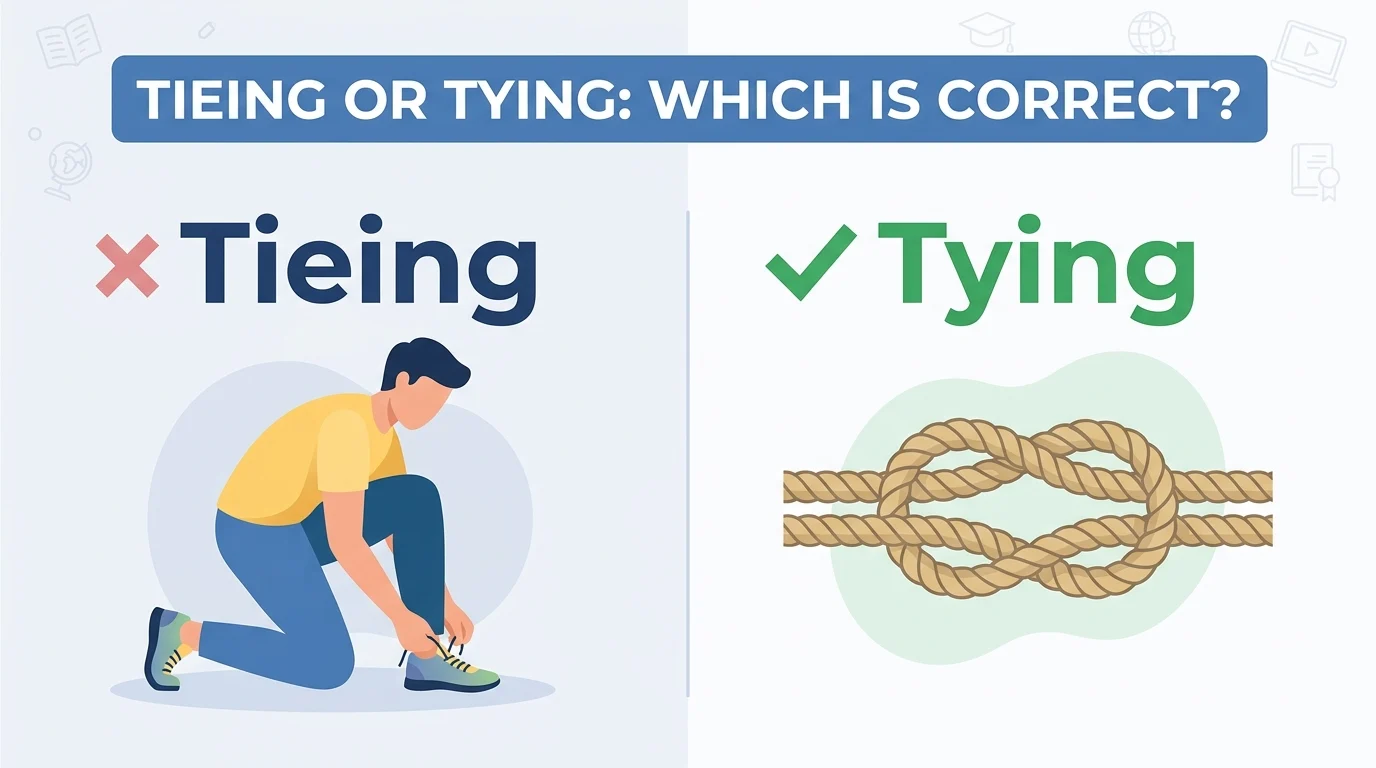
Quick Ans: Tying is the correct spelling. Tieing is incorrect because the verb tie changes to tying when adding the ending ing. The final e is removed before adding ing. For example, “She is tying her shoes.” Remember this simple rule: tie becomes tying, not tieing.
Tieing or tying is a common spelling confusion because many English verbs keep their final e when an ending is added. However, tie follows a different pattern.
The correct form is tying. The spelling tieing is incorrect in standard English.
The confusion happens because the base word tie already contains the letters “ie.” When you add ing, you might expect to write “tieing.” English spelling rules don’t work that way here. Instead, the final e is removed and the ie changes to y.
Knowing this rule helps you avoid mistakes in emails, school assignments, social media posts, and professional writing. Once you understand how tie changes before ing, the spelling becomes easy to remember.
Quick Answer and Key Takeaway
| Form | Correct? | Example |
|---|---|---|
| Tying | Yes | She is tying her shoes. |
| Tieing | No | She is tieing her shoes. |
Key takeaway: The correct spelling is tying. Never write tieing in standard English.
Definition and Explanation
Tying is the present participle and gerund form of the verb tie.
The verb tie means to fasten something with a knot, connect things, or attach something securely.
When you add ing, the spelling changes:
Tie → tying
The final e is removed, and the i changes to y.
Examples include:
- He is tying his shoelaces.
- She is tying a ribbon around the gift.
- They are tying the boat to the dock.
- I enjoy tying fishing knots.
The form tieing is not the standard spelling.
Is This a Grammar, Usage, or Vocabulary Issue?
This is mainly a spelling issue.
The grammar is straightforward. Tying can function as a present participle or gerund depending on the sentence.
For example:
Present participle: She is tying her hair.
Gerund: Tying a secure knot takes practice.
The important point is remembering the spelling transformation from tie to tying.
Real World Usage Examples
Workplace
Correct: The employee is tying the packages before shipping them.
Incorrect: The employee is tieing the packages before shipping them.
Recap: Use tying when describing an action happening now.
Academic Writing
Correct: Tying the variables together helps explain the relationship.
Incorrect: Tieing the variables together helps explain the relationship.
Recap: Academic writing also requires the standard spelling tying.
Everyday Writing
Correct: I’m tying my shoes before leaving.
Incorrect: I’m tieing my shoes before leaving.
Recap: The same spelling rule applies in everyday communication.
Regional or Global Usage Differences
There is no meaningful regional spelling difference between tying and tieing.
Tying is the standard spelling across major varieties of English, including American and British English.
Unlike words such as traveled and travelled, this isn’t a case where both spellings are standard regional variants.
| Word | Status |
|---|---|
| Tying | Correct |
| Tieing | Incorrect |
When NOT to Use It
Avoid tieing in these situations:
- Don’t write tieing when you mean the present participle of tie.
- Don’t assume every verb ending in e keeps the e before ing.
- Don’t use tieing in academic assignments.
- Don’t use tieing in professional emails or documents.
- Don’t change tying to tieing because the base word is spelled tie.
- Don’t confuse tying with tied, which is the past tense and past participle.
- Don’t confuse tying with tie, which is the base form.
Common Mistakes and Corrections
| Correct Sentence | Incorrect Sentence | Why |
|---|---|---|
| She is tying her shoes. | She is tieing her shoes. | The correct spelling is tying. |
| He is tying the rope. | He is tieing the rope. | Tie changes to tying before ing. |
| I am tying a knot. | I am tieing a knot. | The final e is removed and the spelling changes. |
| They are tying the boxes. | They are tieing the boxes. | Tieing is not the standard form. |
| Tying your hair is easy. | Tieing your hair is easy. | The gerund form is tying. |
Simple Decision Rule
Tie + ing = tying.
Think of it as a spelling change rather than simply adding ing to the word tie.
Exercises With Answers
Choose the correct form.
- She is ___ her shoelaces.
- He spent five minutes ___ the rope.
- They are ___ the boat to the dock.
- I am ___ a ribbon around the box.
- ___ your shoes properly can prevent accidents.
Answers
- tying
- tying
- tying
- tying
- Tying
Related Concepts and Comparisons
Several verbs follow similar spelling patterns when they change into forms ending in ing.
| Base Word | Correct Ing Form |
|---|---|
| tie | tying |
| lie | lying |
| die | dying |
These words are useful to learn together because they all change their spelling before ing.
For example:
lie → lying
die → dying
tie → tying
FAQs
Is tieing or tying correct?
Tying is correct. Tieing is not the standard English spelling.
Why is tying spelled with a y?
The spelling changes when tie takes the ing ending. The final e is removed, producing tying.
Is tieing ever correct in English?
No. In standard modern English, tying is the accepted spelling for the present participle and gerund of tie.
How do you spell tying correctly?
Spell it tying. Remember the pattern: tie → tying.
What is the difference between tie and tying?
Tie is the base form of the verb. Tying is its present participle or gerund form.
Is tying a verb or noun?
It can be either depending on the sentence. In “She is tying her shoes,” it is part of the verb phrase. In “Tying knots takes practice,” it functions as a gerund.
Is tying the same in British and American English?
Yes. Tying is the standard spelling in both major varieties of English.
Is lying spelled like tying?
They follow a similar spelling pattern. Lie becomes lying, just as tie becomes tying.
Conclusion
The correct spelling is tying, not tieing. Although tie contains a final e, you don’t simply add ing to create the present participle. Instead, the spelling changes from tie to tying.
This rule applies consistently in standard English. It doesn’t matter whether you’re writing for an American, British, or international audience. Tying is the accepted form.
You can also remember tying alongside lying and dying, which follow similar spelling patterns.
If you ever hesitate between tieing or tying, remember the simple formula: tie → tying.
Practical tip: Don’t spell the word by adding ing directly to tie. Remove the final e and change the spelling to tying.