
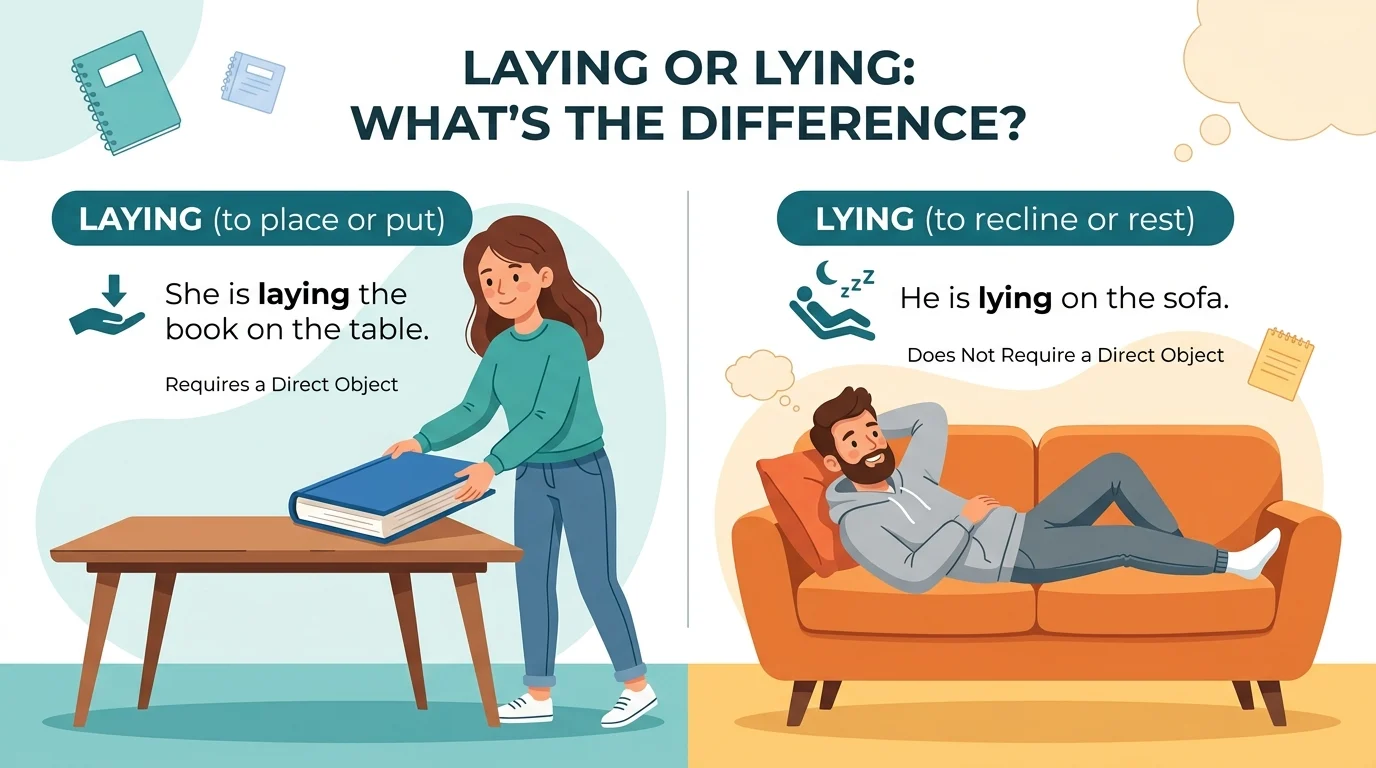
Quick Ans: Laying and lying are both correct words, but they have different meanings and grammatical uses. Laying usually means putting something down and needs an object, while lying usually means being in a resting or horizontal position. The key is simple: you lay something down, but you lie down yourself.
Laying or lying can confuse even experienced English speakers because both words come from similar verbs. However, they don’t mean the same thing, and choosing the wrong form can change your sentence.
The easiest way to remember the difference is to ask whether an object receives the action. If you are putting something somewhere, you are laying it down. If you are resting or reclining yourself, you are lying down.
For example, you can say, “She is laying the book on the table.” On the other hand, you can say, “She is lying on the sofa.” The first sentence has an object, the book, while the second describes a person’s position.
Once you understand this basic rule, the difference becomes much easier. Moreover, learning the related forms of lay and lie will help you avoid common mistakes in everyday and formal writing.
Quick Answer and Key Takeaway
| Word | Meaning | Example |
|---|---|---|
| Laying | Putting something somewhere | She is laying the book on the desk. |
| Lying | Resting or reclining | She is lying on the bed. |
Key takeaway: If you are putting something down, use laying. If you are resting yourself, use lying.
Definition and Explanation
What Does Laying Mean?
Laying comes from the verb lay, which means to put or place something somewhere.
Because lay normally takes an object, you need something that receives the action.
Examples:
- He is laying the keys on the table.
- She is laying the baby in the crib.
- They are laying the papers on the desk.
Here, keys, baby, and papers receive the action.
What Does Lying Mean?
Lying comes from the verb lie, which means to rest or remain in a horizontal position.
Unlike lay, lie doesn’t normally take a direct object.
Examples:
- I am lying on the sofa.
- She is lying in bed.
- The dog is lying on the floor.
Therefore, if the person or animal is simply resting, lying is usually the correct choice.
Is This a Grammar, Usage, or Vocabulary Issue?
This is mainly a grammar and verb usage issue. The confusion happens because lay and lie have different forms.
| Verb | Present | Past | Present Participle |
|---|---|---|---|
| Put something down | lay | laid | laying |
| Rest or recline | lie | lay | lying |
The unusual part is the past tense of lie. The past form is lay, which can make these verbs especially confusing.
For example:
- Present: I lie on the sofa.
- Past: Yesterday, I lay on the sofa.
- Continuous: I am lying on the sofa.
However:
- Present: I lay the book down.
- Past: I laid the book down.
- Continuous: I am laying the book down.
Real World Usage Examples
Workplace
Laying: She is laying the documents on the manager’s desk.
Lying: The employee is lying on the office sofa during a break.
Recap: Use laying when someone places something. Use lying when someone rests.
Academic Writing
Laying: The researcher is laying the samples on a clean surface.
Lying: The specimens are lying on the laboratory tray.
Recap: Look for the action and the object before choosing the verb.
Everyday Writing
Laying: I’m laying the clothes on the bed.
Lying: I’m lying on the bed.
Recap: You lay something, but you lie yourself down.
Regional or Global Usage Differences
Unlike many spelling differences, laying and lying don’t have a major regional difference. English speakers generally use the same grammatical distinction.
However, people sometimes use laying incorrectly when they mean lying, especially in casual conversation.
For instance:
Incorrect: I am laying on the couch.
Correct: I am lying on the couch.
The problem comes from the fact that lay sounds natural in phrases such as “lay down.” Nevertheless, standard grammar distinguishes the two verbs.
When NOT to Use It
Avoid these common mistakes:
- Don’t say “I am laying on the bed” when you mean that you are resting.
- Don’t use lying when you are placing an object somewhere.
- Don’t forget the object after laying when the sentence requires one.
- Don’t confuse laying with the past tense lay.
- Don’t assume that “lay down” always means laying is correct.
- Don’t use laid as the present participle of lay.
- Don’t use laying simply because the sentence describes someone being horizontal.
Common Mistakes and Corrections
| Correct Sentence | Incorrect Sentence | Why |
|---|---|---|
| I am lying on the couch. | I am laying on the couch. | You are resting, not placing something. |
| She is laying the book down. | She is lying the book down. | She is placing an object. |
| The dog is lying on the floor. | The dog is laying on the floor. | The dog is resting. |
| He is laying the baby in bed. | He is lying the baby in bed. | He is placing the baby somewhere. |
| We are lying in the grass. | We are laying in the grass. | We are resting in a horizontal position. |
Simple Decision Rule
If you can answer “laying what?” use laying. If you are describing someone or something resting, use lying.
Exercises With Answers
Choose laying or lying.
- She is ___ on the sofa.
- He is ___ the phone on the desk.
- The cat is ___ under the table.
- They are ___ the blankets on the bed.
- I am ___ down because I’m tired.
Answers
- lying
- laying
- lying
- laying
- lying
Related Concepts and Comparisons
Remember these four forms:
Lie → lay → lain → lying
Lay → laid → laid → laying
For example:
- I lie down every afternoon.
- Yesterday, I lay down for an hour.
- I have lain here since noon.
- I am lying on the couch.
Meanwhile:
- I lay the book on the table.
- Yesterday, I laid the book there.
- I have laid the papers on the desk.
- I am laying the papers down.
FAQs
Is laying or lying correct?
Both are correct, but they have different meanings. Laying means putting or placing something, while lying means resting or being in a horizontal position.
Should I say I am laying or lying down?
Use lying when you mean that you are resting yourself. Therefore, the standard sentence is “I am lying down.”
Is laying down grammatically correct?
Yes, when laying has an object. For example, “I am laying the book down” is correct because you are placing the book.
Why do people confuse laying and lying?
The verbs lay and lie have several forms that look and sound similar. Additionally, the past tense of lie is lay, which creates further confusion.
Is it laying on the bed or lying on the bed?
Use lying on the bed when you mean resting there. Use laying on the bed only when you are placing something on the bed.
What is the past tense of lie?
The past tense of lie, meaning to rest, is lay. For example, “Yesterday, I lay on the sofa.”
What is the past tense of lay?
The past tense of lay, meaning to place something, is laid. For example, “She laid the book on the table.”
Can I say I was laying down?
In standard grammar, use I was lying down when you mean that you were resting. Use laying when you are placing an object.
Conclusion
The difference between laying or lying becomes much easier when you focus on the action. Laying means putting or placing something somewhere, while lying means resting or remaining in a horizontal position.
For example, you can say, “I am laying the book on the table,” because the book receives the action. However, you should say, “I am lying on the sofa,” because you are describing your own position.
The verb forms can seem confusing because lay also serves as the past tense of lie. Therefore, learning the complete patterns helps you choose the right word more confidently.
Practical tip: Ask yourself, “Am I placing something?” If yes, use laying. If you’re simply resting, use lying.