
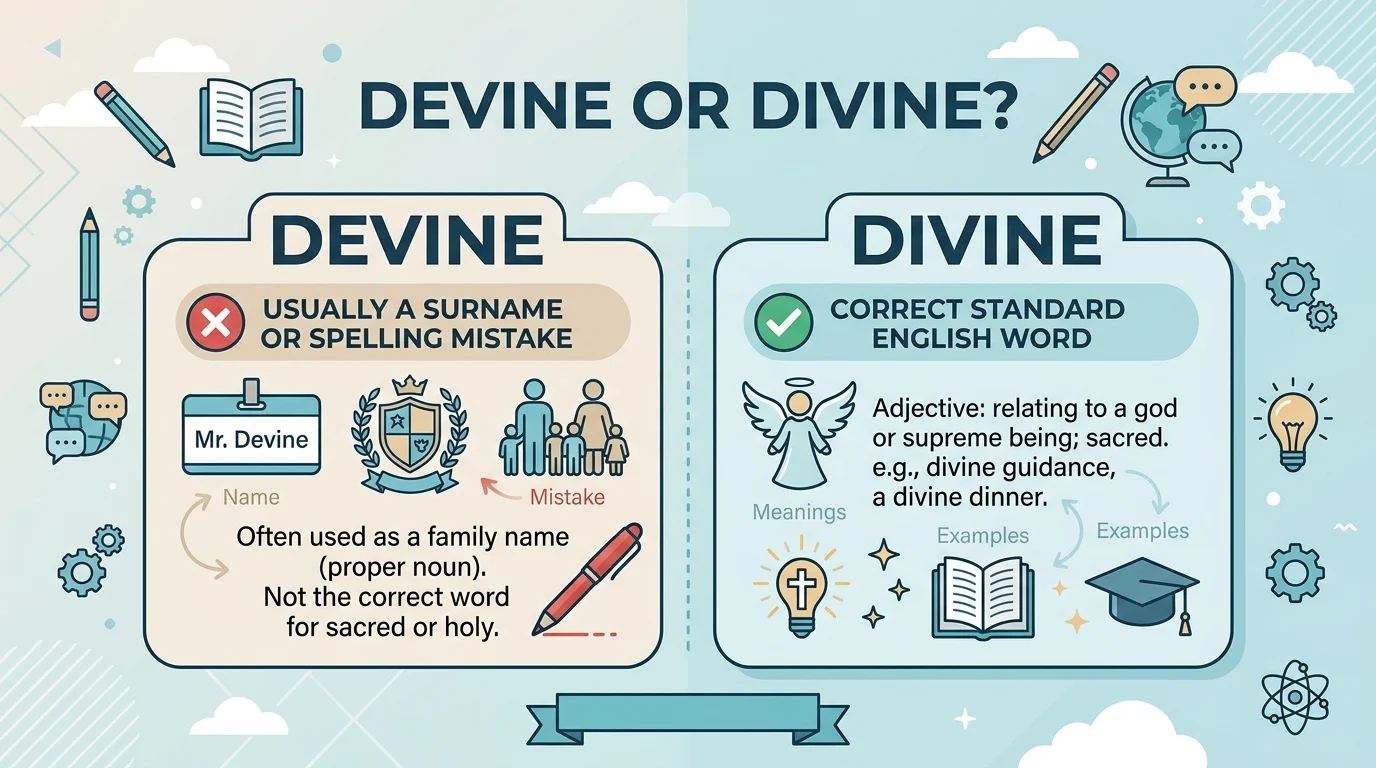
Quick Ans: “Divine” is the correct spelling when you mean something related to God, a deity, or something extremely beautiful or excellent. “Devine” is usually a misspelling of “divine,” although “Devine” can appear as a surname or proper name. For normal English writing, use “divine.”
Are you confused about whether to write “devine or divine”? The correct word in most English sentences is “divine.”
“Divine” has several meanings. It can describe something related to God or a deity. It can also describe something wonderful, beautiful, or excellent. As a verb, “divine” can mean to discover or guess something through intuition.
For example, you might write, “They believed the message was divine.” You could also say, “The dessert was divine,” meaning that it was extremely good.
“Devine,” with an e after the v, is usually a spelling mistake when someone intends to write “divine.” However, Devine can also be a surname or part of a proper name.
For ESL learners, students, and writers, the easiest rule is simple: use “divine” for the ordinary English word. Use “Devine” only when it is a person’s name or another proper name.
Quick Answer and Key Takeaway
| Word | Correct English Word? | Meaning |
|---|---|---|
| Divine | Yes | Related to God, or extremely wonderful |
| Devine | Usually no | Usually a misspelling, but can be a surname |
Remember: “divine” is the standard spelling of the English word.
Definition and Explanation
Divine
“Divine” can work as an adjective and a verb.
As an adjective, it means related to God or a deity.
Example: They believed the king had divine authority.
It can also mean wonderful or excellent.
Example: The chocolate cake was divine.
As a verb, “divine” means to discover something through intuition, guesswork, or special insight.
Example: Somehow, she divined the truth.
Devine
“Devine” is not normally the correct spelling of the common English word “divine.”
However, “Devine” can be a surname. For example, a person’s family name may be Devine. In that case, the capital letter matters because it is a proper name.
| Feature | Divine | Devine |
|---|---|---|
| Standard English word | Yes | No |
| Common meaning | Related to God or extremely wonderful | Usually a surname |
| Part of speech | Adjective and verb | Proper noun when used as a name |
| Example | Divine wisdom | Mr. Devine |
The main rule is easy. If you mean something holy, godlike, or wonderful, choose “divine.”
Is This a Grammar, Usage, or Vocabulary Issue?
This is mainly a spelling and vocabulary issue. “Divine” and “Devine” do not normally represent two different spellings of the same English word.
The word “divine” can have several meanings depending on context. It can describe religious ideas, something exceptionally good, or an act of discovering something through intuition.
By contrast, “Devine” usually appears as a surname or proper name. Therefore, capitalizing it can signal that you are referring to a person’s name.
Real World Usage Examples
Workplace Example
“The team delivered a divine customer experience” would sound unusual in a formal workplace report because “divine” is expressive. A more precise phrase might be “excellent customer experience.”
Recap: “Divine” can mean extremely excellent, but formal writing may prefer a more specific word.
Academic Example
“The researchers examined the concept of divine authority in ancient societies.”
Here, “divine” refers to a religious or god related idea.
Recap: Academic writing commonly uses “divine” when discussing religion, theology, or history.
Everyday Example
“That dessert was absolutely divine!”
Here, “divine” means extremely delicious or wonderful.
Recap: In casual English, “divine” can simply mean exceptionally good.
Regional or Global Usage Differences
“Divine” has the same standard spelling in American and British English. There is no major regional spelling difference.
The word also appears in many other varieties of English because it has both religious and general meanings.
“Devine” may appear in different countries as a surname. Its pronunciation can vary depending on the person or family, so you should not treat the surname as another spelling of the adjective “divine.”
When NOT to Use It
Do not write “devine” when you mean something related to God.
Do not assume that “Devine” is an acceptable alternative spelling in ordinary English.
Avoid using “divine” in formal writing when a more precise word would communicate your meaning better.
Do not change a person’s surname from “Devine” to “Divine.” Names should keep their correct spelling.
Common Mistakes and Corrections
| Correct Sentence | Incorrect Sentence | Why |
|---|---|---|
| They believed the power was divine. | They believed the power was devine. | “Divine” is the correct spelling. |
| The food was divine. | The food was devine. | “Divine” means extremely good here. |
| She studied divine law. | She studied devine law. | The adjective is spelled “divine.” |
| Mr. Devine called this morning. | Mr. Divine called this morning. | “Devine” can be a person’s surname. |
Decision Rule: If you mean holy, god related, or extremely wonderful, use “divine.” If “Devine” is someone’s name, keep the spelling “Devine.”
Exercises With Answers
Choose “divine” or “Devine.”
- The ancient people believed in _____ intervention.
- The dessert tasted _____.
- Mr. _____ sent an email yesterday.
- She studied _____ wisdom in the text.
- The word meaning “godlike” is _____.
- “Devine” can be used as a person’s _____.
Answer Key
- divine
- divine
- Devine
- divine
- divine
- surname
Related Concepts and Comparisons
Readers may also search for divine meaning, divine definition, divine vs godly, divine pronunciation, common spelling mistakes, adjective vs noun, proper nouns, religious vocabulary, and words commonly confused in English.
FAQs
Is devine or divine correct?
“Divine” is the correct spelling of the common English word. “Devine” is usually a spelling mistake, although it can be a surname.
What does divine mean?
“Divine” can mean related to God or a deity. It can also mean extremely wonderful, beautiful, or excellent.
Is Devine a real word?
“Devine” can be a real name, especially a surname. However, it is not normally the correct spelling when you mean the common adjective “divine.”
What is the difference between divine and Devine?
“Divine” is a standard English word, while “Devine” is usually a proper name. For example, “divine power” is correct, while “Devine” could refer to someone’s surname.
How do you spell divine correctly?
The standard spelling is “divine,” with an i after the v. A useful way to remember it is to connect “divine” with words such as “divinity” and “divine.”
Does divine mean beautiful?
It can. In informal English, “divine” can describe something extremely beautiful, enjoyable, or delicious. For example, “The cake was divine” means the cake was exceptionally good.
Is divine a noun or adjective?
“Divine” can be an adjective and a verb. As an adjective, it describes something related to God or something exceptionally good. As a verb, it means to discover or guess something through intuition.
Is divine used in religious writing?
Yes. “Divine” is common in religious, theological, and historical writing. Phrases such as “divine power” and “divine intervention” refer to God or a deity.
Conclusion
When choosing between “devine or divine,” remember that “divine” is the correct spelling for the ordinary English word. It can describe something related to God, a deity, or something exceptionally wonderful.
For example, “divine wisdom” refers to wisdom associated with God, while “the food was divine” means the food was extremely good. The same word can therefore appear in both religious and everyday contexts.
“Devine” is usually a spelling error when someone intends to write “divine.” However, it can also be a surname. In that situation, “Devine” is correct because proper names keep their own spelling.
The easiest way to avoid this mistake is to connect “divine” with “divinity.” Both words contain the same central spelling pattern.
Practical tip: if you mean holy, god related, or exceptionally wonderful, write “divine.” Only use “Devine” when you are referring to a proper name or another specific name that uses that spelling.