
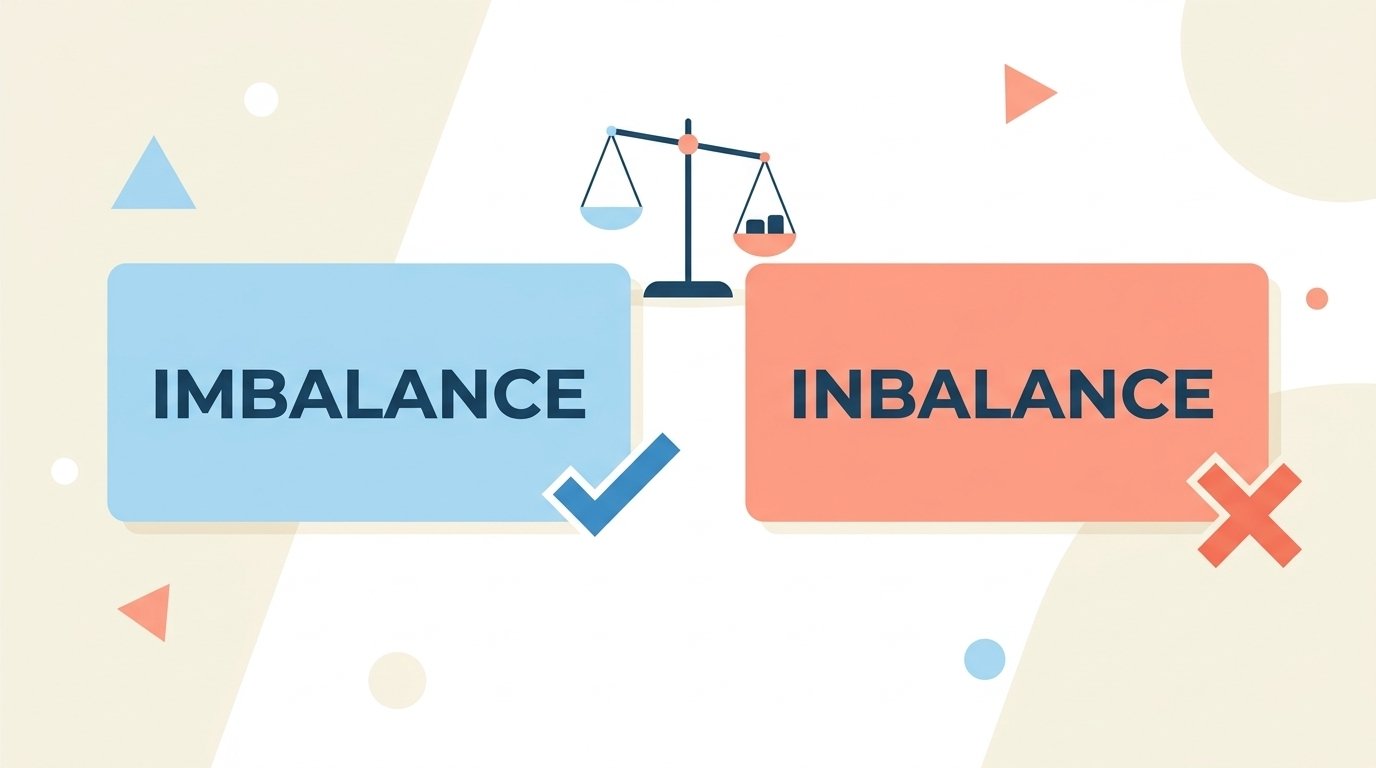
Quick Ans: “Imbalance” is the correct standard English word. “Inbalance” is generally incorrect when you mean a lack of balance, equality, or stability. Use “imbalance” in academic, professional, and everyday writing.
If you are wondering whether the correct spelling is inbalance or imbalance, the answer is “imbalance.” This word describes a situation where things are not equal, stable, or properly balanced.
You may see “inbalance” because English often uses the prefix “in” to create words with negative meanings. However, English spelling does not always follow that pattern. In this case, the accepted standard form is “imbalance.”
The word appears in many areas of English. You can talk about an imbalance of power, an imbalance between supply and demand, or an imbalance in resources. It is common in academic writing, business, economics, health discussions, and everyday communication.
For students and ESL learners, knowing the correct form can prevent a common spelling mistake. The rule is simple: when you mean a lack of balance, use “imbalance.”
Quick Answer and Key Takeaway
| Word | Correct? | Meaning |
|---|---|---|
| Imbalance | Yes | A lack of balance, equality, or stability |
| Inbalance | No, in standard usage | Usually a misspelling of “imbalance” |
The correct word is “imbalance.” Use it when something lacks balance, equality, proportion, or stability.
Definition and Explanation
Imbalance
“Imbalance” is a noun. It describes a situation in which two or more things are not equal, balanced, or properly proportioned.
Example: There is an imbalance between supply and demand.
The word can describe physical, financial, social, or abstract situations.
Examples include an imbalance of power, an imbalance in resources, and an imbalance between work and family life.
Inbalance
“Inbalance” is not the standard spelling of the noun. In most cases, it is simply a spelling mistake.
If you want to describe a lack of balance, write “imbalance.”
| Feature | Imbalance | Inbalance |
|---|---|---|
| Standard English | Yes | No |
| Part of speech | Noun | Not standard |
| Meaning | Lack of balance | Usually intended to mean “imbalance” |
| Best choice | Yes | No |
The main point is simple. “Imbalance” is the established English word, while “inbalance” should normally be avoided.
Is This a Grammar, Usage, or Vocabulary Issue?
This is mainly a spelling and vocabulary issue. “Imbalance” is the accepted noun, while “inbalance” is generally not accepted as the standard form.
The confusion may come from other words that begin with “in.” However, English prefixes do not always work by simply attaching “in” to another word.
In formal writing, academic assignments, business communication, and professional content, always use “imbalance.”
Real World Usage Examples
Workplace Example
The company has an imbalance between workload and available staff.
Here, “imbalance” describes an unequal situation.
Academic Example
The researchers examined the imbalance between energy consumption and production.
Academic writing often uses “imbalance” when comparing unequal levels.
Everyday Example
There is an imbalance between work and family time.
The word also sounds natural in everyday English.
Regional or Global Usage Differences
“Imbalance” is the standard form in major varieties of English, including American and British English.
Unlike “color” and “colour,” there is no common US and UK spelling difference for this word.
Whether you are writing for readers in the United States, United Kingdom, Australia, Canada, or another English speaking region, “imbalance” is the standard choice.
When NOT to Use It
Do not use “inbalance” when you mean a lack of balance.
Do not assume that adding “in” to “balance” creates the correct word.
Avoid “inbalance” in academic essays and professional documents.
Do not choose “inbalance” simply because it looks logical.
When you mean a lack of equality, stability, or proportion, use “imbalance.”
Common Mistakes and Corrections
| Correct Sentence | Incorrect Sentence | Why |
|---|---|---|
| There is an imbalance of power. | There is an inbalance of power. | “Imbalance” is the standard noun. |
| The study found an imbalance in resources. | The study found an inbalance in resources. | “Inbalance” is not standard. |
| An imbalance can affect performance. | An inbalance can affect performance. | Use “imbalance.” |
| The company has an imbalance between supply and demand. | The company has an inbalance between supply and demand. | “Imbalance” is the correct form. |
Decision Rule: When you mean a lack of balance, equality, or stability, always write “imbalance.”
Exercises With Answers
Choose the correct word.
- The report identified an _____ between supply and demand.
- An _____ of power can create problems.
- The study examined the _____ in resources.
- Which spelling is correct: inbalance or _____?
- The team noticed an _____ between workload and staff.
Answer Key
- imbalance
- imbalance
- imbalance
- imbalance
- imbalance
Related Concepts and Comparisons
Readers may also search for balance vs imbalance, imbalance meaning, imbalance definition, how to spell imbalance, imbalanced meaning, balanced vs unbalanced, unequal distribution, and common English spelling mistakes.
FAQs
Is inbalance or imbalance correct?
“Imbalance” is the correct standard English spelling. “Inbalance” is generally a misspelling and should be avoided in formal writing.
What does imbalance mean?
“Imbalance” means a lack of balance, equality, or proper proportion. It can describe physical, financial, social, or other situations.
Why is imbalance spelled with im instead of in?
The standard English form is “imbalance.” English spelling does not always follow a simple rule where “in” is added directly to another word.
Is imbalance one word or two words?
“Imbalance” is written as one word. You should not normally write it as “im balance.”
Is imbalance correct in American and British English?
Yes. “Imbalance” is standard in both American and British English. There is no common regional spelling difference.
What is the adjective form of imbalance?
The common adjective is “imbalanced.” For example, you can say, “The system is imbalanced.”
What is the opposite of imbalance?
The opposite is generally “balance.” Depending on context, words such as equality, stability, and equilibrium may also work.
How can ESL learners remember the correct spelling?
Remember that the standard noun is “imbalance,” with “im” at the beginning. If you mean a lack of balance, choose “imbalance.”
Conclusion
When choosing between “inbalance or imbalance,” always use “imbalance” in standard English. It is the correct noun for a situation where something lacks balance, equality, stability, or proper proportion.
The word is common in academic writing, business communication, news articles, and everyday English. You might read about an imbalance of power, an imbalance in resources, or an imbalance between two factors.
Although “inbalance” may seem logical because English uses “in” in many words, it is not the standard spelling for this meaning. The difference is also not related to American versus British English. Both varieties use “imbalance.”
For students and ESL learners, the easiest rule is simple. If you mean “a lack of balance,” write “imbalance.”
Practical tip: when proofreading your writing, search for “inbalance.” If you find it, replace it with “imbalance” unless you have a specific reason to use a different term.
6 thoughts on “Inbalance or Imbalance: Which Spelling Is Correct?”