
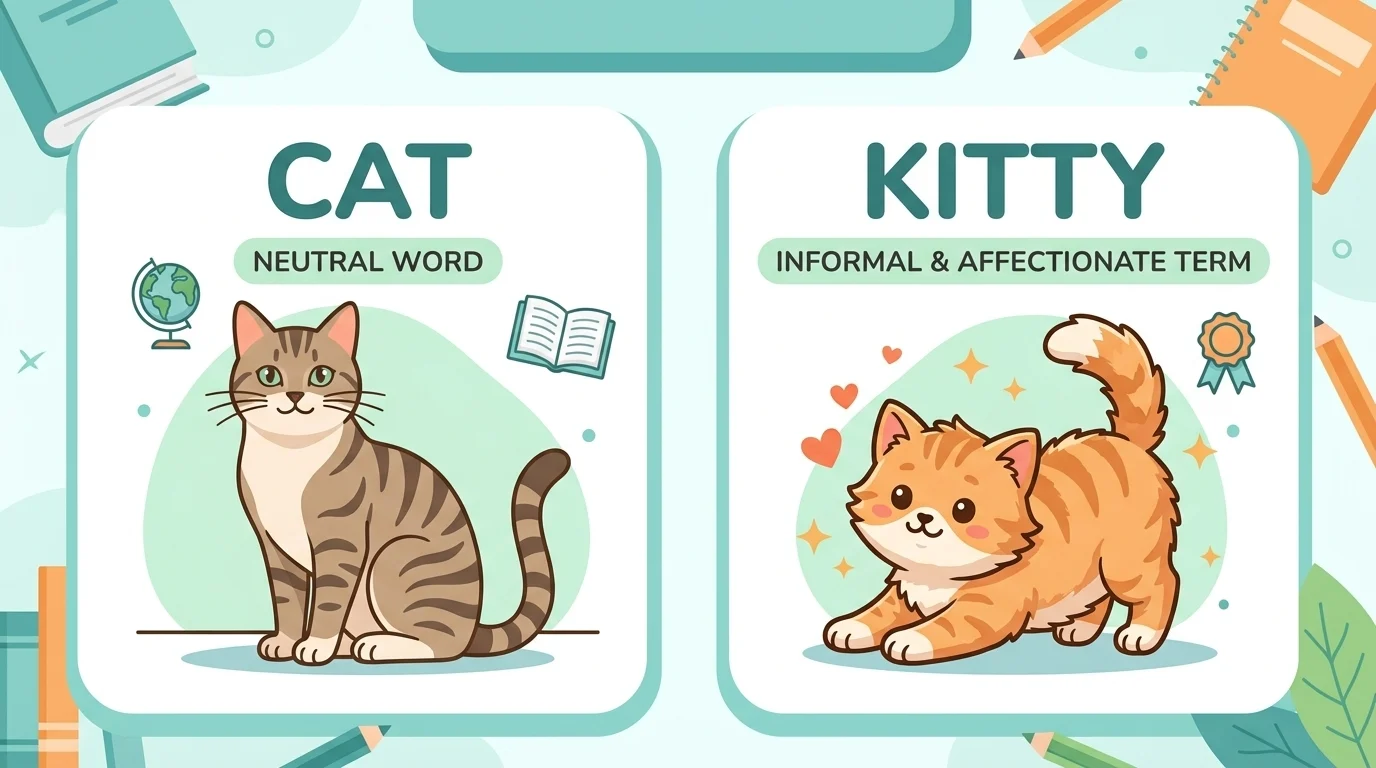
Quick Ans: “Kitty” and “cat” both refer to the same animal, but they have different tones. “Cat” is the standard and neutral word for the animal. “Kitty” is a more informal, affectionate, and often child friendly word. Choose “cat” for general or formal writing and “kitty” when you want a warm or playful tone.
Are you wondering about the difference between “kitty or cat”? Both words can describe a domestic feline, so their basic meaning is closely related. However, they do not always create the same feeling.
“Cat” is the normal English word for the animal. You can use it in everyday conversation, academic writing, news articles, and professional contexts. For example, “I have a cat” sounds neutral and natural.
“Kitty” has a softer and more affectionate tone. People often use it when talking to children, speaking lovingly about a pet, or describing a cat in a cute way. For example, “Look at that little kitty!” sounds warm and playful.
Therefore, the choice depends on context and tone. If you simply want the standard word, use “cat.” If you want to sound affectionate or playful, “kitty” can be a better choice.
Quick Answer and Key Takeaway
| Word | Meaning | Tone | Example |
|---|---|---|---|
| Cat | A feline animal | Neutral | I saw a cat outside. |
| Kitty | A cat | Informal and affectionate | The kitty is sleeping. |
“Cat” is the standard term. “Kitty” is a friendly and affectionate alternative.
Definition and Explanation
Cat
“Cat” is a noun that refers to a small domesticated feline or, more broadly, a member of the cat family.
Example: My cat likes to sleep near the window.
The word works well in almost any context. It is clear, simple, and neutral.
Kitty
“Kitty” is a noun that commonly means “cat.” It has an affectionate, playful, or child friendly tone.
Example: The little kitty followed me home.
People often use “kitty” as a pet name. However, it does not necessarily refer to a young cat. An adult cat can also be called a kitty.
| Feature | Cat | Kitty |
|---|---|---|
| Part of speech | Noun | Noun |
| Basic meaning | Feline animal | Cat |
| Tone | Neutral | Affectionate or playful |
| Formal writing | Suitable | Usually less suitable |
| Refers only to kittens? | No | No |
In short, “cat” is neutral, while “kitty” adds warmth or affection. Both can refer to an adult cat.
Is This a Grammar, Usage, or Vocabulary Issue?
This is mainly a vocabulary and usage issue rather than a grammar problem. Both words are grammatically correct.
The main difference is register. “Cat” works in formal and informal English, while “kitty” sounds more casual.
For example, a scientific article would normally say “cat,” not “kitty.” On the other hand, someone talking to a pet might naturally say, “Come here, kitty!”
Real World Usage Examples
Workplace Example
“The company mascot is a black cat.”
Here, “cat” sounds neutral and professional.
Recap: Use “cat” when you want clear and neutral language.
Academic Example
“The domestic cat belongs to the species Felis catus.”
An academic text uses “cat” because it provides a precise and professional tone.
Recap: “Cat” is the better choice for academic writing.
Everyday Example
“Look at that cute kitty!”
Here, “kitty” makes the sentence sound affectionate and playful.
Recap: Use “kitty” when you want a warm or informal tone.
Regional or Global Usage Differences
“Cat” is widely used in English speaking countries and has the same basic meaning across major varieties of English.
“Kitty” is also widely understood in American and British English. However, people may use it more or less often depending on their age, region, family, and personal style.
Other affectionate terms for cats also exist. For example, some speakers say “puss,” “pussycat,” or “mogg” in particular contexts or regions. Still, “cat” remains the safest general term.
When NOT to Use It
Do not use “kitty” when you need a highly formal or scientific tone.
Avoid “kitty” if the context requires precise terminology and a neutral style.
Do not assume “kitty” means a baby cat. It can describe cats of any age.
Do not use “cat” when your goal is specifically to create a cute or affectionate tone.
Avoid replacing “cat” with “kitty” in every sentence because the repetition can make formal writing sound childish.
Common Mistakes and Corrections
| Correct Sentence | Incorrect Sentence | Why |
|---|---|---|
| I adopted a cat from the shelter. | I adopted a kitty from the shelter. | The second is not grammatically wrong, but “cat” is more neutral. |
| The cat belongs to a domestic species. | The kitty belongs to a domestic species. | “Cat” suits scientific or formal writing better. |
| Look at that cute kitty! | Look at that cute cat! | Both are correct, but “kitty” sounds more affectionate. |
| My adult cat is sleeping. | My adult kitty is sleeping. | Both can be correct because “kitty” does not only mean a young cat. |
Decision Rule: Use “cat” for the standard, neutral term. Use “kitty” when you want your language to sound cute, warm, affectionate, or playful.
Exercises With Answers
Choose “cat” or “kitty.”
- The scientist studied the domestic _____.
- Come here, little _____!
- I saw a _____ in the garden.
- The children wanted to pet the cute _____.
- A formal report would normally use “cat” or “kitty”?
Answer Key
- cat
- kitty
- cat
- kitty
- cat
Related Concepts and Comparisons
Readers may also search for cat vs kitten, kitty meaning, kitten vs kitty, cat synonyms, cute names for cats, domestic cat meaning, feline meaning, and formal vs informal English.
FAQs
What is the difference between kitty and cat?
“Cat” is the neutral word for the animal, while “kitty” is a more affectionate and informal term. Both words can refer to cats of any age.
Does kitty mean kitten?
Not necessarily. “Kitty” can refer to an adult cat as well as a young one. “Kitten” specifically refers to a young cat.
Is kitty a proper word for a cat?
Yes. “Kitty” is a common informal noun for a cat. People often use it when speaking affectionately to or about a pet.
Is cat more formal than kitty?
Yes. “Cat” is more neutral and works well in academic, professional, and everyday writing. “Kitty” sounds more casual and affectionate.
Can you call an adult cat a kitty?
Yes. “Kitty” does not specifically mean a young cat. Many people use it as an affectionate name for adult cats.
Is kitty a childish word?
It can sound child friendly, but adults use it too. The word often creates a cute or affectionate tone rather than strictly a childish one.
What is the difference between a kitten and a kitty?
A kitten is a young cat. A kitty can mean a cat of any age, so these words are not exact synonyms.
Should I use cat or kitty in formal writing?
Use “cat” in formal writing. It is neutral, clear, and widely accepted, while “kitty” usually sounds too informal for academic or professional contexts.
Conclusion
The difference between “kitty or cat” is mainly about tone. Both words can refer to the same animal, but “cat” is the standard and neutral term. “Kitty” adds an affectionate, playful, or cute feeling.
Use “cat” when writing an academic paper, professional document, news article, or general explanation. The word is simple and suitable for almost every context. Meanwhile, “kitty” works naturally in casual conversations, family settings, social media, and conversations about pets.
Remember that “kitty” does not necessarily mean a kitten. An adult cat can also be called a kitty when the speaker wants to sound affectionate.
The easiest rule is to think about your audience. If you need neutral English, choose “cat.” If you want a warm or playful tone, “kitty” may be the better choice.
Practical tip: when you’re unsure, use “cat.” It is always clear, natural, and appropriate.