
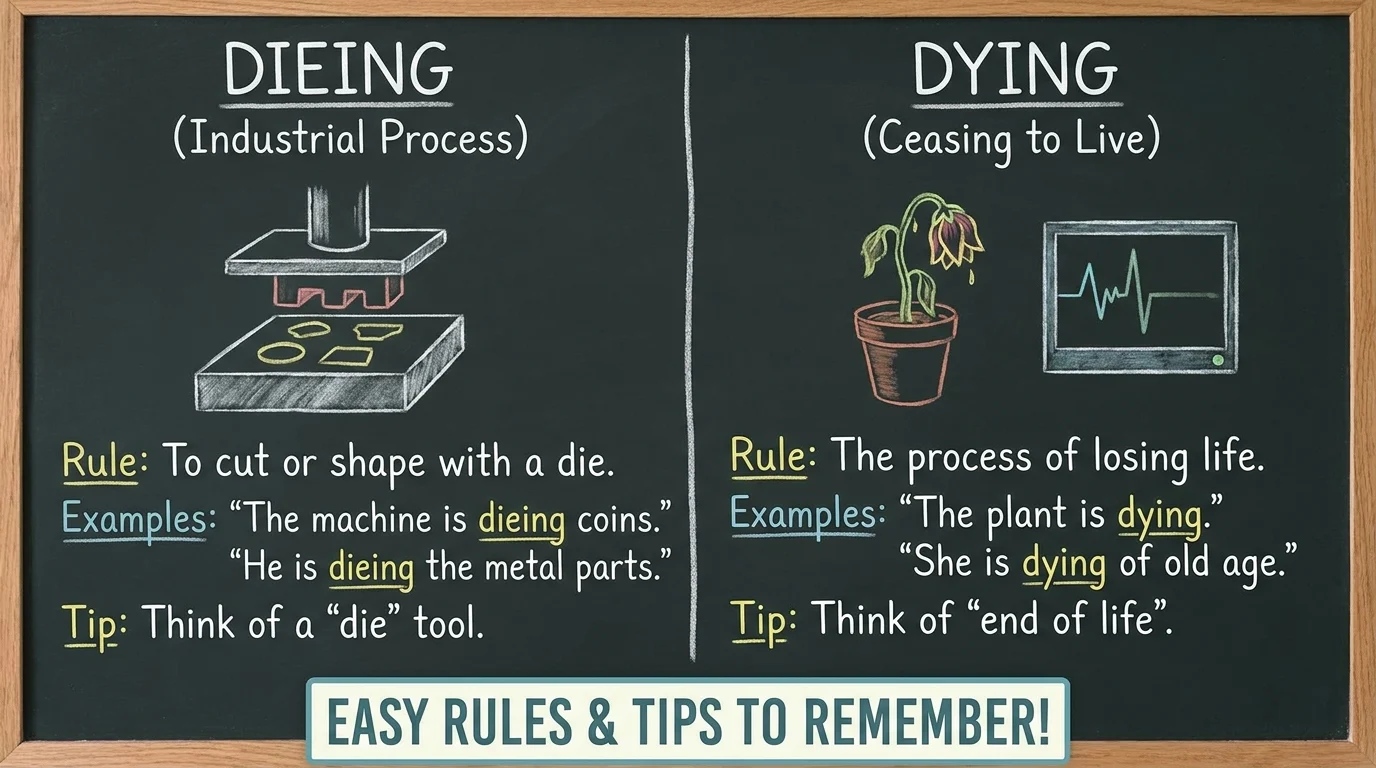
Quick Ans: “Dying” is the correct spelling when you mean becoming dead or stopping to live. “Dieing” is usually incorrect. The confusion happens because the verb “die” changes to “dying” when you add the ending “ing.” You do not keep the final “e” in this form.
Are you confused about whether to write “dieing or dying”? The correct spelling is almost always “dying.”
The mistake is easy to make. Many English verbs simply take “ing” after their base form. For example, “play” becomes “playing,” and “work” becomes “working.” However, verbs ending in a silent “e” often follow a different spelling rule.
The verb “die” is one of those words. When you add “ing,” the final “e” changes. The result is “dying,” not “dieing.”
You will see “dying” in everyday conversations, books, news articles, medical writing, and creative writing. It can describe someone who is close to death, something that is losing life, or something that is gradually disappearing.
Once you know the spelling rule, this common mistake becomes much easier to avoid.
Quick Answer: Dieing or Dying?
| Word | Correct? | Meaning | Example |
|---|---|---|---|
| Dying | Yes | Becoming dead or losing life | The plant is dying. |
| Dieing | Usually no | Usually a spelling mistake | Do not use this for “die.” |
Quick rule: The correct form of “die” with “ing” is dying.
Definition and Explanation
Dying
“Dying” is the present participle and gerund form of the verb “die.”
It means approaching death, losing life, or gradually coming to an end.
Example: The old tree is dying.
It can also describe something that is becoming less active or popular.
Example: The tradition is slowly dying.
Dieing
“Dieing” is generally considered an incorrect spelling when you mean the present participle of “die.”
Example:
Incorrect: The plant is dieing.
Correct: The plant is dying.
The spelling changes because “die” does not simply take “ing.” The final “ie” changes to “y.”
| Base Verb | Correct “ing” Form | Example |
|---|---|---|
| Die | Dying | The flower is dying. |
| Lie | Lying | She is lying down. |
| Tie | Tying | He is tying his shoes. |
The key pattern is simple. Words ending in “ie” usually change “ie” to “y” before adding “ing.”
Is This a Grammar, Usage, or Spelling Issue?
This is mainly a spelling issue caused by an English word formation rule.
When “die” becomes “dying,” the spelling changes from “ie” to “y.” Therefore, adding “ing” directly to make “dieing” does not work in standard English.
The same pattern appears in words such as “lie” and “tie.” We write “lying” and “tying,” not “lieing” and “tieing.”
So, if you are unsure, remember the pattern: ie changes to y before ing.
Real World Usage Examples
Workplace Examples
“The company is dying because it failed to adapt.”
Here, “dying” describes a business that is gradually losing success or activity.
“Several older products are dying out.”
The phrase means that the products are gradually disappearing.
Recap: “Dying” can describe something that is declining, not only a living person or animal.
Academic Examples
“The plant is dying because it lacks water.”
Here, “dying” describes the loss of life in a plant.
“The species is slowly dying out.”
The phrase describes a species that is becoming less common and may eventually disappear.
Recap: Academic writing can use “dying” for living things and disappearing populations.
Everyday Examples
“My phone battery is dying.”
This common expression means the battery is almost empty.
“The flowers are dying.”
The flowers are losing their freshness and life.
Recap: “Dying” appears frequently in everyday English.
Regional or Global Usage Differences
“Dying” is the standard spelling in American English, British English, Canadian English, Australian English, and other major varieties of English.
There is no significant regional spelling difference here.
Although you may see “dieing” online, especially in informal posts, it is generally a spelling error when the writer means “dying.”
When NOT to Use It
Do not write “dieing” when you mean becoming dead or losing life.
Do not add “ing” directly to “die.” Change “ie” to “y” first.
Do not confuse “dying” with “dyeing.” “Dyeing” means coloring something with dye.
Avoid using “dying” when you actually mean “dyeing,” such as when someone is coloring fabric.
Do not assume that every word ending in “ie” follows exactly the same pattern in every form. Check the correct spelling when you are unsure.
Common Mistakes and Corrections
| Correct Sentence | Incorrect Sentence | Why |
|---|---|---|
| The plant is dying. | The plant is dieing. | “Die” changes to “dying.” |
| His battery is dying. | His battery is dieing. | The correct “ing” form is “dying.” |
| The tradition is dying out. | The tradition is dieing out. | “Dying” is the standard spelling. |
| She is dyeing the fabric. | She is dying the fabric. | “Dyeing” means coloring something with dye. |
Decision Rule: If you mean losing life or coming to an end, use dying. If you mean coloring something with dye, use dyeing.
Exercises With Answers
Choose the correct word.
- The flowers are _____.
- My phone battery is _____.
- She is _____ the fabric blue.
- The species is _____ out.
- Is “dieing” the correct form of “die”?
- He is _____ his hair.
Answer Key
- dying
- dying
- dyeing
- dying
- No
- dyeing
Related Concepts and Comparisons
Readers may also search for dying vs dyeing, die past tense, dieing meaning, dying meaning, dyeing meaning, lie vs lying, tie vs tying, and words ending in ie.
FAQs
Is dieing or dying correct?
“Dying” is the correct spelling when you mean becoming dead or losing life. “Dieing” is generally a spelling mistake.
Why is dying spelled without the e?
The word “die” changes its final “ie” to “y” before adding “ing.” Therefore, “die” becomes “dying.”
What is the difference between dying and dyeing?
“Dying” relates to death or losing life. “Dyeing” means coloring something with dye, such as fabric or hair.
Is dieing a word?
You may find “dieing” in dictionaries or specialized contexts, but it is not the standard spelling of the “ing” form of “die.” For normal English writing, use “dying.”
How do you spell dying correctly?
The correct spelling is “dying.” It is written D Y I N G, without an “e” after the “i.”
Is dying the present participle of die?
Yes. “Dying” is the present participle and gerund form of “die.” For example, “The tree is dying.”
Is dying spelled differently in British English?
No. “Dying” has the same standard spelling in British and American English.
What is the past tense of die?
The past tense of “die” is “died.” For example, “The plant died last winter.”
Conclusion
When choosing between “dieing or dying,” the correct spelling is dying when you mean losing life, approaching death, or gradually disappearing.
The reason is a simple spelling rule. The verb “die” ends in “ie.” When you add “ing,” the “ie” changes to “y,” giving you “dying.” The incorrect form “dieing” often appears when writers simply add “ing” to the original word.
Also, don’t confuse “dying” with “dyeing.” The first relates to death or decline, while the second means coloring something with dye.
This spelling stays the same across major varieties of English, so you can confidently use “dying” in both formal and informal writing.
Practical tip: Remember the pattern die → dying, just as lie → lying and tie → tying. This will help you avoid the “dieing” mistake immediately.