
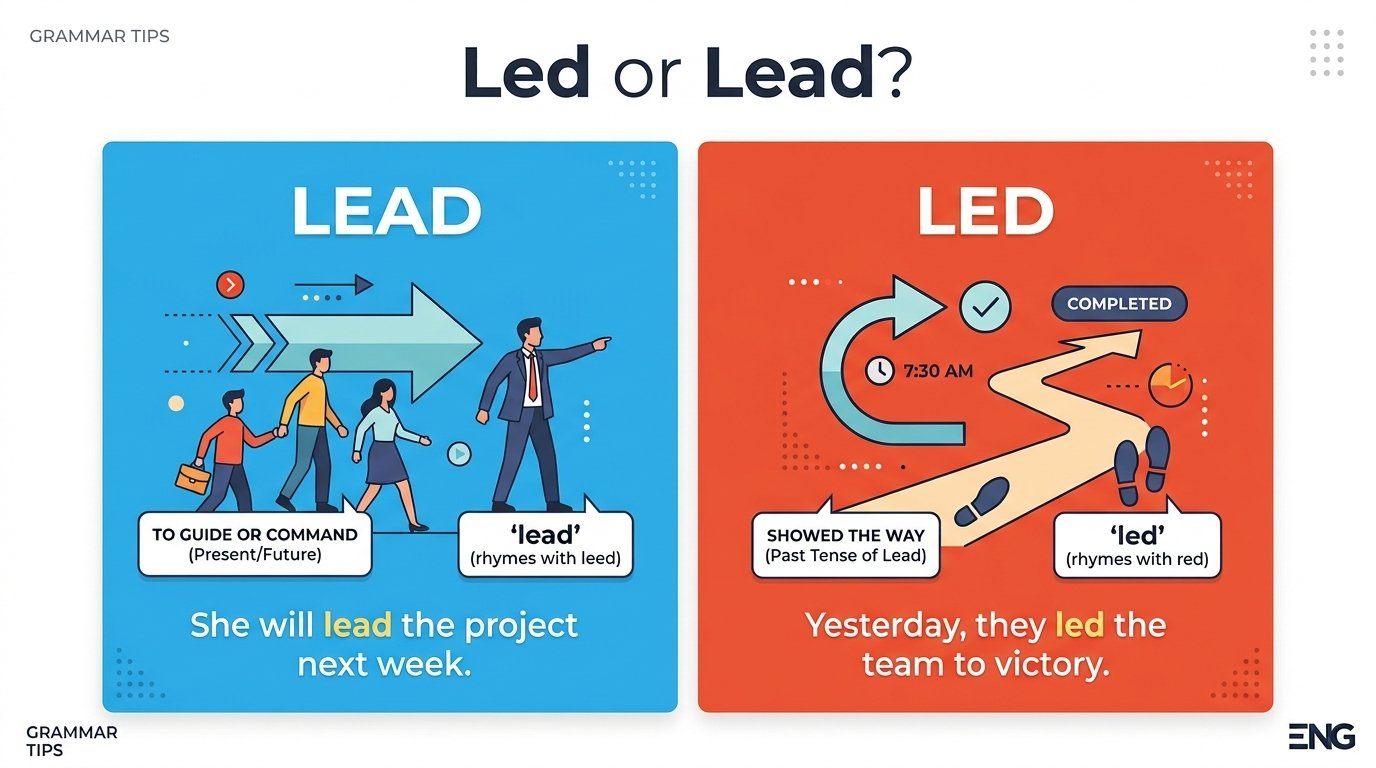
Quick Ans: “Led” and “lead” are both correct English words, but they have different meanings and pronunciations. “Lead” is usually pronounced “leed” when it means to guide, while “led” is pronounced “led” and is the past tense of “lead.” The metal “lead” is pronounced “led.”
Are you confused about whether to use “led or lead”? You’re not alone. These words cause problems because they can look almost identical while having different meanings and pronunciations.
The confusion becomes especially common when talking about past actions. If someone guides a team today, you might say, “She leads the team.” If she did the same thing yesterday, you should say, “She led the team.”
“Lead” and “led” also appear in many common situations. You may see them in workplace writing, school assignments, news reports, and everyday conversations. Learning the difference will help you write more clearly and avoid a common English mistake.
For American English speakers and learners, one pronunciation detail matters too. The verb “lead” sounds like “leed,” while its past tense “led” sounds like “bed” or “said.” Meanwhile, the noun “lead,” meaning the metal, is pronounced “led.”
Once you understand these patterns, choosing the right word becomes much easier.
Quick Answer: Led or Lead?
| Word | Meaning | Pronunciation | Example |
|---|---|---|---|
| Lead | Guide or direct | “leed” | I lead the team. |
| Led | Past tense of lead | “led” | I led the team yesterday. |
| Lead | A metal | “led” | The pipe contains lead. |
The easiest rule is: use “lead” for the present and “led” for the past.
Led or Lead: Definitions and Differences
Lead
“Lead” is usually a verb when it means to guide, direct, or be in charge of something.
Example: She leads the marketing team.
It can also function as a noun. For example, “lead” can mean the main position in a competition.
Example: Our team has the lead.
When “lead” means to guide, its pronunciation rhymes with “need.”
Led
“Led” is the past tense and past participle of the verb “lead.”
Example: She led the team last year.
It describes an action that already happened.
The pronunciation of “led” rhymes with “bed.”
Lead as a Metal
“Lead” also refers to a chemical element and heavy metal. In this meaning, it is pronounced “led.”
Example: The old paint contained lead.
This pronunciation is the same as “led,” but the meaning comes from the context.
| Word | Part of Speech | Meaning | Example |
|---|---|---|---|
| Lead | Verb | Guide or direct | He will lead the group. |
| Led | Verb | Past form of lead | He led the group yesterday. |
| Lead | Noun | A heavy metal | The material contains lead. |
So, “led” is the past form of the verb “lead.” The word “lead” can also have a completely different meaning when it refers to the metal.
Is This a Grammar, Usage, or Pronunciation Issue?
This is mainly a grammar, vocabulary, and pronunciation issue.
The biggest mistake happens when writers use “lead” for a past action.
Incorrect: She lead the project last year.
Correct: She led the project last year.
In the present tense, use “lead.”
Correct: She will lead the project next month.
In the past tense, use “led.”
Correct: She led the project last month.
However, “lead” can refer to the metal, and that word has the “led” pronunciation. Context tells you which meaning applies.
Real World Usage Examples
Workplace Examples
“Our director will lead the meeting tomorrow.”
The action will happen in the future, so “lead” is correct.
“Maria led the meeting yesterday.”
The meeting already happened, so “led” is correct.
Recap: Use “lead” for current or future actions and “led” for completed actions.
Academic Examples
“The researcher led the study for three years.”
The researcher directed the study in the past.
“Students will lead the discussion tomorrow.”
The discussion has not happened yet.
Recap: Check the time of the action before choosing “lead” or “led.”
Everyday Examples
“He led us to the restaurant.”
The action happened in the past.
“Can you lead the way?”
The action is happening now or will happen next.
Recap: The tense determines whether you need “lead” or “led.”
Regional or Global Usage Differences
The spelling of “lead” and “led” is the same in American and British English.
The main pronunciation pattern also remains consistent. The verb “lead” sounds like “leed,” while “led” sounds like “led.”
The metal “lead” has the same pronunciation as “led.”
Therefore, American and British writers generally follow the same rule when choosing between these words.
When NOT to Use It
Do not use “lead” when you are describing a completed action of guiding or directing someone.
Do not write “She lead the team yesterday.” Use “She led the team yesterday.”
Do not confuse the verb “lead” with the metal “lead.” Context changes both meaning and pronunciation.
Avoid choosing the word based only on how it sounds. The same spelling can represent different meanings.
Do not assume that “lead” is always pronounced “leed.” When it means the metal, it is pronounced “led.”
Common Mistakes and Corrections
| Correct Sentence | Incorrect Sentence | Why |
|---|---|---|
| She led the team last year. | She lead the team last year. | “Led” is the past tense of “lead.” |
| He will lead the meeting. | He will led the meeting. | After “will,” use the base verb “lead.” |
| They lead the project every year. | They led the project every year. | The sentence describes a regular present action. |
| The paint contained lead. | The paint contained led. | “Lead” is the correct spelling for the metal. |
Decision Rule: If the action happened in the past, use “led.” If it happens now or will happen later, use “lead.”
Exercises With Answers
Choose “lead” or “led.”
- She _____ the team last year.
- I will _____ the discussion tomorrow.
- They _____ the project every month.
- He _____ us to the correct building yesterday.
- The old pipes contained _____.
- Who will _____ the meeting?
Answer Key
- led
- lead
- lead
- led
- lead
- lead
Related Concepts and Comparisons
Readers may also search for lead vs led, lead pronunciation, led meaning, lead meaning, lead past tense, lead or led grammar, read vs read, and past tense spelling.
FAQs
Is led or lead correct?
Both words are correct, but they have different uses. “Lead” is the present form of the verb, while “led” is its past tense.
Is lead the past tense of lead?
No. The past tense of the verb “lead” is “led.” For example, “She leads the team” becomes “She led the team.”
How do you pronounce lead and led?
When “lead” means to guide, it is pronounced like “leed.” “Led” sounds like “bed,” while “lead” meaning the metal also sounds like “led.”
Why is lead sometimes pronounced led?
“Lead” has two different meanings and pronunciations. The verb meaning “to guide” sounds like “leed,” while the metal is pronounced “led.”
Is led a word?
Yes. “Led” is the past tense and past participle of the verb “lead.” For example, “She led the team to victory.”
Should I use lead or led for past tense?
Use “led” for the past tense. A sentence such as “He led the company for ten years” is correct.
What is the difference between lead and led in American English?
In American English, “lead” means to guide when pronounced “leed,” while “led” is its past tense. “Lead” can also mean the metal when pronounced “led.”
Is “I lead the team yesterday” correct?
No. Because “yesterday” shows that the action happened in the past, the correct sentence is “I led the team yesterday.”
Conclusion
The difference between “led” and “lead” becomes easy once you focus on time and meaning. “Lead” is the present form of the verb when you mean guide or direct. “Led” is the past tense.
For example, you can say, “I lead the team today,” but you should say, “I led the team yesterday.” After words such as “will,” always use the base form: “She will lead the meeting.”
There is another meaning to remember. “Lead” can refer to the metal, and in that case, it is pronounced “led.” So, pronunciation alone cannot always tell you which word you are seeing.
American and British English use the same spellings and basic rules.
Practical tip: look for a past time word such as yesterday, last week, or previously. If the action happened in the past, choose “led.”
3 thoughts on “Led or Lead: What’s the Difference? Easy Rules, Examples & Tips”