
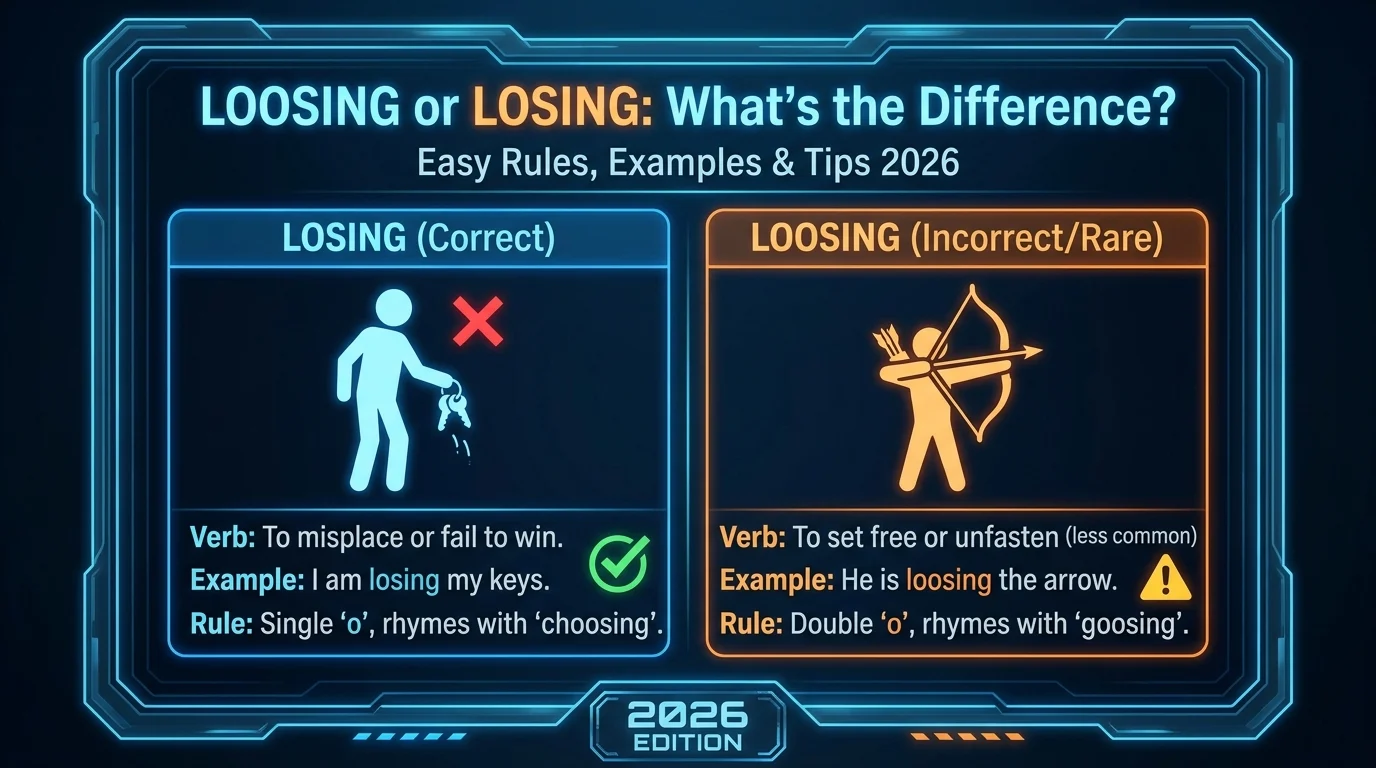
Quick Ans: “Losing” is the correct spelling when you mean failing to keep something, being defeated, or no longer having something. “Loosing” is also a real word, but it is much less common and means releasing, freeing, or making something loose. The two words have different meanings.
Are you confused about whether to write “loosing or losing”? This is one of the most common spelling mistakes in English. The words look very similar, but they come from different verbs.
“Losing” comes from the verb “lose.” You use it when someone no longer has something, fails to win, or cannot find something. For example, “I am losing my keys” means the keys are disappearing from your possession.
“Loosing,” on the other hand, comes from the verb “loose.” It means releasing or setting something free. For example, “The hunter is loosing the dogs” means the hunter is releasing them.
In everyday writing, “losing” is far more common. Most people who write “loosing” actually mean “losing.” Knowing the difference will help you avoid this common spelling error in emails, assignments, articles, and social media posts.
The easiest way to remember the difference is to focus on the base word. “Lose” becomes “losing,” while “loose” becomes “loosing.”
Quick Answer and Key Takeaway
| Word | Base Word | Meaning | Example |
|---|---|---|---|
| Losing | Lose | No longer having or failing to win | I am losing my phone. |
| Loosing | Loose | Releasing or setting free | He is loosing the birds. |
Quick rule: If you mean “not winning” or “no longer having something,” use losing.
Definition and Explanation
Losing
“Losing” is the present participle of the verb “lose.”
It can mean failing to win.
Example: Our team is losing the game.
It can also mean no longer having something.
Example: She is losing her patience.
Another meaning is failing to keep or find something.
Example: I’m losing my keys again.
Loosing
“Loosing” is the present participle of the verb “loose.”
“Loose” means to release, free, or let go.
Example: The farmer is loosing the horses.
The word is grammatically correct, but it is uncommon in everyday English. In many cases, writers use “loosing” by mistake when they actually mean “losing.”
| Form | Verb | Meaning | Example |
|---|---|---|---|
| Losing | Lose | Failing to keep or win | He is losing money. |
| Loosing | Loose | Releasing or freeing | She is loosing the animals. |
The important difference is the base verb. Lose means to no longer have or win. Loose means not tight or to release.
Is This a Grammar, Usage, or Vocabulary Issue?
This is mainly a spelling and vocabulary issue. Both “losing” and “loosing” are valid words, but they have different meanings.
The common mistake happens because “lose” and “loose” already look similar. When adding “ing,” writers sometimes keep the extra “o” and create “loosing.”
However, “lose” becomes “losing,” not “loosing.”
Correct: She is losing weight.
Incorrect: She is loosing weight.
“Loosing” should only appear when you mean releasing or freeing something.
Real World Usage Examples
Workplace Examples
“The company is losing customers.”
The company is no longer keeping some of its customers.
“She is losing interest in the project.”
Her interest is decreasing.
Recap: Use “losing” when something is being lost or reduced.
Academic Examples
“The experiment is losing accuracy over time.”
The experiment is becoming less accurate.
“The researchers are losing valuable data.”
The researchers are no longer retaining the data.
Recap: Academic writing commonly uses “losing” to describe something that is being lost.
Everyday Examples
“I keep losing my keys.”
You cannot keep track of your keys.
“Stop losing your socks!”
You keep misplacing them.
Recap: “Losing” is the normal choice for everyday situations involving loss.
Regional or Global Usage Differences
“Losing” has the same spelling and meaning in American, British, Canadian, and Australian English.
“Loosing” also has the same basic meaning across these varieties, but it is uncommon. Most English speakers are much more likely to use “releasing” or “setting free” instead.
Therefore, the difference is not regional. It depends on the meaning of the sentence.
When NOT to Use It
Do not use “loosing” when you mean failing to win.
Do not write “I am loosing the game.” The correct sentence is “I am losing the game.”
Avoid “loosing weight.” The correct expression is “losing weight.”
Do not use “loosing” when you mean misplacing something.
Use “losing” when something is disappearing from your possession.
Remember that “loosing” is correct only when you mean releasing or freeing something.
Common Mistakes and Corrections
| Correct Sentence | Incorrect Sentence | Why |
|---|---|---|
| I am losing the game. | I am loosing the game. | “Losing” comes from “lose.” |
| She is losing weight. | She is loosing weight. | The correct verb is “lose weight.” |
| He keeps losing his phone. | He keeps loosing his phone. | “Losing” means no longer having something. |
| The farmer is loosing the horses. | The farmer is losing the horses. | “Loosing” means releasing the horses. |
Decision Rule: Ask yourself whether you mean losing something or releasing something. Loss means “losing.” Release means “loosing.”
Exercises With Answers
Choose “losing” or “loosing.”
- I am _____ my patience.
- Our team is _____ the match.
- She keeps _____ her keys.
- The farmer is _____ the animals from the gate.
- He is _____ weight.
- The company is _____ money.
Answer Key
- losing
- losing
- losing
- loosing
- losing
- losing
Related Concepts and Comparisons
Readers may also search for lose vs loose, lose vs loose vs loss, losing weight spelling, losing meaning, loose meaning, lose meaning, common spelling mistakes, and loose or lose.
FAQs
Is loosing or losing correct?
Both words are correct, but they have different meanings. “Losing” comes from “lose,” while “loosing” comes from “loose” and means releasing something.
Is losing spelled with one o or two?
“Losing” is spelled with one “o” after the “l.” The correct spelling is L O S I N G.
Why do people spell losing as loosing?
People often make this mistake because “lose” and “loose” look similar. However, the correct form of “lose” with “ing” is “losing.”
What does losing mean?
“Losing” can mean failing to win, no longer having something, or gradually becoming without something. For example, “She is losing her patience.”
What does loosing mean?
“Loosing” means releasing, freeing, or letting something go. It comes from the verb “loose.”
Is “I am loosing weight” correct?
No. The correct sentence is “I am losing weight.” Weight loss comes from the verb “lose,” so the correct form is “losing.”
Is loosing a real word?
Yes. “Loosing” is a real word, but it is uncommon. It means releasing or setting something free.
What is the easiest way to remember losing vs loosing?
Remember that “lose” means to no longer have or win something, so it becomes “losing.” “Loose” means not tight or to release something, so it becomes “loosing.”
Conclusion
The difference between “loosing or losing” becomes easy once you remember their base verbs. “Losing” comes from “lose” and describes failing to win, misplacing something, or no longer having something.
For example, you can say, “I am losing the game,” “She is losing her keys,” or “He is losing weight.”
“Loosing” comes from “loose.” It means releasing or setting something free. Although it is a correct word, it appears much less often in everyday English.
The most common mistake is writing “loosing” when you actually mean “losing.” If you are talking about a game, money, weight, a possession, patience, or something similar, “losing” is almost certainly the word you need.
Practical tip: remember the base word before adding “ing.” Lose becomes losing. Loose becomes loosing.
2 thoughts on “Loosing or Losing: What’s the Difference? Easy Rules, Examples & Tips 2026”