
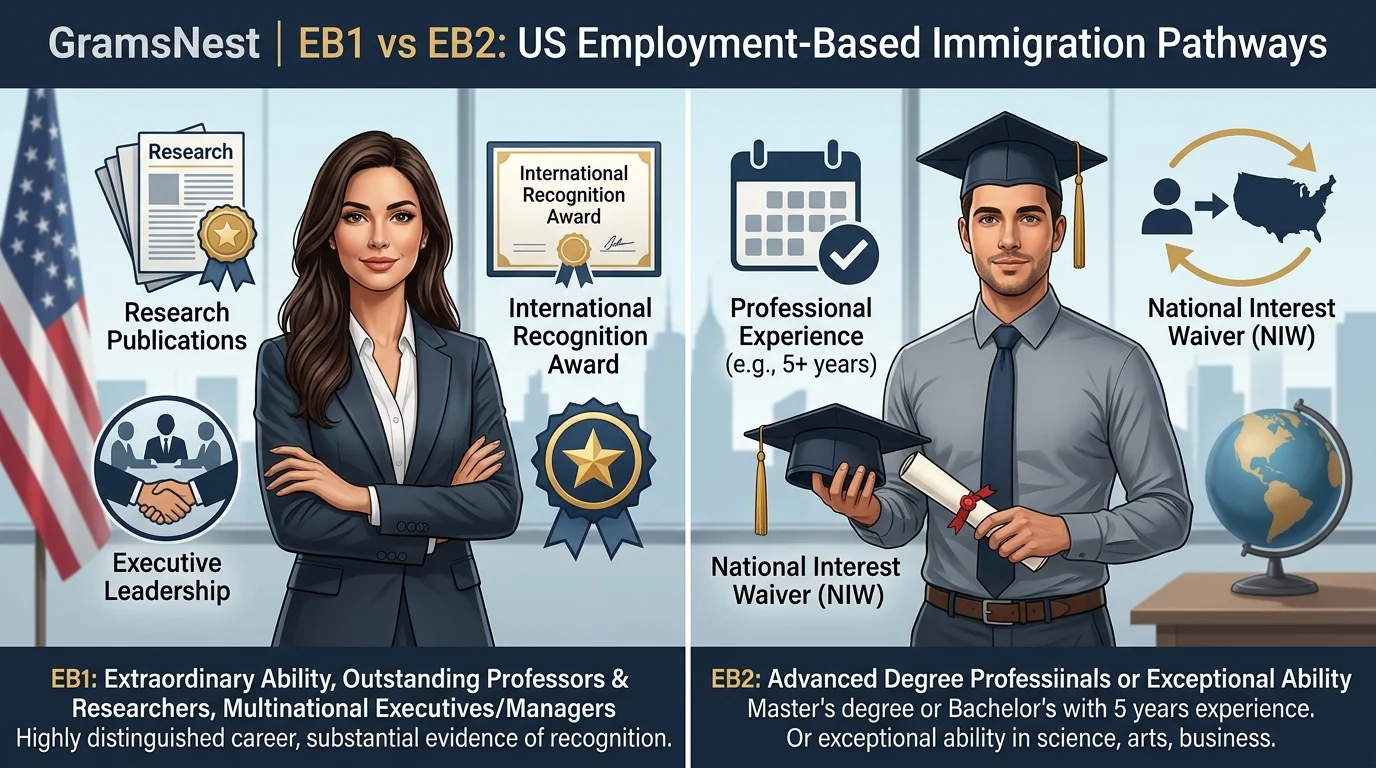
Quick Ans: EB1 and EB2 are employment based immigrant visa categories for people seeking permanent residence in the United States. EB1 generally covers priority workers, including people with extraordinary ability, outstanding professors or researchers, and certain multinational executives or managers. EB2 covers professionals with advanced degrees or exceptional ability, including some applicants seeking a National Interest Waiver.
EB1 vs EB2 is an important comparison for professionals considering employment based immigration to the United States. Both categories can lead to a Green Card, but they are designed for different types of applicants.
EB1 is the first employment based preference category. It includes three main groups: people with extraordinary ability, outstanding professors and researchers, and certain multinational executives or managers.
EB2 is the second employment based preference category. It generally covers professionals with advanced degrees and people with exceptional ability in the sciences, arts, or business. EB2 also includes the National Interest Waiver, commonly called NIW, which can waive the usual job offer and labor certification requirements when the applicant meets the applicable standard.
The key difference is therefore not simply that one category is “better.” Each category has different eligibility requirements, evidence standards, and filing considerations.
Quick Answer and Key Takeaway
EB1 is the first employment based preference category, while EB2 is the second. EB1 focuses on priority workers such as people with extraordinary ability, outstanding professors and researchers, and certain multinational executives or managers. EB2 focuses on advanced degree professionals and people with exceptional ability, with an additional National Interest Waiver pathway.
EB1 vs EB2: Definition and Explanation
What Is EB1?
EB1 stands for Employment Based First Preference.
It has three main classifications:
- EB1A: People with extraordinary ability
- EB1B: Outstanding professors and researchers
- EB1C: Certain multinational managers and executives
USCIS materials identify these three classifications under the EB1 category.
For example, an internationally recognized researcher may potentially qualify under EB1A or EB1B depending on the facts of the case and the applicable requirements.
What Is EB2?
EB2 stands for Employment Based Second Preference.
It generally covers:
- Professionals holding advanced degrees
- People with exceptional ability
- Certain applicants qualifying for a National Interest Waiver
USCIS describes exceptional ability as expertise significantly above that ordinarily encountered in the sciences, arts, or business.
An applicant using the advanced degree route may qualify through a qualifying master’s degree or equivalent, or through a bachelor’s degree followed by the required progressive experience in the specialty.
Is This a Grammar, Usage, or Vocabulary Issue?
No. EB1 vs EB2 is an immigration and legal classification comparison.
The terms describe two different employment based immigrant preference categories under US immigration law.
Because immigration requirements and visa availability can change, applicants should verify current information with USCIS and the Department of State before making decisions.
EB1 vs EB2: Key Differences
| Feature | EB1 | EB2 |
|---|---|---|
| Preference | First employment based preference | Second employment based preference |
| Main applicants | Extraordinary ability, outstanding professors or researchers, multinational managers or executives | Advanced degree professionals or people with exceptional ability |
| National Interest Waiver | Not the EB1 pathway | Available under EB2 |
| Job offer | Depends on classification | Generally required, but NIW can waive the job offer requirement |
| Labor certification | Depends on classification | Generally required, but NIW can waive it |
| Evidence | Depends on EB1 classification | Depends on advanced degree, exceptional ability, or NIW route |
The exact requirements depend on the specific classification and individual circumstances.
Real World Usage Examples
EB1 Example
A researcher with significant recognition and evidence of achievements may explore an EB1 category that matches their background.
An executive who worked for a qualifying multinational organization may potentially fall under EB1C if the statutory and regulatory requirements are satisfied.
EB2 Example
A professional with an advanced degree may qualify for EB2 if the position and other requirements meet the applicable rules.
A professional with exceptional ability may also qualify through the EB2 exceptional ability route. USCIS requires evidence under the applicable criteria and evaluates the evidence as a whole.
EB2 NIW Example
An EB2 applicant may seek a National Interest Waiver. Under the USCIS framework, the applicant must first establish EB2 eligibility and then satisfy the requirements for the waiver. The Dhanasar framework considers the proposed endeavor’s substantial merit and national importance, whether the person is well positioned to advance it, and whether waiving the job offer requirement would benefit the United States.
Regional or Global Differences
The eligibility rules for EB1 and EB2 are federal US immigration rules, but visa availability can differ based on the applicant’s country of chargeability and priority date.
For September 2026, the Department of State Visa Bulletin lists different Final Action Dates for EB1 and EB2 depending on the country. For example, EB1 is listed as current for many chargeability areas but has separate dates for China and India. EB2 is also current for many areas while having different dates for China and India.
These dates can change from month to month, so an article should not treat a particular Visa Bulletin date as permanent.
When NOT to Use EB1 or EB2 as a General Label
Avoid assuming that someone qualifies simply because they:
- Have a master’s degree
- Have a high salary
- Work for a large company
- Have published research
- Have several years of experience
- Have an impressive job title
Eligibility depends on the specific requirements and supporting evidence for the relevant category.
Similarly, having an advanced degree does not automatically mean someone qualifies for every EB2 pathway.
Common Mistakes and Corrections
| Correct Understanding | Incorrect Assumption | Why |
|---|---|---|
| EB1 has three major classifications | EB1 is only for extraordinary ability | EB1 also includes outstanding professors and researchers and certain multinational managers or executives |
| EB2 includes advanced degree professionals | Every master’s degree holder automatically qualifies | Other requirements may apply |
| EB2 can include NIW | Every EB2 applicant receives an NIW | NIW has additional requirements |
| Visa availability can change | A Visa Bulletin date is permanent | Visa dates can advance, retrogress, or become unavailable |
| EB1 and EB2 have different requirements | They are identical Green Card categories | They are separate employment based preferences |
Easy Decision Rule
Start by identifying which eligibility category actually matches the applicant’s background.
Then review the evidence requirements, employer requirements, and current visa availability for that category.
Exercises With Answers
Choose EB1 or EB2.
- First employment based preference category: ______
- Advanced degree professionals: ______
- National Interest Waiver pathway: ______
- Outstanding professors and researchers: ______
- Certain multinational managers and executives: ______
Answers
- EB1
- EB2
- EB2
- EB1
- EB1
Related Concepts and Comparisons
EB1A vs EB2 NIW
EB1A focuses on extraordinary ability, while EB2 NIW involves first establishing EB2 eligibility and then meeting the requirements for a National Interest Waiver. These are separate immigration pathways with different standards.
EB1B vs EB2
EB1B is designed for qualifying outstanding professors and researchers. EB2 can cover professionals with advanced degrees or exceptional ability.
EB1C vs EB2
EB1C applies to qualifying multinational managers and executives. EB2 generally concerns advanced degree professionals or people with exceptional ability.
FAQs
What is the main difference between EB1 and EB2?
EB1 is the first employment based preference category and includes priority workers. EB2 is the second preference category and generally covers advanced degree professionals and people with exceptional ability.
Is EB1 harder to qualify for than EB2?
The categories have different eligibility standards rather than one universal difficulty level. The appropriate category depends on the applicant’s qualifications and evidence.
Can a person qualify for both EB1 and EB2?
Potentially, yes. A person may have qualifications that fit more than one employment based category, but each petition must satisfy the requirements of the category being requested.
What is EB2 NIW?
EB2 NIW is a National Interest Waiver pathway. It can allow an eligible applicant to seek a waiver of the job offer and labor certification requirements after establishing the underlying EB2 eligibility.
Does EB2 always require a job offer?
The general EB2 category normally involves a job offer and labor certification, but an eligible National Interest Waiver can waive those requirements.
What are the three types of EB1?
The three major EB1 classifications are EB1A for extraordinary ability, EB1B for outstanding professors and researchers, and EB1C for certain multinational managers and executives.
Does having a master’s degree qualify someone for EB2?
A qualifying advanced degree can establish one part of the EB2 eligibility route, but additional requirements apply. USCIS also recognizes certain bachelor’s degree plus progressive experience cases as an advanced degree equivalent.
Do EB1 and EB2 have the same visa wait times?
No. Visa availability depends on the category, priority date, and country of chargeability. The Department of State publishes monthly Visa Bulletins showing current availability.
Conclusion
EB1 vs EB2 is a comparison between two employment based immigrant preference categories, but they serve different applicant profiles. EB1 includes extraordinary ability applicants, outstanding professors and researchers, and certain multinational managers or executives. EB2 generally covers professionals with advanced degrees and people with exceptional ability, with the additional National Interest Waiver pathway.
The right category depends on the applicant’s qualifications, evidence, employment situation, and specific immigration circumstances. A degree, job title, publication record, or years of experience alone does not automatically establish eligibility.
Visa availability is another important factor. The Department of State updates employment based Final Action Dates and Dates for Filing through its monthly Visa Bulletin, and those dates can vary by country and category.
If you’re researching these categories, start by identifying the specific EB1 or EB2 classification that matches your circumstances, then verify the current USCIS requirements and Visa Bulletin before taking action.
1 thought on “EB1 vs EB2: What’s the Difference? Requirements, Benefits & Examples”