
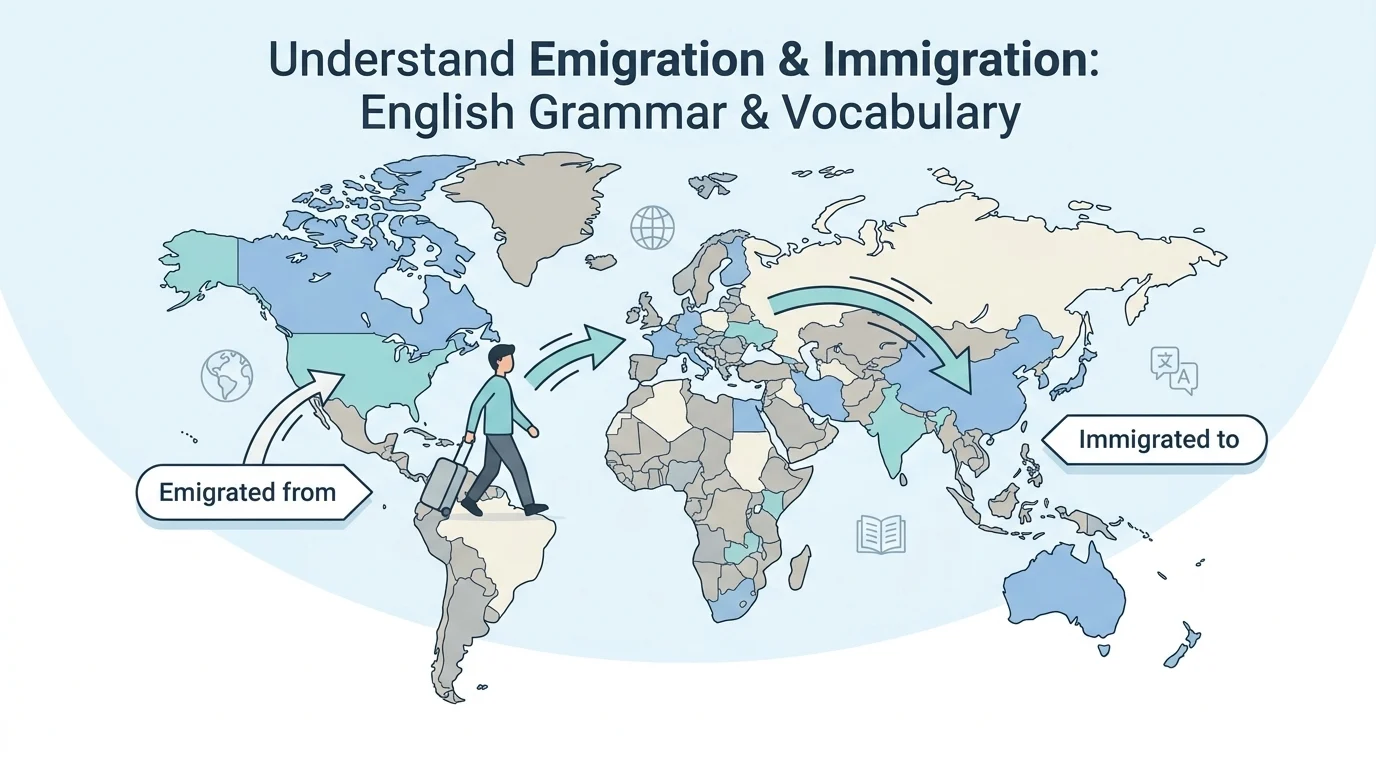
Quick Ans: “Emigrated” and “immigrated” both describe moving from one country to another, but they focus on different sides of that move. “Emigrated” means leaving your home country, while “immigrated” means moving into a new country. The right word depends on the direction you want to describe.
Are you confused about whether to use “emigrated or immigrated”? The two words describe the same international move, but they look at it from different directions.
Suppose Maria leaves Pakistan and moves to Canada. From Pakistan’s point of view, Maria emigrated from Pakistan. From Canada’s point of view, she immigrated to Canada.
This difference matters in everyday English, academic writing, news reports, immigration documents, and formal communication. Using the wrong word can make your sentence unclear because each verb has a different focus.
Fortunately, there is an easy way to remember them. Think of “emigrate” as “exit” from a country. Think of “immigrate” as “into” a country. The prefixes can help you remember the direction.
Both words are usually followed by “from” and “to” in predictable ways. Once you understand that pattern, choosing between them becomes much easier.
Quick Answer and Key Takeaway
| Word | Meaning | Common Pattern | Example |
|---|---|---|---|
| Emigrated | Left a country to live elsewhere | emigrated from | She emigrated from India. |
| Immigrated | Moved into another country to live | immigrated to | She immigrated to Canada. |
The easiest rule is simple: you emigrate from a country and immigrate to a country.
Definition and Explanation
Emigrated
“Emigrated” is the past tense of “emigrate.” It means left one’s country to live permanently or for a long period in another country.
Example: His family emigrated from Ireland in 1995.
Here, the sentence focuses on the country the family left.
Immigrated
“Immigrated” is the past tense of “immigrate.” It means moved to another country to live there.
Example: His family immigrated to Australia in 1995.
Here, the focus is on the country where the family settled.
| Feature | Emigrated | Immigrated |
|---|---|---|
| Basic meaning | Left a country | Entered a new country to live |
| Focus | Country of departure | Country of arrival |
| Common preposition | From | To |
| Example | He emigrated from Mexico. | He immigrated to the United States. |
The same person can both emigrate and immigrate. The difference depends on which country you are discussing.
Is This a Grammar, Usage, or Vocabulary Issue?
This is mainly a vocabulary and usage issue. Both words are grammatically correct, but they have different meanings.
“Emigrate” focuses on leaving. “Immigrate” focuses on entering a new country.
The words are not interchangeable in a sentence. For example, “She immigrated from France” sounds incorrect when you mean that France was the country she left. Instead, say “She emigrated from France.”
Similarly, “She emigrated to Germany” can be understood, but “She immigrated to Germany” is the more precise choice when you are focusing on her arrival.
Real World Usage Examples
Workplace Example
“Several employees immigrated to the United States for new career opportunities.”
Here, the sentence focuses on the country where they moved.
Recap: Use “immigrated to” when focusing on the destination.
Academic Example
“The family emigrated from Italy in the early twentieth century.”
The sentence focuses on Italy as the country they left.
Recap: Use “emigrated from” when focusing on the departure country.
Everyday Example
“My grandparents immigrated to Canada when they were young.”
The speaker focuses on Canada as their new home.
Recap: The destination usually takes “immigrated to.”
Regional or Global Usage Differences
“Emigrate” and “immigrate” have the same basic meanings in American and British English. The distinction does not change significantly between the two varieties.
Other English speaking regions also generally follow the same pattern. Therefore, this is not a US versus UK spelling issue.
The nouns follow the same distinction. An “emigrant” is someone who leaves their country, while an “immigrant” is someone who moves into another country.
When NOT to Use It
Do not use “immigrated” when you are specifically talking about someone leaving a country.
Do not use “emigrated” when your sentence focuses on someone entering a new country.
Avoid saying “emigrated to” when “immigrated to” gives a clearer destination focused meaning.
Likewise, avoid “immigrated from” when you mean the country the person left. “Emigrated from” is usually clearer.
Do not assume that the two verbs describe two different people. The same person can be an emigrant from one country and an immigrant in another.
Common Mistakes and Corrections
| Correct Sentence | Incorrect Sentence | Why |
|---|---|---|
| She emigrated from India. | She immigrated from India. | “From” identifies the country she left. |
| She immigrated to Canada. | She emigrated to Canada. | “To” identifies her new country. |
| They emigrated from Spain in 2010. | They immigrated from Spain in 2010. | The sentence focuses on departure. |
| They immigrated to Germany in 2010. | They emigrated to Germany in 2010. | The sentence focuses on arrival. |
Decision Rule: Ask yourself, “Am I talking about leaving or arriving?” Leaving means “emigrated from.” Arriving in a new country means “immigrated to.”
Exercises With Answers
Choose “emigrated” or “immigrated.”
- She _____ from France in 2005.
- He _____ to the United States last year.
- Their family _____ from China.
- Thousands of people _____ to Australia each year.
- My grandparents _____ from Italy and later settled in Canada.
- She _____ to Canada after getting a new job.
Answer Key
- emigrated
- immigrated
- emigrated
- immigrated
- emigrated
- immigrated
Related Concepts and Comparisons
Readers may also want to learn about immigrant vs emigrant, immigration vs emigration, migrant vs immigrant, migration meaning, immigrate vs migrate, emigrate from or to, immigration vocabulary, and immigration grammar.
FAQs
What is the difference between emigrated and immigrated?
“Emigrated” means left a country to live elsewhere, while “immigrated” means moved into another country. For example, “She emigrated from India and immigrated to Canada.”
Is it emigrated from or immigrated from?
Use “emigrated from” when you are talking about the country someone left. For example, “They emigrated from Mexico in 2018.”
Is it emigrated to or immigrated to?
Use “immigrated to” when you are talking about the country someone moved into. For example, “They immigrated to Australia.”
Can someone both emigrate and immigrate?
Yes. A person can emigrate from their home country and immigrate to a new country during the same move. The two words simply describe different sides of that move.
What is the difference between an immigrant and an emigrant?
An immigrant is someone who moves into a country to live there. An emigrant is someone who leaves their country to live somewhere else.
Which is correct, emigrated or immigrated to another country?
“Immigrated to another country” is usually the better choice when you are focusing on the destination. For example, “She immigrated to Canada in 2020.”
How can I remember emigrated vs immigrated?
Think of “emigrate” as leaving and “immigrate” as entering. You can remember the common patterns as “emigrate from” and “immigrate to.”
Are emigrated and immigrated synonyms?
No. They are closely related, but they are not exact synonyms. Each word focuses on a different direction of international movement.
Conclusion
The difference between “emigrated or immigrated” becomes simple once you focus on direction. “Emigrated” describes leaving a country, while “immigrated” describes moving into another country.
For example, if someone leaves India and settles in Canada, you can say, “She emigrated from India.” You can also say, “She immigrated to Canada.” Both sentences describe the same move, but each one focuses on a different country.
The most useful patterns are “emigrated from” and “immigrated to.” Remembering these combinations will help you avoid most mistakes.
The distinction also applies to the nouns “emigrant” and “immigrant.” An emigrant leaves a country, while an immigrant enters a new country to live.
Practical tip: when you are unsure, ask yourself whether your sentence focuses on the place the person left or the place they entered. If they left, choose “emigrated.” If they arrived in a new country, choose “immigrated.