
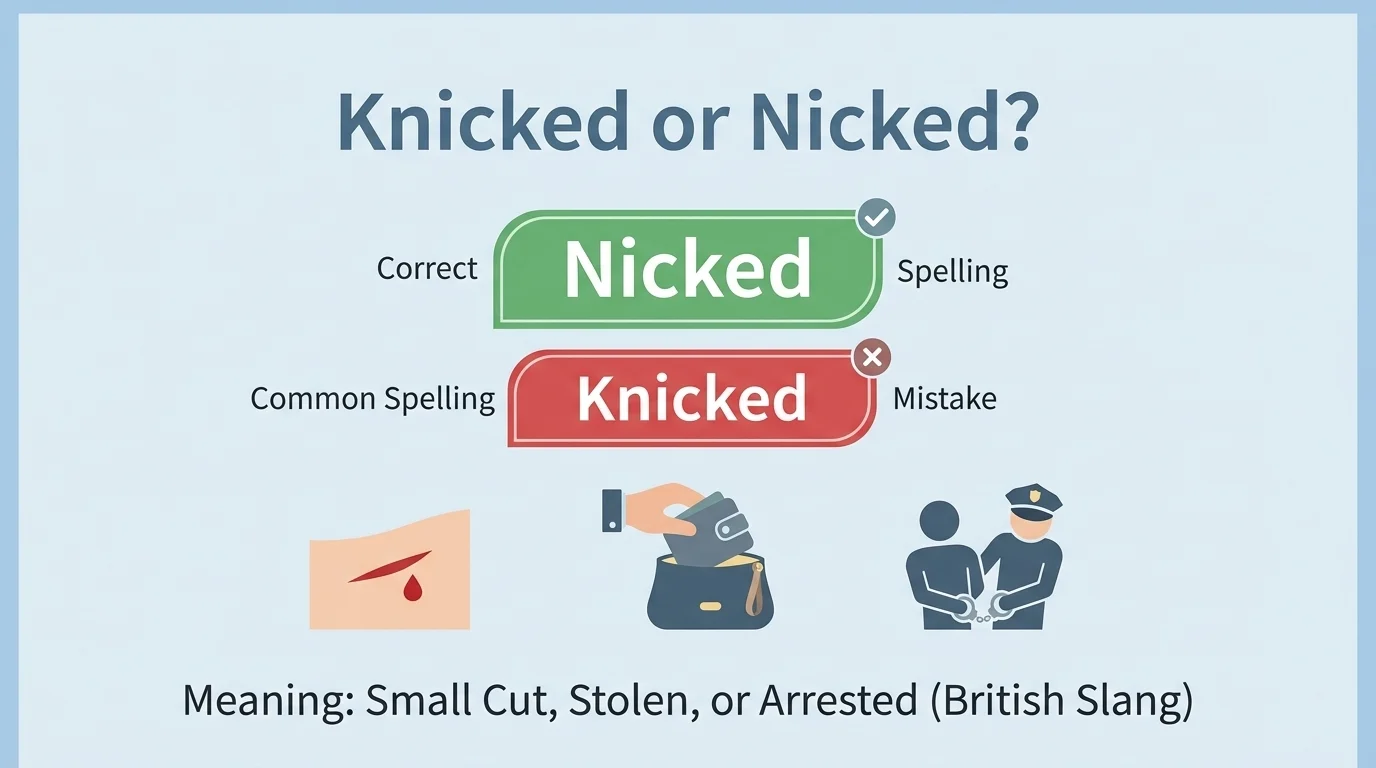
Quick Ans: “Nicked” is the standard spelling when you mean made a small cut, stole something, or were arrested in informal British English. “Knicked” is generally a misspelling of “nicked.” The word “nicked” comes from the verb “nick,” which has several meanings depending on context. (Cambridge Dictionary)
Are you wondering whether to write “knicked or nicked”? In standard English, “nicked” is the correct spelling.
The word comes from the verb “nick.” It can mean making a small cut, stealing something, or, in British slang, being arrested. For example, “I nicked my finger” means that I made a small cut on my finger. In British informal English, “Someone nicked my phone” means someone stole my phone. (Cambridge Dictionary)
The confusion often happens because the word sounds as though it might begin with “kn.” English has several words that begin with silent “k,” such as “knife” and “knee.” However, “nick” does not follow that pattern.
Therefore, if you are writing an email, article, school assignment, or social media post, use “nicked” when this is the word you need.
Quick Answer and Key Takeaway
| Form | Standard Spelling? | Meaning |
|---|---|---|
| Nicked | Yes | Past tense of “nick” |
| Knicked | Generally no | Usually a misspelling of “nicked” |
The correct form is “nicked.” Remember that “nick” becomes “nicked” by adding “ed.”
Definition and Explanation
Nicked
“Nicked” is the past tense and past participle of “nick.” The word has several meanings.
First, it can mean making a small cut.
Example: I nicked my finger while shaving.
Second, British informal English uses “nicked” to mean stolen.
Example: Someone nicked my bicycle.
Third, British slang uses “nicked” to mean arrested by the police.
Example: The police nicked him for speeding. (Cambridge Dictionary)
Knicked
“Knicked” is generally not the standard spelling of the past tense of “nick.” If you mean made a small cut, stole something, or were arrested in the slang sense, write “nicked.”
| Feature | Nicked | Knicked |
|---|---|---|
| Standard form | Yes | No |
| Base word | Nick | Not applicable |
| Example | He nicked his hand. | He knicked his hand. |
| Common use | Standard English | Usually a spelling mistake |
So, when you mean the past tense of “nick,” choose “nicked.”
Is This a Grammar, Usage, or Vocabulary Issue?
This is mainly a spelling and vocabulary issue. “Nicked” is a correctly formed past tense of “nick.”
The confusion comes from pronunciation. “Nick” sounds exactly like it begins with the letter “n,” so there is no reason to add a “k” before the “n.”
Also, the meaning of “nicked” depends on context. In standard usage, it can describe a small accidental cut. In British informal English, it can mean stolen or arrested. (Cambridge Dictionary)
Real World Usage Examples
Workplace Example
“I nicked the edge of the table while moving it.”
Here, “nicked” means caused a small cut or mark.
Recap: Use “nicked” when describing a small cut or mark.
Academic Example
“The sample was nicked accidentally during preparation.”
Here, “nicked” describes a small unintended cut or break.
Recap: In technical writing, “nicked” can describe minor physical damage.
Everyday Example
“Someone nicked my umbrella from the café.”
In British informal English, “nicked” means stole.
Recap: British speakers often use “nicked” informally to mean stolen. (Cambridge Dictionary)
Regional or Global Usage Differences
“Nicked” is standard English in both American and British English when it functions as the past tense of “nick.”
However, some meanings are more strongly associated with British informal English. In British English, “nick” can mean steal something or arrest someone. (Cambridge Dictionary)
American English commonly uses “nicked” for a small cut or mark. American speakers may understand the British slang meanings through films, television, and online content.
The spelling itself does not change. “Nicked” remains the correct form.
When NOT to Use It
Do not write “knicked” when you mean the past tense of “nick.”
Do not add a silent “k” simply because other English words contain one.
Avoid using the slang meaning of “nicked” in formal writing when “stolen” or “arrested” would be clearer.
Do not assume that every English speaker uses “nicked” to mean stolen.
When writing for an international audience, choose “stolen” if you want to avoid regional slang.
Common Mistakes and Corrections
| Correct Sentence | Incorrect Sentence | Why |
|---|---|---|
| I nicked my finger. | I knicked my finger. | “Nicked” is the correct past tense of “nick.” |
| Someone nicked my phone. | Someone knicked my phone. | British informal English uses “nicked” for stolen. |
| He nicked the surface with a knife. | He knicked the surface with a knife. | The standard spelling is “nicked.” |
| The police nicked him. | The police knicked him. | British slang uses “nicked” for arrested. |
Decision Rule: If the base verb is “nick,” its past tense is “nicked.” Never add a “k” after the “n.”
Exercises With Answers
Choose the correct form.
- I _____ my hand while cooking.
- Someone _____ my wallet on the train.
- The police _____ him last night.
- The correct spelling is “nicked” or “knicked”?
- She _____ the paint while moving the furniture.
- In British slang, “nicked” can mean what?
Answer Key
- nicked
- nicked
- nicked
- nicked
- nicked
- Stolen or arrested
Related Concepts and Comparisons
Readers may also search for nick vs nicked, nicked meaning, nicked British slang, nicked meaning stolen, nicked meaning arrested, nick vs cut, British slang words, and common English spelling mistakes.
FAQs
Is knicked or nicked correct?
“Nicked” is the standard spelling. “Knicked” is generally a misspelling when you mean the past tense of “nick.”
What does nicked mean in English?
“Nicked” can mean made a small cut or mark. In British informal English, it can also mean stolen or arrested. (Cambridge Dictionary)
Does nicked mean stolen?
Yes, in British informal English, “nicked” can mean stolen. For example, “Someone nicked my bike” means someone stole my bike. (Cambridge Dictionary)
What does nicked mean in British English?
In British English, “nicked” can mean stolen or arrested in informal speech. It can also have the ordinary meaning of making a small cut. (Cambridge Dictionary)
Is nicked a real word?
Yes. “Nicked” is the past tense and past participle of “nick.” Dictionaries list several meanings for the verb. (Cambridge Dictionary)
How do you spell nicked?
The correct spelling is “nicked,” with one “k” at the end of the base word and an “ed” ending. The form “knicked” is generally incorrect.
What is the difference between nicked and cut?
“Nicked” can mean making a small, usually unintended cut. “Cut” is much broader and can describe anything from a small injury to a deliberate division of an object.
Can nicked mean arrested?
Yes. In British slang, “nicked” can mean arrested by the police. For example, “He got nicked” can mean “He got arrested.” (Cambridge Dictionary)
Conclusion
When choosing between “knicked or nicked,” the correct standard spelling is “nicked.” It is the past tense and past participle of the verb “nick.”
The word has several meanings, so context matters. You can “nick” something by making a small cut or mark. In British informal English, “nick” can also mean steal, while the police can “nick” someone to mean arrest them. (Cambridge Dictionary)
The main spelling rule is easy. Start with “nick” and add “ed” to form “nicked.” You do not add another “k” before the “n.”
Although “knicked” may appear in online writing, it is generally a spelling mistake when the intended word is “nicked.” Therefore, careful writers should always choose “nicked.”
Practical tip: remember the base word first. If you can write “nick,” you can write its past tense as “nicked.” This simple pattern will help you avoid the common “knicked” mistake.
2 thoughts on “Knicked or Nicked: Which Spelling Is Correct?”