
Quick Ans: “Flip or flop” is a common English expression with several meanings depending on context. It can describe a choice between success and failure, a buying and selling strategy, or a popular phrase used in entertainment. Understanding the context helps you know exactly what “flip or flop” means.
What does “flip or flop” mean? You may hear this phrase when someone is talking about business, real estate, food, fashion, or a new idea.
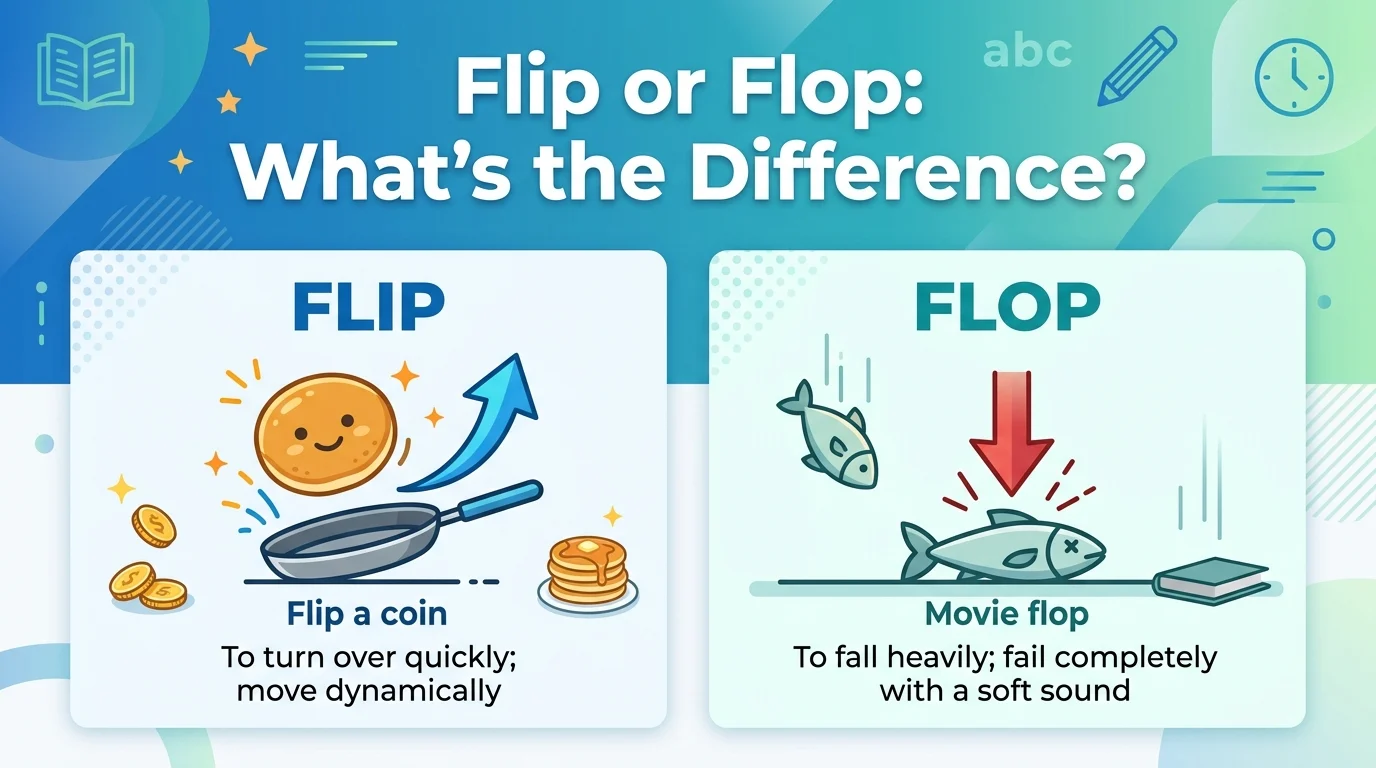
The expression is easy to understand once you know the two words. “Flip” can mean turning something over or quickly buying and selling something for profit. “Flop” can mean failing, performing poorly, or becoming unsuccessful.
Together, “flip or flop” often presents two possible outcomes. Something can work well, or it can fail.
The phrase is also used as a catchy way to ask whether an idea, product, or decision will succeed. For example, someone might ask, “Is this new product a flip or flop?” They want to know whether the product will succeed or fail.
Because the expression is informal, it appears most often in conversations, headlines, social media, entertainment, and marketing.
Quick Answer and Key Takeaway
| Expression | Meaning | Example |
|---|---|---|
| Flip | Turn over or make a quick profit | He flipped the house. |
| Flop | Fail or perform poorly | The movie was a flop. |
| Flip or flop | Success or failure, depending on context | Will the idea be a flip or flop? |
The key idea is simple: “flip” suggests success or a profitable result, while “flop” suggests failure.
Definition and Explanation
Flip
“Flip” can be a verb or noun.
As a verb, it can mean to turn something over.
Example: Flip the pancake.
In business and real estate, “flip” can mean buying something and quickly selling it for a profit.
Example: They bought the house to flip it.
Flop
“Flop” can also be a verb or noun.
As a verb, it can mean to fail or perform badly.
Example: The new product flopped.
As a noun, “flop” can describe something unsuccessful.
Example: The movie was a flop.
| Word | Part of Speech | Common Meaning | Example |
|---|---|---|---|
| Flip | Verb or noun | Turn over or resell for profit | They flipped the property. |
| Flop | Verb or noun | Fail or be unsuccessful | The project flopped. |
| Flip or flop | Expression | Possible success or failure | Will it flip or flop? |
So, the exact meaning depends on the situation. “Flip” does not always mean success, and “flop” does not always refer to business.
Is This a Grammar, Usage, or Vocabulary Issue?
“Flip or flop” is mainly a vocabulary and usage question.
Both “flip” and “flop” are standard English words. The expression itself is informal and often sounds playful or catchy.
In formal writing, choose more precise words when necessary. Instead of saying “The plan was a flop,” you could write “The plan was unsuccessful.”
Likewise, instead of “Will this product flip or flop?” a formal report might ask whether the product is likely to succeed.
Real World Usage Examples
Workplace Example
“Management wants to know whether the new product will be a flip or flop.”
Here, the phrase asks whether the product will succeed or fail.
Recap: “Flip or flop” can describe the possible success of a business idea.
Academic Example
“The researchers examined whether the proposed method would succeed or fail.”
This wording is more suitable than “flip or flop” for formal academic writing.
Recap: Academic writing usually favors precise terms over informal expressions.
Everyday Example
“Do you think this new restaurant will be a flip or flop?”
The speaker is asking whether the restaurant will become successful.
Recap: The expression works naturally in casual conversations.
Regional or Global Usage Differences
“Flip” and “flop” are widely understood in American and British English. Their basic meanings remain similar across major varieties of English.
However, “flip or flop” as a catchy expression is especially common in American media and entertainment. English speakers elsewhere can usually understand it from context.
The phrase may also appear in business discussions, especially when people talk about real estate or products.
When NOT to Use It
Do not use “flip or flop” when you need highly formal or technical language.
Avoid calling a serious academic failure a “flop” unless the tone allows informal wording.
Do not assume “flip” always means financial success. It can simply mean turning something over.
Avoid using “flop” when you mean a physical movement unless the context supports that meaning.
Do not use the phrase when a precise term such as “successful,” “unsuccessful,” “profitable,” or “unprofitable” would communicate your meaning better.
Common Mistakes and Corrections
| Correct Sentence | Incorrect Sentence | Why |
|---|---|---|
| The movie was a flop. | The movie was a flip. | “Flop” describes something unsuccessful. |
| They flipped the house for a profit. | They flopped the house for a profit. | “Flip” can mean buying and reselling property. |
| Flip the pancake carefully. | Flop the pancake carefully. | “Flip” means turn something over. |
| The new product flopped. | The new product flipped. | “Flopped” means it failed or performed poorly. |
Decision Rule: Think of “flip” as turning or reselling, and “flop” as failing. Then use the word that matches the context.
Exercises With Answers
Choose “flip” or “flop.”
- Please _____ the pancake.
- The movie was a complete _____.
- They bought the property to _____ it.
- The new app _____ after only a few months.
- Do you think the business will succeed or _____?
Answer Key
- flip
- flop
- flip
- flopped
- flop
Related Concepts and Comparisons
Readers may also search for flip meaning, flop meaning, flip vs flop, flip or flop meaning, flop meaning in business, house flipping, success vs failure, and informal English expressions.
FAQs
What does flip or flop mean?
“Flip or flop” usually describes two possible outcomes: success or failure. The exact meaning depends on the context.
Is flip or flop a common phrase?
Yes. The expression is common in casual speech, media, marketing, and entertainment. It has a catchy and informal tone.
What does flop mean in slang?
In informal English, “flop” can mean to fail or perform badly. For example, “The new show flopped” means the show was unsuccessful.
What does flip mean in business?
In business, “flip” can mean buying something and selling it relatively quickly for a profit. Real estate investors often use “flip” this way.
Is flip or flop formal English?
Not usually. The expression has an informal and conversational tone. In formal writing, “success or failure” may be a clearer alternative.
What is a flop in American English?
A “flop” is something that fails or performs poorly. People commonly use the word for movies, products, businesses, shows, and ideas.
Can flip mean turn over?
Yes. “Flip” commonly means to turn something over or change its position. For example, “Flip the page” means turn the page over.
What is the opposite of a flop?
A success is the clearest opposite of a flop. In business, you might also use “hit” to describe something that performs very well.
Conclusion
“Flip or flop” is a flexible English expression that usually presents two possible outcomes. In casual contexts, “flip” can suggest a successful or profitable result, while “flop” suggests failure or poor performance.
However, the individual words have other meanings. “Flip” can mean turning something over, as in “Flip the pancake.” It can also describe buying and reselling something for profit. “Flop” can describe something that fails, such as a movie, product, or business.
The phrase is informal, so it works best in everyday conversation, entertainment, marketing, and casual writing. For academic or professional documents, clearer words such as “success,” “failure,” “profitable,” or “unsuccessful” may work better.
The easiest way to remember the difference is to connect flip with turning or reselling and flop with failure.
Practical tip: before using “flip or flop,” check the context. If you need a formal tone, replace it with a more precise expression.
1 thought on “Flip or Flop: What’s the Difference? Easy Rules, Meanings & Examples”