
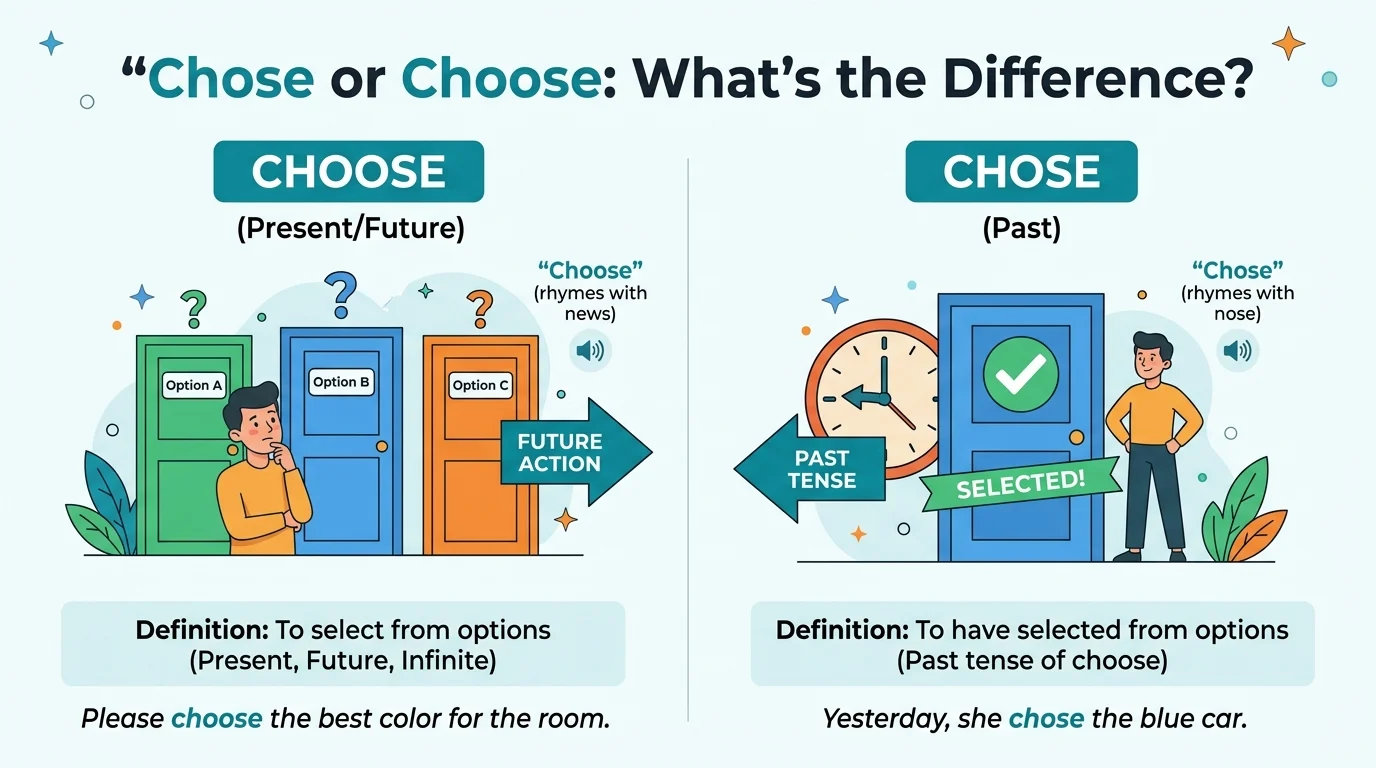
Quick Ans: “Choose” is the present tense verb meaning to select or decide between options. “Chose” is the simple past tense of “choose.” The easiest way to remember the difference is to use “choose” for something happening now or later, and “chose” for something that already happened.
Are you confused about whether to use “chose or choose”? These two words are easy to mix up because they come from the same verb. However, they describe different times.
Use “choose” when someone selects something in the present or will make a selection in the future. For example, “I need to choose a dress” refers to a decision that has not happened yet.
Use “chose” when the decision happened in the past. For example, “I chose the blue dress yesterday” tells us that the selection is already finished.
The difference matters in everyday conversations, emails, school assignments, and professional writing. A small change in the verb can change the time of the action.
There is also a pronunciation difference. “Choose” sounds like “chews,” while “chose” sounds like “toes.” Once you understand the tense and pronunciation, the choice becomes much easier.
Quick Answer and Key Takeaway
| Word | Tense | Meaning | Example |
|---|---|---|---|
| Choose | Present | Select something | I choose the blue one. |
| Chose | Past | Selected something | I chose the blue one yesterday. |
| Chosen | Past participle | Selected with a helping verb | She has chosen a dress. |
Quick rule: Choose for the present or future. Chose for the past.
Definition and Explanation
Choose
“Choose” is a verb meaning to select something from two or more options.
Example: I will choose a new laptop tomorrow.
It is the base form of the verb and can describe a present or future decision.
Example: We choose our meals from the menu.
“Choose” is pronounced like “chews.”
Chose
“Chose” is the simple past tense of “choose.”
Example: She chose the red car last week.
Because the decision happened in the past, “chose” is correct.
“Chose” is pronounced like “toes.”
Chosen
“Chosen” is the past participle of “choose.” It normally appears with a helping verb such as “has,” “have,” “had,” or “was.”
Example: They have chosen a new leader.
You should not normally use “chosen” by itself as the simple past tense.
| Word | Tense or Form | Example |
|---|---|---|
| Choose | Present or base form | I choose carefully. |
| Chose | Simple past | I chose carefully yesterday. |
| Chosen | Past participle | I have chosen carefully. |
The key difference is time. “Choose” describes the present or future, while “chose” describes a completed past action.
Is This a Grammar, Usage, or Vocabulary Issue?
This is mainly a grammar and verb tense issue.
The most common mistake is using “chose” for a present or future action.
Incorrect: I will chose the blue shirt.
Correct: I will choose the blue shirt.
After helping verbs such as “will,” “can,” “should,” and “must,” use the base form “choose.”
Example: You should choose wisely.
For past actions, use “chose.”
Example: She chose the cheaper option yesterday.
When using the present perfect, use “chosen.”
Example: She has chosen the cheaper option.
Real World Usage Examples
Workplace Examples
“We need to choose a new supplier.”
The decision has not happened yet, so “choose” is correct.
“The manager chose a different supplier last year.”
The decision happened in the past, so “chose” is correct.
Recap: Look at when the business decision happened.
Academic Examples
“Students can choose any topic for their projects.”
The students are making a current or future choice.
“Maria chose biology for her research project.”
The selection already happened.
Recap: The verb changes according to the time of the choice.
Everyday Examples
“Which movie should we choose?”
The decision is happening now.
“We chose that movie last night.”
The decision happened in the past.
Recap: Present choice means “choose.” Past choice means “chose.”
Regional or Global Usage Differences
“Choose” and “chose” are used in the same way in American, British, Canadian, and Australian English.
The spelling does not change between these varieties.
Pronunciation is also generally consistent. “Choose” has a long vowel sound, while “chose” has a different vowel sound.
Therefore, this is not a regional English difference. It is a standard verb tense distinction.
When NOT to Use It
Do not use “chose” after “will.” Say “will choose,” not “will chose.”
Do not use “chose” after modal verbs such as “can,” “should,” or “must.” Use “choose.”
Do not use “choose” when a completed past action requires “chose.”
Do not use “chosen” as the simple past form. Say “She chose,” not “She chosen.”
Avoid choosing the word based only on spelling. Check the tense first.
Common Mistakes and Corrections
| Correct Sentence | Incorrect Sentence | Why |
|---|---|---|
| I will choose the blue one. | I will chose the blue one. | Use the base verb after “will.” |
| She chose the blue one yesterday. | She choose the blue one yesterday. | “Chose” is the past tense. |
| You should choose carefully. | You should chose carefully. | Use the base verb after “should.” |
| They have chosen a new leader. | They have chose a new leader. | “Have” requires the past participle “chosen.” |
Decision Rule: If the action happened in the past, use “chose.” If it is happening now or will happen later, use “choose.” After “have,” “has,” or “had,” use “chosen.”
Exercises With Answers
Fill in the correct form.
- I will _____ the blue dress.
- She _____ the red dress yesterday.
- We need to _____ a restaurant.
- They have _____ a new captain.
- He _____ the cheaper option last week.
- You should _____ carefully.
Answer Key
- choose
- chose
- choose
- chosen
- chose
- choose
Related Concepts and Comparisons
Readers may also search for choose vs chose, chose vs chosen, choose past tense, chose meaning, chosen meaning, select vs choose, verb tense rules, and common irregular verbs.
FAQs
What is the difference between chose and choose?
“Choose” is the present or base form of the verb. “Chose” is the simple past tense, so use it when the selection happened earlier.
Is chose the past tense of choose?
Yes. “Chose” is the simple past tense of “choose.” For example, “I choose the blue shirt” becomes “I chose the blue shirt yesterday.”
Should I say choose or chose?
Check the time of the action. Use “choose” for present or future decisions and “chose” for completed past decisions.
What is the past tense of choose?
The past tense of “choose” is “chose.” For example, “She chose a new phone last week.”
Is chosen the past tense of choose?
No. “Chose” is the simple past tense, while “chosen” is the past participle. You usually use “chosen” with a helping verb, such as “has chosen.”
How do you pronounce choose and chose?
“Choose” sounds like “chews.” “Chose” sounds like “toes.” Their different pronunciations can help you remember which form you are using.
Is “I will chose” correct?
No. The correct form is “I will choose.” After “will,” always use the base form of the verb.
Can I say “I have chose”?
No. The correct phrase is “I have chosen.” The present perfect requires the past participle “chosen.”
Conclusion
The difference between “choose” and “chose” is mainly about verb tense. Use “choose” when someone is making a selection now or will make one later. Use “chose” when the selection already happened.
For example, “I will choose a new phone tomorrow” is correct because the decision is in the future. On the other hand, “I chose a new phone yesterday” is correct because the decision happened in the past.
Remember “chosen” too. It is the past participle, so you use it with helping verbs such as “has,” “have,” and “had.”
The pronunciation can also help. “Choose” sounds like “chews,” while “chose” sounds like “toes.”
Practical tip: look for a time clue. Words such as “yesterday” and “last week” usually point to “chose,” while “will,” “can,” and “should” require “choose.”