
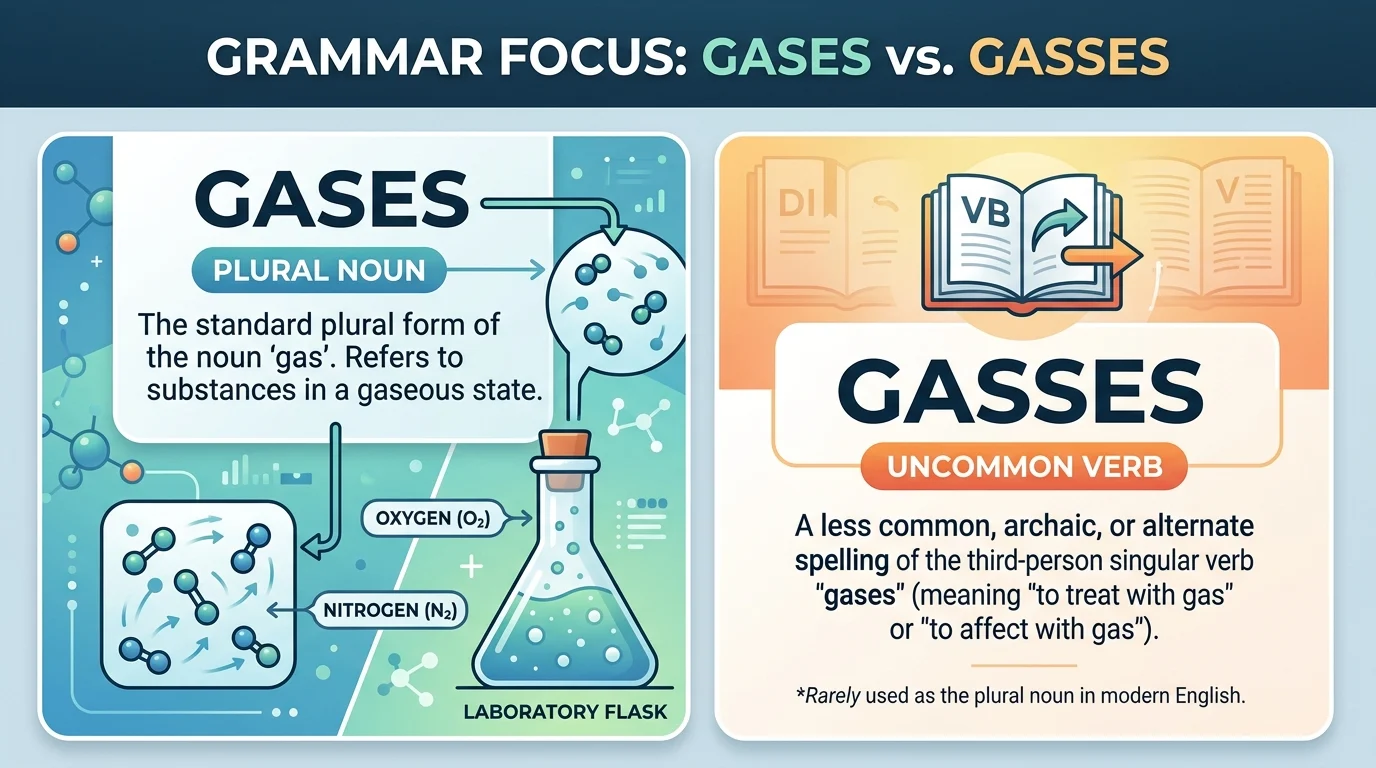
Quick Ans: Gases is the standard plural of gas and is used when talking about substances such as oxygen, carbon dioxide, or natural gas. Gasses is usually a verb form meaning to stare or breathe with difficulty, although it is uncommon. For the plural noun, gases is the correct choice in standard English.
Gases or gasses can be confusing because both spellings are technically possible, but they don’t usually serve the same grammatical purpose. If you’re writing about chemistry, science, weather, or physical substances, choosing the correct form matters.
The word gas has a simple plural form: gases. You can use it when referring to more than one type or quantity of gas. For example, scientists may study different gases in the atmosphere.
Gasses, on the other hand, is much less common. It can function as a verb, particularly as a form of gass, meaning to stare or look intensely. It can also appear as a verb related to breathing or exposing something to gas, depending on context.
This guide explains the difference between gases and gasses, shows real examples, covers common mistakes, and gives you a simple rule to remember which spelling to use.
Quick Answer and Key Takeaway
| Word | Meaning | Example |
|---|---|---|
| Gases | Plural of gas | Several gases are present in the atmosphere. |
| Gasses | Rare verb form | He gasses at the strange sight. |
Key takeaway: Use gases when you mean more than one gas. Use gasses only when the sentence clearly requires the uncommon verb form.
Definition and Explanation
What Does Gases Mean?
Gases is the plural form of gas. It refers to two or more gases or different types of gas.
Examples:
- Oxygen and nitrogen are gases.
- Some gases are invisible.
- Greenhouse gases affect the climate.
- Scientists analyze gases in the laboratory.
What Does Gasses Mean?
Gasses is a much rarer word. It can be the third person singular form of the verb gass, which means to stare or look intensely.
For example:
- He gasses at the unusual object.
However, this usage is uncommon. In most everyday writing, gases is the word you need.
Is This a Grammar, Usage, or Vocabulary Issue?
The difference between gases and gasses is mainly a vocabulary and spelling issue, but grammar also determines which form belongs in a sentence.
When gas is being used as a noun, its plural is gases.
When a sentence uses the rare verb gass, the form can be gasses.
The important point is that these words aren’t interchangeable.
Simple rule: If you’re talking about chemical substances, air, fuel, or other forms of gas, choose gases.
Real World Usage Examples
Workplace Examples
- The factory releases several gases during production.
- Workers must monitor harmful gases carefully.
- Different gases are stored in separate cylinders.
Recap: Use gases when discussing gases in professional or industrial settings.
Academic Examples
- The experiment measured three different gases.
- Greenhouse gases are an important environmental topic.
- The researchers examined how gases reacted under pressure.
Recap: Scientific and academic writing almost always requires gases for the plural noun.
Everyday Examples
- Some gases have strong odors.
- Cooking can release gases into the kitchen.
- Several gases are found in Earth’s atmosphere.
Recap: In ordinary conversation and writing, gases is the standard plural.
Regional or Global Usage Differences
There is no major regional difference between gases and gasses when gas is used as a noun.
English speakers generally use gases as the plural of gas. The spelling gasses may appear because writers assume that doubling the final consonant is necessary before adding a plural ending.
The rare verb gass can produce forms such as gasses, but this usage is not common in modern everyday English.
When NOT to Use It
Avoid gasses when you mean multiple gases.
Common situations where gases is correct
- Talking about oxygen, nitrogen, hydrogen, or carbon dioxide.
- Discussing greenhouse gases.
- Writing about gases in chemistry.
- Describing gases in the atmosphere.
- Discussing fuel or industrial gases.
- Referring to different gaseous substances.
For example:
Incorrect: Several gasses are present in the sample.
Correct: Several gases are present in the sample.
Common Mistakes and Corrections
| Correct Sentence | Incorrect Sentence | Why |
|---|---|---|
| Different gases were detected. | Different gasses were detected. | Gases is the standard plural noun. |
| Greenhouse gases affect the climate. | Greenhouse gasses affect the climate. | The plural of gas is gases. |
| The gases expanded when heated. | The gasses expanded when heated. | Gases is correct for scientific substances. |
| Scientists study gases in the atmosphere. | Scientists study gasses in the atmosphere. | Gases is the standard spelling. |
Easy Decision Rule
Ask yourself: Am I talking about more than one gas?
If yes, use gases.
If you are using the rare verb gass, then gasses may be appropriate. Otherwise, gases is almost certainly the word you need.
Exercises With Answers
Choose gases or gasses.
- Scientists identified several harmful ___.
- Oxygen and nitrogen are common ___.
- The experiment measured different ___.
- Greenhouse ___ contribute to climate change.
- He ___ at the strange object.
Answer Key
- gases
- gases
- gases
- gases
- gasses
The first four use gases because they refer to multiple gaseous substances. The final sentence uses gasses as the rare verb form.
Related Concepts and Comparisons
Gas vs Gases
Gas is singular, while gases is plural.
- One gas was detected.
- Several gases were detected.
Gases vs Gas
Use gas for one substance or a general uncountable reference. Use gases when referring to multiple types or individual gases.
- Carbon dioxide is a gas.
- Carbon dioxide and methane are gases.
FAQs
Is gases the plural of gas?
Yes. Gases is the standard plural form of gas. It is used when referring to more than one gas or different types of gas.
Is gasses a correct word?
Yes, but it is uncommon. Gasses can be a verb form of the rare word gass, while gases is the normal plural noun.
Should I write gases or gasses in science?
Use gases. Scientific writing uses gases when referring to multiple gaseous substances.
Why do some people spell gases as gasses?
Some writers may apply a spelling pattern used with other words ending in a consonant. However, the standard plural of gas is gases.
Are gases and gasses pronounced the same?
In most contexts, they are pronounced differently according to their grammatical use and the pronunciation of the underlying word. The spelling and meaning should therefore be considered together.
What is the plural of gas in English?
The standard plural is gases. For example, “Several gases were found in the container.”
Is gasses acceptable in formal writing?
It can be correct when used as the rare verb form, but it should not replace gases as the plural of gas. In formal scientific writing, use gases for the plural noun.
What is the difference between gases and gasses?
Gases is the standard plural of gas. Gasses is an uncommon verb form, so the correct choice depends on the meaning of your sentence.
Conclusion
The difference between gases or gasses becomes simple once you identify the word’s role in the sentence. Gases is the standard plural of gas, so it is the correct spelling when you’re talking about multiple gaseous substances.
You will see gases frequently in chemistry, biology, environmental science, industry, and everyday writing. Examples include oxygen, nitrogen, carbon dioxide, and greenhouse gases.
Gasses is much less common and generally appears as a verb form of the rare word gass. It should not be used as the ordinary plural of gas.
When you’re unsure, remember this practical rule: more than one gas = gases. If your sentence refers to chemical substances, atmospheric gases, fuel gases, or other gaseous materials, choose gases. This simple distinction will help you avoid one of the most common spelling mistakes involving the word gas.
2 thoughts on “Gases or Gasses: What’s the Difference? Easy Rules, Examples & Tips”