
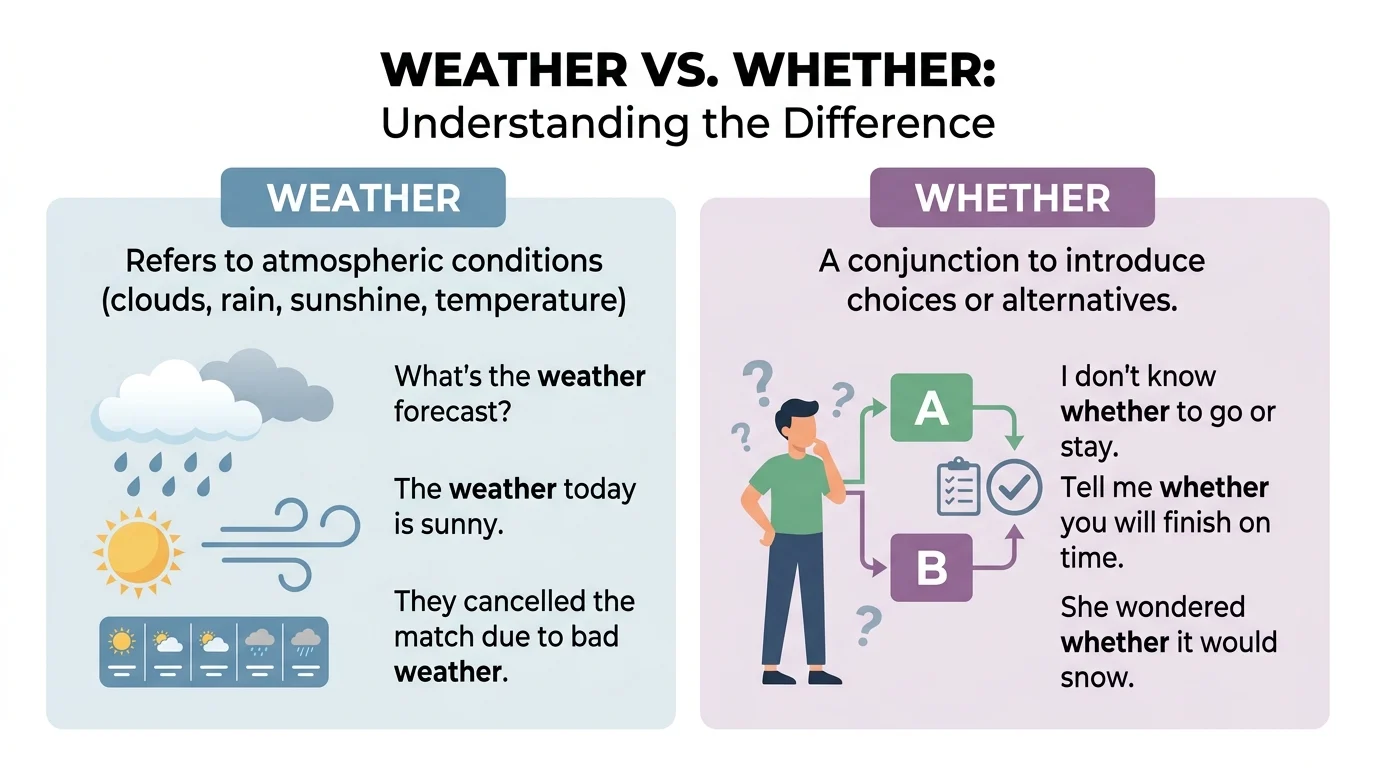
Quick Ans: Weather refers to the conditions outside, such as rain, wind, heat, or snow. Whether is used when talking about a choice, possibility, or uncertainty between alternatives. Although weather or whether sound alike, they have different meanings and grammatical roles. Knowing the difference helps you avoid common spelling and usage mistakes.
Weather or whether is a common English confusion because both words sound almost identical when spoken. However, their meanings are completely different. Weather relates to the atmosphere and conditions outside, while whether introduces a choice, possibility, or uncertainty.
For example, you might say, “The weather is cold today.” But you would say, “I don’t know whether she will come.” The first sentence talks about outdoor conditions. The second expresses uncertainty.
This confusion often appears in emails, school assignments, social media posts, and everyday writing. A simple spelling mistake can change the meaning of a sentence or make your writing unclear.
The good news is that the difference is easy to remember once you connect each word with its meaning. This guide explains weather or whether with clear definitions, examples, common mistakes, and simple rules so you can choose the correct word confidently.
Quick Answer and Key Takeaway
Weather is a noun that describes atmospheric conditions, such as rain, sunshine, snow, temperature, or wind.
Whether is usually a conjunction that introduces two possibilities, choices, or uncertainty.
| Word | Meaning | Example |
|---|---|---|
| Weather | Conditions outside | The weather is beautiful today. |
| Whether | A choice or possibility | I don’t know whether he agrees. |
Easy rule: If you are talking about rain, sunshine, temperature, or conditions outside, use weather. If you are talking about a choice or possibility, use whether.
Definition and Explanation
What Does Weather Mean?
Weather refers to the state of the atmosphere at a particular time and place. It can include temperature, rain, snow, wind, clouds, humidity, and sunshine.
Examples:
- The weather is warm today.
- We checked the weather before leaving.
- Bad weather delayed the flight.
Weather can also be used as a verb, meaning to survive or endure something difficult.
Example:
- The company managed to weather the financial crisis.
What Does Whether Mean?
Whether is used when discussing alternatives, possibilities, or uncertainty. It often appears before two choices.
Examples:
- I can’t decide whether to stay or leave.
- She asked whether I needed help.
- We don’t know whether it will work.
A useful pattern is whether…or.
Example:
- Tell me whether you want tea or coffee.
Is This a Grammar, Usage, or Vocabulary Issue?
The confusion between weather and whether is mainly a vocabulary and spelling issue, although grammar also matters.
Both words are pronounced similarly, but they serve different purposes in sentences. Weather usually works as a noun, while whether commonly functions as a conjunction.
Understanding the meaning is more useful than trying to hear the difference in conversation because many speakers pronounce them almost identically.
Real World Usage Examples
Workplace
- We need to check the weather before planning the outdoor event.
- Please let me know whether you can attend the meeting.
Recap: Use weather for outdoor conditions and whether for a workplace choice or possibility.
Academic
- The research examines how weather affects crop production.
- The study investigates whether temperature affects plant growth.
Recap: Weather describes atmospheric conditions, while whether introduces a question of possibility.
Everyday Conversation
- What will the weather be like tomorrow?
- I’m not sure whether I’ll go shopping today.
Recap: Think outside conditions for weather and uncertainty for whether.
Regional or Global Usage Differences
There is no major regional difference in the basic meanings of weather and whether. Both words are standard English and are used in countries where English is spoken.
Pronunciation can vary slightly between speakers. In some varieties of English, whether may be pronounced with a subtle difference from weather. In everyday speech, however, many speakers pronounce them the same way.
The spelling and meaning remain different regardless of pronunciation.
When NOT to Use It
Do Not Use Weather for Choices
Incorrect: I don’t know weather she will come.
Correct: I don’t know whether she will come.
Do Not Use Whether for Outdoor Conditions
Incorrect: The whether is terrible today.
Correct: The weather is terrible today.
Do Not Use Weather Before Two Alternatives
Incorrect: We need to decide weather to travel.
Correct: We need to decide whether to travel.
Do Not Use Whether for Rain or Sunshine
Incorrect: The whether forecast says it will rain.
Correct: The weather forecast says it will rain.
Do Not Confuse “Whether or Not”
Whether can correctly appear with or not when expressing uncertainty.
Example:
- I don’t know whether or not he will attend.
Common Mistakes and Corrections
| Correct Sentence | Incorrect Sentence | Why |
|---|---|---|
| The weather is cold today. | The whether is cold today. | Weather describes outdoor conditions. |
| I don’t know whether she agrees. | I don’t know weather she agrees. | Whether introduces uncertainty. |
| Check the weather forecast. | Check the whether forecast. | A forecast describes weather. |
| We must decide whether to go. | We must decide weather to go. | Whether introduces a choice. |
| The bad weather caused delays. | The bad whether caused delays. | Weather means atmospheric conditions. |
Decision Rule: Ask yourself, “Am I talking about conditions outside?” If yes, choose weather. If you’re talking about a choice, possibility, or uncertainty, choose whether.
Exercises With Answers
Choose weather or whether.
- The ______ looks cloudy today.
- I don’t know ______ they will arrive.
- We checked the ______ before our trip.
- She asked ______ I wanted to join.
- Bad ______ cancelled the game.
- He couldn’t decide ______ to accept the offer.
Answer Key
- weather
- whether
- weather
- whether
- weather
- whether
Related Concepts and Comparisons
Weather vs Climate
Weather describes short term atmospheric conditions. Climate describes long term weather patterns in a region.
Example:
- Today’s weather is rainy.
- The region has a dry climate.
Whether vs If
Whether and if can sometimes introduce similar ideas, especially when expressing uncertainty.
Example:
- I don’t know whether she will come.
- I don’t know if she will come.
However, whether is especially useful when presenting alternatives.
Example:
- We must decide whether to stay or leave.
FAQs
What is the difference between weather and whether?
Weather describes atmospheric conditions such as rain, wind, and temperature. Whether expresses a choice, possibility, or uncertainty.
Is whether related to the weather?
No. Whether and weather have different meanings and origins. Their similar pronunciation is what commonly causes confusion.
How do I remember weather or whether?
Connect weather with the outdoors. If you can talk about rain, sunshine, wind, or temperature, use weather. Use whether for choices and possibilities.
Which is correct: “I don’t know weather” or “I don’t know whether”?
“I don’t know whether” is correct when expressing uncertainty. For example, “I don’t know whether she will come.”
Is “whether or not” correct English?
Yes. Whether or not is a standard expression used to show uncertainty or discuss two possibilities.
Can weather be used as a verb?
Yes. Weather can mean to survive or endure a difficult situation. For example, “The team weathered the crisis successfully.”
Is whether a noun?
Whether is generally used as a conjunction. It introduces alternatives, choices, or uncertainty in a sentence.
Why do weather and whether sound the same?
In many varieties of English, the two words have the same or very similar pronunciation. Their meanings and spellings are different even when they sound alike.
Should I use whether or if?
Both can introduce uncertainty in many sentences. Whether is often preferred when the sentence clearly presents alternatives, especially with “or.”
Conclusion
Weather and whether sound alike in many varieties of English, but they have completely different meanings. Weather refers to atmospheric conditions such as rain, wind, temperature, clouds, and sunshine. Whether introduces a choice, possibility, or uncertainty.
The easiest way to remember the difference is to connect weather with the world outside. If you’re discussing rain, heat, snow, or a forecast, weather is the correct choice. If you’re discussing whether something will happen, whether someone agrees, or which option to choose, use whether.
For example, “The weather is terrible” talks about outdoor conditions, while “I don’t know whether he will come” expresses uncertainty.
When you’re unsure, look at the meaning rather than the pronunciation. Ask yourself whether the sentence describes the atmosphere or presents a possibility. This simple check will help you use weather or whether correctly in schoolwork, professional writing, and everyday communication.