
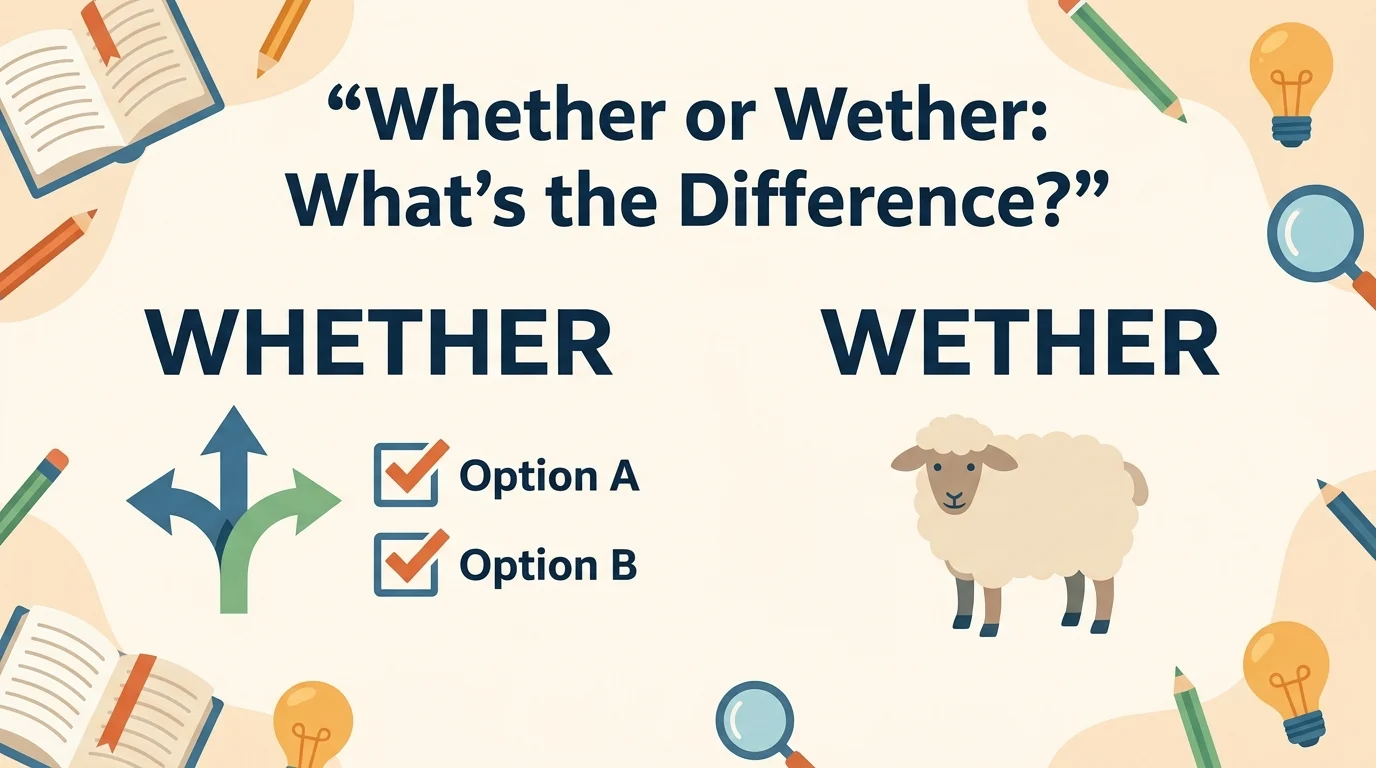
Quick Ans: “Whether” and “wether” are both real English words, but they have completely different meanings. “Whether” is used to talk about choices, alternatives, or possibilities. “Wether” is a less common noun that means a castrated male sheep or goat. For everyday writing, “whether” is usually the word you need.
Are you confused about whether or wether? These words sound almost identical, so it is easy to mix them up when writing.
The difference becomes clear when you look at their meanings. “Whether” is a common grammar word. We use it when discussing two possibilities or choices. For example, “I don’t know whether she will come” means you are unsure if she will come.
“Wether,” on the other hand, is a specific noun used mainly in farming and animal related contexts. It refers to a castrated male sheep or goat. Because this word is uncommon in everyday conversation, many English learners rarely encounter it.
There is also a third word that often causes confusion: “weather.” It refers to conditions such as rain, wind, heat, and snow.
Therefore, knowing the difference between these three words can help you avoid spelling mistakes. In most everyday sentences about choices or uncertainty, “whether” is the correct choice.
Quick Answer and Key Takeaway
| Word | Meaning | Example |
|---|---|---|
| Whether | Expresses a choice or possibility | I don’t know whether he will come. |
| Wether | A castrated male sheep or goat | The farmer raised a wether. |
| Weather | Conditions outside | The weather is sunny today. |
Quick rule: If you are talking about a choice or possibility, use “whether.”
Definition and Explanation
Whether
“Whether” is a conjunction used to introduce alternatives, choices, or possibilities.
Example: I don’t know whether she is coming.
It can also appear with “or not.”
Example: We will go whether or not it rains.
Here, “whether” introduces two possible situations.
Wether
“Wether” is a noun. It refers to a castrated male sheep or, in some usage, a castrated male goat.
Example: The farmer bought a young wether.
This word is uncommon outside farming, agriculture, and discussions about livestock.
Weather
“Weather” is a noun referring to the condition of the atmosphere at a particular time and place.
Example: The weather is cold today.
| Word | Part of Speech | Meaning | Example |
|---|---|---|---|
| Whether | Conjunction | Choice or possibility | I wonder whether he knows. |
| Wether | Noun | Castrated male sheep or goat | The wether stayed with the flock. |
| Weather | Noun | Atmospheric conditions | The weather changed quickly. |
The main difference is meaning. “Whether” relates to choices, “wether” relates to livestock, and “weather” relates to atmospheric conditions.
Is This a Grammar, Usage, or Vocabulary Issue?
This is mainly a spelling and vocabulary issue.
“Whether” is a common grammar word, while “wether” is a specialized vocabulary word. Both are correct, but you cannot normally replace one with the other.
For example:
Correct: I don’t know whether he agrees.
Incorrect: I don’t know wether he agrees.
The second sentence uses a livestock term where a conjunction is required.
Meanwhile, “weather” has an entirely different meaning.
Correct: The weather is getting colder.
Real World Usage Examples
Workplace Example
“We need to decide whether to accept the proposal.”
Here, “whether” introduces two possible choices.
Recap: Use “whether” when discussing a decision or alternative.
Academic Example
“The study examined whether the treatment improved results.”
The sentence describes an investigation into a possible outcome.
Recap: “Whether” is common in academic writing when discussing uncertainty.
Everyday Example
“I can’t decide whether to stay or leave.”
The speaker is choosing between two possibilities.
Recap: “Whether” is common in everyday questions and decisions.
Farming Example
“The farmer separated the wether from the younger animals.”
Here, “wether” refers to a specific type of male sheep or goat.
Recap: Use “wether” only when discussing the relevant livestock meaning.
Regional or Global Usage Differences
“Whether” has the same basic meaning in American and British English. It is widely used in both varieties.
“Wether” also has the same basic meaning across major English varieties, although it is uncommon in everyday conversation.
The word “weather” is also widely understood worldwide.
Therefore, the main challenge is not regional usage. Instead, the problem comes from their similar pronunciation and different meanings.
When NOT to Use It
Do not use “wether” when you mean “whether.”
Do not use “weather” when you are talking about a choice or possibility.
Avoid writing “I don’t know wether she will come.” The correct sentence is “I don’t know whether she will come.”
Do not use “whether” to describe rain, temperature, wind, or storms.
Avoid using “wether” unless you are specifically talking about livestock.
Common Mistakes and Corrections
| Correct Sentence | Incorrect Sentence | Why |
|---|---|---|
| I don’t know whether she will come. | I don’t know wether she will come. | “Whether” introduces a possibility. |
| We will go whether it rains or not. | We will go wether it rains or not. | “Wether” refers to livestock. |
| The weather is beautiful today. | The whether is beautiful today. | “Weather” describes atmospheric conditions. |
| The farmer owns a wether. | The farmer owns a whether. | “Wether” is the livestock term. |
Decision Rule: Ask yourself what you mean. A choice needs “whether,” atmospheric conditions need “weather,” and a castrated male sheep or goat is a “wether.”
Exercises With Answers
Choose the correct word.
- I don’t know _____ she will attend.
- The _____ is cold today.
- The farmer bought a young _____.
- We need to decide _____ to stay.
- I will go _____ or not you come.
- The _____ changed suddenly.
Answer Key
- whether
- weather
- wether
- whether
- whether
- weather
Related Concepts and Comparisons
Readers may also search for whether vs weather, whether or not, weather vs whether, wether meaning, if vs whether, weather meaning, commonly confused words, and English spelling mistakes.
FAQs
What is the difference between whether and wether?
“Whether” introduces a choice, alternative, or possibility. “Wether” is a noun referring to a castrated male sheep or goat.
Is wether a real word?
Yes. “Wether” is a real English word, but it is uncommon. It is mainly used when talking about certain livestock.
Is whether or wether correct?
Both are correct words, but they have different meanings. In a sentence such as “I don’t know whether she will come,” only “whether” is correct.
What does whether mean in English?
“Whether” is used when discussing alternatives or possibilities. For example, “She asked whether I wanted tea or coffee.”
What does wether mean?
“Wether” is a noun for a castrated male sheep or goat. The word is mainly used in farming and livestock contexts.
Is whether the same as weather?
No. “Whether” refers to choices or possibilities, while “weather” describes atmospheric conditions such as rain, wind, and temperature.
How do you remember whether vs wether?
Remember that “whether” contains the letters “her,” which can help you recognize it as the common grammar word. “Wether” is the specialized livestock term.
Why do whether and wether sound the same?
They are homophones, meaning they have the same or nearly the same pronunciation but different meanings and spellings. Context tells you which word is correct.
Conclusion
The difference between whether or wether is simple once you remember their meanings. “Whether” is the common word used for choices, alternatives, and possibilities. For example, “I don’t know whether he will come.”
“Wether” has a much more specific meaning. It is a noun referring to a castrated male sheep or goat, so you will mainly see it in farming or livestock contexts.
Don’t forget “weather” either. It refers to atmospheric conditions, such as rain, snow, wind, and temperature. Although all three words can sound similar, their meanings are completely different.
For everyday writing, “whether” will usually be the correct choice when you are discussing uncertainty or alternatives. Check the meaning before choosing the spelling, especially when the sentence contains words such as “if,” “or,” or “not.”
Practical tip: If you can replace the word with “if,” you probably need “whether.”
2 thoughts on “Whether or Wether: What’s the Difference? Easy Rules, Examples & Tips”