
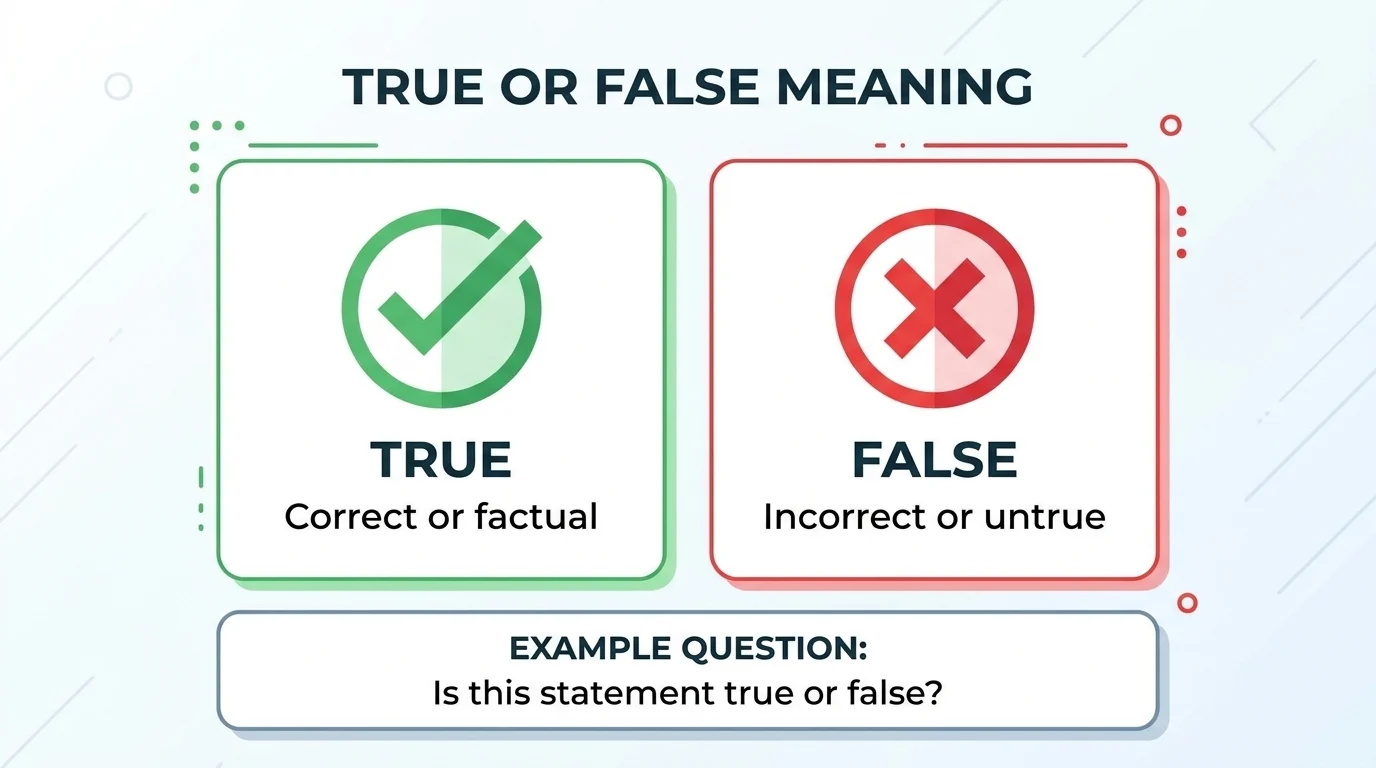
Quick Ans: “True or false” is a common English expression used to ask whether a statement is correct or incorrect. “True” means correct or factual, while “false” means incorrect or untrue. The phrase is widely used in exams, quizzes, surveys, games, and everyday conversations.
If you are searching for “true or false,” you may want to know what the expression means or how to use it correctly.
The phrase gives you two possible choices. You decide whether a statement matches the facts or does not. For example, “The Earth is round. True or false?” asks you to decide whether the statement is correct.
Teachers often use true or false questions to test knowledge. Likewise, websites and apps use them for quizzes and quick assessments. In everyday English, people may also use the expression to check whether something they heard is correct.
Although the phrase looks simple, learners sometimes confuse “true” with “truth” or “false” with “falsely.” Understanding their grammatical roles makes the difference clear.
Quick Answer and Key Takeaway
| Term | Meaning | Example |
|---|---|---|
| True | Correct or factual | The statement is true. |
| False | Incorrect or untrue | The statement is false. |
| True or false | Two possible answers | Is this true or false? |
Easy rule: Use “true” for something correct and “false” for something incorrect.
Definition and Explanation
True
“True” is an adjective. It describes something that agrees with facts or reality.
Example: The information is true.
It can also describe something genuine or accurate.
Example: That is a true story.
False
“False” is also an adjective. It describes something that is not true, correct, or factual.
Example: The statement is false.
Both words can describe statements, information, answers, claims, and beliefs.
| Word | Part of Speech | Meaning | Example |
|---|---|---|---|
| True | Adjective | Correct or factual | Her answer is true. |
| False | Adjective | Incorrect or untrue | His answer is false. |
| Truth | Noun | What is true | Tell me the truth. |
The important difference is grammatical. “True” and “false” describe something, while “truth” names the idea of what is true.
Is This a Grammar, Usage, or Vocabulary Issue?
“True or false” is mainly a vocabulary and usage question. Both words are grammatically correct, but they have opposite meanings.
You can use the expression as a direct question:
“Is this statement true or false?”
You can also use it as an instruction:
“True or false: Water freezes at 0°C.”
In formal writing, the expression works well in tests and educational material. In casual conversation, people may simply ask, “Is that true?”
Real World Usage Examples
Workplace Example
“True or false: Employees must complete the training before Friday.”
The question checks whether employees understand a workplace rule.
Recap: Use “true or false” for a quick knowledge check.
Academic Example
“True or false: Plants use photosynthesis to produce food.”
Students must decide whether the statement is accurate.
Recap: Teachers commonly use this format in exams and quizzes.
Everyday Example
“True or false, you already knew about the surprise?”
The speaker wants confirmation about a claim.
Recap: The phrase also works in casual conversations.
Regional or Global Usage Differences
“True or false” has the same basic meaning in American, British, Canadian, and Australian English.
There is no major regional spelling difference. Educational systems may use different question formats, but English speakers generally understand the expression in the same way.
When NOT to Use It
Do not use “true or false” when a question requires several possible answers.
Avoid using “truth” when you need the adjective “true.”
Do not use “false” when you mean something is simply unlikely or difficult.
Avoid forcing a true or false answer when a situation is more complicated and needs explanation.
In academic research, don’t reduce a complex finding to “true” or “false” without considering evidence and context.
Common Mistakes and Corrections
| Correct Sentence | Incorrect Sentence | Why |
|---|---|---|
| Is the statement true or false? | Is the statement truth or false? | “True” is the adjective. |
| The answer is true. | The answer is truth. | “True” describes the answer. |
| The statement is false. | The statement is falsely. | “False” is the correct adjective. |
| True or false: Water freezes at 0°C. | Truth or false: Water freezes at 0°C. | The standard expression uses “true.” |
Decision Rule: Ask whether the statement agrees with the facts. If it does, choose “true.” If it does not, choose “false.”
Exercises With Answers
Decide whether each statement is true or false.
- The Earth orbits the Sun.
- “False” means correct.
- “True” is an adjective.
- “True or false” gives two possible answers.
- The Sun rises in the west.
- “Truth” and “true” are the same part of speech.
Answer Key
- True
- False
- True
- True
- False
- False
Related Concepts and Comparisons
Readers searching for “true or false” may also want to learn about true vs false, truth vs true, correct vs incorrect, fact vs opinion, true or false questions, true meaning, false meaning, and statement vs question.
FAQs
What does true or false mean?
“True or false” asks whether a statement is correct or incorrect. “True” means the statement agrees with the facts, while “false” means it does not.
Is true or false grammatically correct?
Yes. “True or false” is a standard English expression. It is especially common in quizzes, exams, surveys, and educational materials.
What is the difference between true and false?
“True” describes something that agrees with reality or facts. “False” describes something that does not.
What is a true or false question?
A true or false question gives you a statement and asks you to decide whether it is correct. You normally choose either “true” or “false.”
Can true or false be used in everyday English?
Yes. People can use the phrase when checking information in casual conversation. For example, “True or false, you met him yesterday?”
What is the difference between true and truth?
“True” is an adjective, while “truth” is a noun. You can say “The statement is true” and “Tell me the truth.”
Is false the opposite of true?
Yes. “False” is the usual opposite of “true” when discussing whether something is correct or factual.
Can I use true or false in formal writing?
Yes. The expression is acceptable in formal contexts, especially for tests and assessments. However, complex academic claims usually need evidence and explanation.
Conclusion
“True or false” is a simple and useful English expression. It presents two possible choices and asks whether a statement is correct or incorrect.
Use “true” when something agrees with facts or reality. Use “false” when it does not. For example, “The Earth orbits the Sun” is true, while “The Earth is the center of the solar system” is false.
The expression works in exams, quizzes, surveys, games, workplaces, and everyday conversations. Its meaning remains consistent across major varieties of English.
Remember that “true” and “false” are adjectives, while “truth” is a noun. Therefore, say “The statement is true,” not “The statement is truth.”
Practical tip: When you see a true or false question, check the statement against the facts first. Then choose “true” if it is correct and “false” if it is not.