
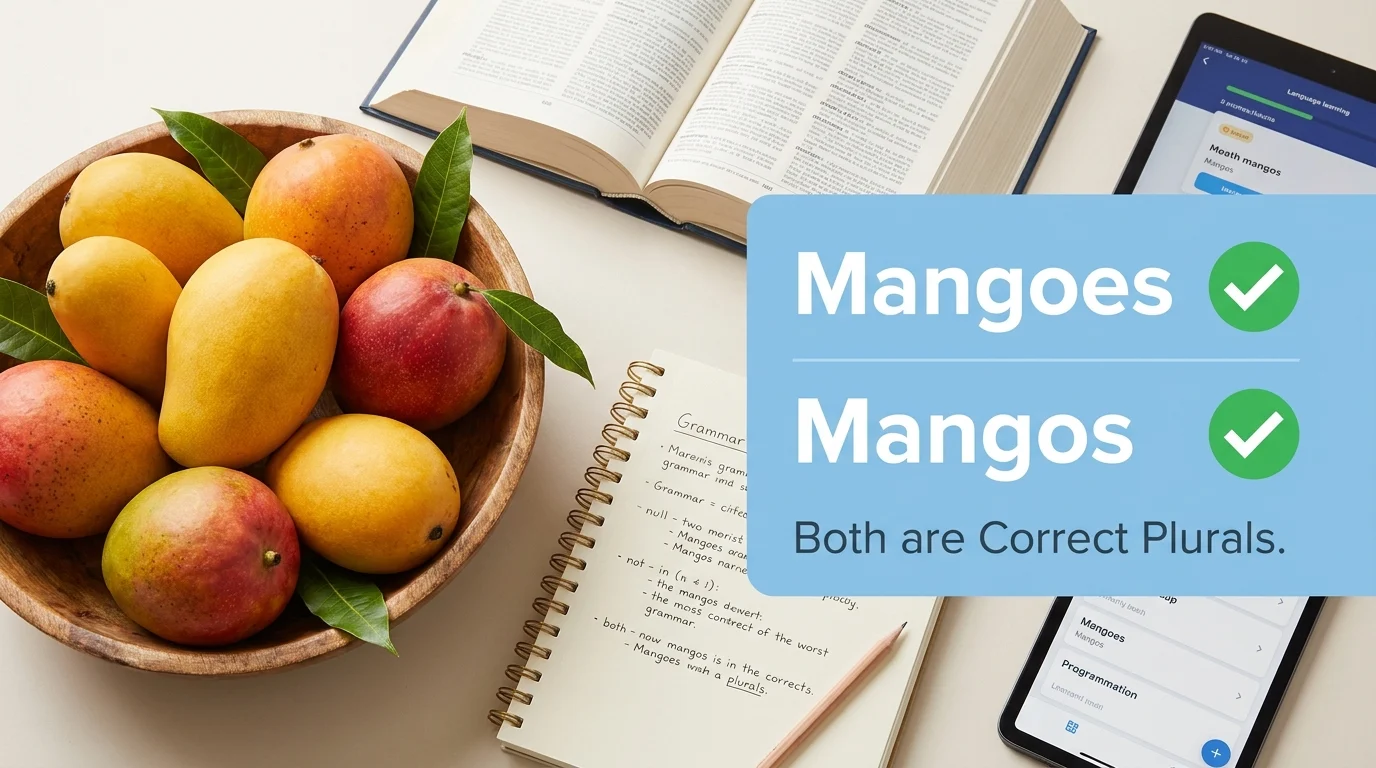
Quick Ans: Both mangoes and mangos are correct plural forms of mango. Mangoes is the more common spelling in general English, while mangos is also widely accepted, especially in some American dictionaries and usage. If you want the safest and most familiar spelling, use mangoes.
Mangoes or mangos is a spelling question that often confuses English learners and writers. The word mango refers to the popular tropical fruit, but its plural form can appear with either es or simply s.
Both spellings are considered correct, so this isn’t a case where one form is simply right and the other is wrong. However, mangoes is generally the more common plural spelling, while mangos is also established and appears frequently in modern English.
Knowing why both forms exist can help you avoid unnecessary spelling mistakes. This is especially useful when writing recipes, grocery lists, school assignments, food articles, menus, or product descriptions.
In this guide, you’ll learn the difference between mangoes and mangos, which form is more common, how to use each one in a sentence, and what other plural forms can teach us about English spelling.
Quick Answer and Key Takeaway
| Spelling | Correct? | Commonness |
|---|---|---|
| Mangoes | Yes | More common |
| Mangos | Yes | Also widely accepted |
Simple rule: Use mangoes if you want the more familiar and widely used spelling. Mangos is also correct, so it should not be treated as a spelling error.
Mangoes or Mangos: Definition and Explanation
What Does Mango Mean?
A mango is a tropical fruit with sweet, juicy flesh and a large seed in the center.
The singular form is:
I ate one mango.
When referring to more than one, you can write:
I bought five mangoes.
You can also write:
I bought five mangos.
Both sentences are grammatically correct.
Why Are There Two Plural Spellings?
English has several nouns that allow more than one accepted plural spelling. Mango is one of them.
The plural can be formed with s or es, giving us:
mango → mangos
mango → mangoes
The spelling with es is more familiar to many English speakers, but the shorter form with s is also standard.
Is This a Grammar, Usage, or Vocabulary Issue?
This is mainly a spelling and usage issue.
The meaning does not change between mangoes and mangos. Both refer to more than one mango.
The main difference is simply spelling preference and frequency of use. Therefore, writing mangos does not automatically mean you have made a grammar mistake.
Real World Usage Examples
Everyday English
We bought some ripe mangoes from the market.
These mangos are incredibly sweet.
Recap: Both forms work when talking about multiple fruits.
Academic and Formal Writing
Mangoes are widely cultivated in tropical and subtropical regions.
For formal writing, mangoes is often a comfortable choice because it is highly familiar to readers.
Recap: Mangoes is a safe choice for general and formal writing.
Food and Recipes
Add two chopped mangoes to the salad.
The smoothie contains fresh mangos and yogurt.
Recap: Both spellings can appear naturally in food related writing.
Mangoes vs Mangos: Which Is More Common?
Mangoes is generally the more common plural form in English.
However, mangos is not an incorrect alternative. It has long been used and is recognized by major dictionaries.
If you’re writing for a broad audience and don’t have a specific style guide to follow, mangoes is usually the safest choice.
Regional or Global Usage Differences
Usage can vary somewhat between English speaking regions and individual publications.
Mangoes is widely used internationally and is especially familiar in British English and many other varieties of English.
Mangos is also common in American usage and appears in major American dictionaries.
The important point is that regional preference does not make one spelling grammatically wrong.
When NOT to Use Mangoes or Mangos
Don’t use either plural form when you’re referring to only one fruit.
Incorrect:
I bought two mango.
Correct:
I bought two mangoes.
Also avoid changing the spelling randomly within the same article. If you choose mangoes, consistency usually makes your writing look more polished.
Common Mistakes and Corrections
| Correct Sentence | Incorrect Sentence | Why |
|---|---|---|
| I bought three mangoes. | I bought three mango. | A plural noun is needed. |
| She sliced two mangos. | She sliced two mango’s. | An apostrophe does not form a plural. |
| Mangoes are in season. | Mango’s are in season. | Mango’s indicates possession, not a plural. |
| We planted mango trees. | We planted mangoes trees. | Mango is used as a noun modifier here. |
Easy Decision Rule
Remember:
One = mango
More than one = mangoes or mangos
If you’re unsure which plural spelling to choose, use mangoes. It’s the more familiar option for most readers.
Exercises With Answers
Choose the correct form.
- I bought four ______ from the store.
- She ate one ______ after lunch.
- ______ are my favorite summer fruit.
- We need two ripe ______ for this recipe.
- The farmer grows hundreds of ______.
Answers
- mangoes or mangos
- mango
- Mangoes or Mangos
- mangoes or mangos
- mangoes or mangos
Related Concepts and Comparisons
Mangoes vs Mango’s
Mangoes is a plural noun. Mango’s is normally possessive.
The mangoes are ripe.
The mango’s skin is green.
Mangoes vs Mango
Mango is singular, while mangoes and mangos are plural.
One mango
Two mangoes
Tomatoes and Potatoes
Mango isn’t the only word that can cause plural spelling confusion. Words such as tomato and potato follow their own plural spelling patterns.
Learning individual plural patterns is often more useful than assuming every English noun follows the same rule.
FAQs
Is mangoes or mangos correct?
Both mangoes and mangos are correct plural forms of mango. Mangoes is generally the more common spelling.
Is mangos a real word?
Yes. Mangos is an accepted plural form of mango and is not a spelling mistake.
Is mangoes the correct plural of mango?
Yes. Mangoes is a standard and widely used plural form of mango.
Which is more common, mangoes or mangos?
Mangoes is generally more common. However, mangos is also widely recognized and used.
Should I write mangoes or mangos in formal writing?
Mangoes is usually the safer choice for general formal writing because it is more familiar to a broad audience. However, mangos is still correct.
What is the plural of mango?
The accepted plural forms are mangoes and mangos.
Is mango’s the plural of mango?
No. Mango’s normally indicates possession or a contraction. The plural forms are mangoes and mangos.
Do British English speakers say mangoes or mangos?
Mangoes is widely used in British English. Mangos is also recognized, but mangoes is generally the more familiar form.
Why does mango have two plural forms?
English permits different plural patterns for some nouns. Both mangoes and mangos have become established through usage.
Conclusion
Mangoes or mangos can both be correct, so you don’t need to worry that one is automatically a spelling error. Mangoes is generally the more common and familiar plural form, making it a good choice for most everyday, academic, and professional writing.
Mangos, however, is also a legitimate plural and is widely recognized, particularly in American usage. The meaning remains exactly the same regardless of which spelling you choose.
The important distinction is between the plural forms and the possessive form. Mangoes and mangos mean more than one mango, while mango’s usually shows possession.
For a simple rule, remember: mango means one, while mangoes or mangos means more than one. When in doubt, choose mangoes for the most familiar spelling and keep your choice consistent throughout your writing.
2 thoughts on “Mangoes or Mangos: Which Spelling Is Correct? Easy Rules & Examples”