
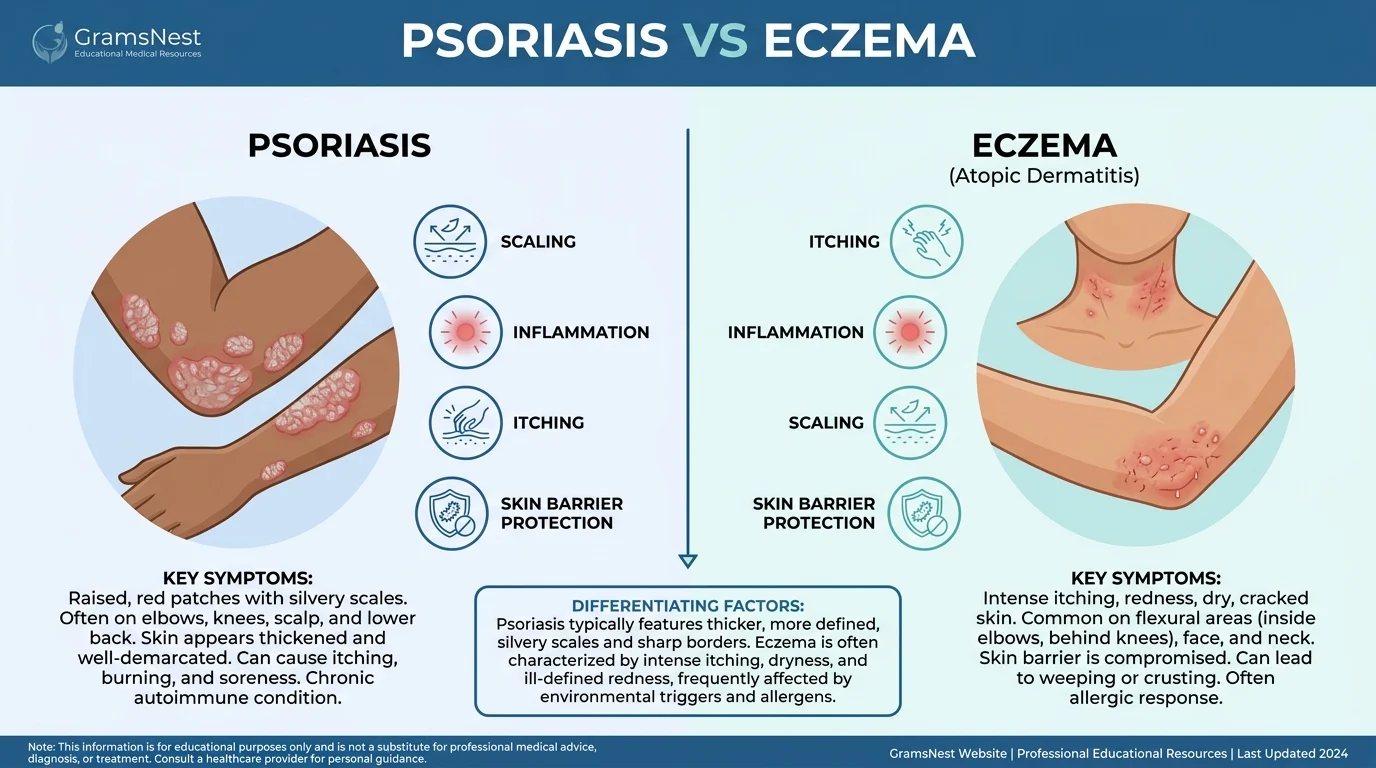
Quick Ans: Psoriasis and eczema are skin conditions that cause dryness, irritation, and inflammation. Psoriasis often creates thick, raised patches with defined edges and silvery scales, while eczema commonly causes intense itching and dry, inflamed skin. Both conditions can look similar, so a healthcare professional may be needed to confirm the diagnosis.
Psoriasis vs eczema is a common comparison for people trying to understand the causes of itchy, dry, or irritated skin. Both conditions can cause redness, scaling, discomfort, and recurring flare ups. However, they differ in their underlying causes, typical appearance, and treatment approaches.
Psoriasis is an immune mediated condition that speeds up skin cell production, causing cells to build up on the skin. Eczema, particularly atopic dermatitis, is associated with a weakened skin barrier that allows moisture to escape and irritants to enter more easily.
Although some symptoms overlap, there are useful clues that can help distinguish them. Psoriasis often causes thicker patches with clearer edges, while eczema frequently causes intense itching and may affect skin folds.
Understanding these differences can help you recognize possible symptoms and know when to seek medical advice. However, appearance alone cannot always confirm which condition you have.
Quick Answer and Key Takeaway
The main difference between psoriasis and eczema is how they affect the skin.
- Psoriasis: Often causes thick, raised, scaly patches with clearly defined edges.
- Eczema: Often causes dry, inflamed skin with intense itching.
Both conditions can be long lasting, and neither is contagious. Their symptoms can overlap, so a dermatologist can help determine the correct diagnosis.
Psoriasis vs Eczema: Definitions and Symptoms
What Is Psoriasis?
Psoriasis is a chronic inflammatory skin condition associated with an overactive immune response. It causes skin cells to develop too quickly, leading to a buildup of cells on the skin’s surface.
Common symptoms include:
- Thick, raised patches of skin
- Dry scales that may appear silvery or whitish
- Itching, soreness, or cracking
- Patches on the scalp, knees, elbows, or lower back
- Possible nail changes, such as pitting or thickening
The appearance can vary with skin tone and the type of psoriasis. American Academy of Dermatology
What Is Eczema?
Eczema is a general term for several inflammatory skin conditions. Atopic dermatitis is one of the most common types. It can occur when the skin barrier does not retain moisture effectively, making the skin more sensitive to irritants.
Common symptoms include:
- Intense itching
- Dry, sensitive skin
- Inflamed or discolored patches
- Cracked or irritated skin
- Rashes around the hands, face, wrists, or folds of the elbows and knees
Symptoms may worsen after exposure to irritating products, allergens, heat, or other personal triggers.
Key Differences Between Psoriasis and Eczema
| Feature | Psoriasis | Eczema |
|---|---|---|
| Appearance | Often thick, raised patches | Often dry, inflamed patches |
| Edges | Usually clearly defined | Often less clearly defined |
| Itching | Can range from mild to severe | Often intense |
| Common locations | Scalp, elbows, knees, lower back | Skin folds, hands, face |
| Main mechanism | Immune changes speed up skin cell production | Skin barrier problems and inflammation |
| Common triggers | Stress, infections, skin injury, some medicines | Irritants, allergens, heat, dry air |
| Nail changes | May cause pitting or thickening | Less typical |
| Contagious | No | No |
These are common patterns, not absolute rules. Both conditions can appear in unexpected places and affect people of different ages. American Academy of Dermatology
Is This a Medical or Vocabulary Issue?
Psoriasis vs eczema is a medical comparison rather than a grammar question. The terms describe different skin conditions, although people sometimes confuse them because their symptoms can look alike.
Knowing the distinction is useful, but self diagnosis can be unreliable. A healthcare professional may examine the skin, ask about your symptoms and medical history, and sometimes recommend further testing.
Real World Examples
Everyday Symptoms
Psoriasis: Someone develops thick, scaly patches on their elbows that keep returning.
Eczema: Someone experiences intensely itchy, dry skin on their wrists after using a fragranced soap.
Recap: Patch thickness, location, and itching can provide clues, but they do not confirm a diagnosis.
Workplace and Daily Activities
Psoriasis: Visible patches may cause discomfort or embarrassment during everyday interactions.
Eczema: Frequent itching may interrupt sleep, concentration, or work.
Recap: Both conditions can affect quality of life, even when the affected skin area is small.
When Not to Assume You Have Psoriasis or Eczema
Do not identify a skin condition based on one symptom alone.
- Red skin does not automatically mean eczema.
- Scaly skin does not always indicate psoriasis.
- Itching can occur with both conditions.
- A rash after using a product may have another cause.
- Symptoms in skin folds do not always mean eczema.
- Nail changes can have causes other than psoriasis.
Seek medical advice if a rash persists, spreads, becomes painful, or does not improve with appropriate care. Prompt assessment is especially important if the skin becomes hot, swollen, or increasingly painful, or if you develop fever.
Common Mistakes and Corrections
| Correct Understanding | Incorrect Assumption | Why |
|---|---|---|
| Both conditions can itch | Only eczema causes itching | Psoriasis can also itch |
| Psoriasis is not contagious | Psoriasis spreads through touch | It is not an infectious disease |
| Eczema can affect adults | Eczema only affects children | It can develop at any age |
| Both need appropriate care | The same treatment works for everyone | Treatment depends on the condition and severity |
Easy Decision Rule
Thick, clearly defined scaly patches may suggest psoriasis, while intense itching and dry, sensitive skin may suggest eczema. Neither pattern is enough to diagnose the condition yourself.
Exercises With Answers
Choose the condition most commonly associated with each description.
- Thick patches with silvery scales.
- Intense itching and a sensitive skin barrier.
- A condition that is not contagious.
- Skin patches accompanied by nail pitting.
Answers:
- Psoriasis
- Eczema
- Both
- Psoriasis
Related Concepts and Comparisons
Psoriasis vs Eczema Treatment
Treatment depends on the diagnosis. Eczema care often includes regular moisturizing, avoiding personal triggers, and prescribed anti inflammatory creams when needed. Psoriasis treatment may include topical medicines, light therapy, or oral and injectable medicines for more severe cases.
A clinician can recommend the most suitable approach. Treatments designed for one condition may not work equally well for the other.
Can You Have Both Conditions?
Yes. Although they are different conditions, one person can have both psoriasis and eczema. Their symptoms may also overlap, making professional assessment particularly useful.
FAQs
What is the main difference between psoriasis and eczema?
Psoriasis often causes thick, clearly defined scaly patches, while eczema commonly causes intensely itchy, dry, inflamed skin. However, symptoms can overlap.
How can you tell if a rash is psoriasis or eczema?
Look at the appearance, location, and severity of itching, but do not rely on these clues alone. A dermatologist can assess the rash and recommend testing if necessary.
Is psoriasis worse than eczema?
Neither condition is always worse. Severity varies from person to person, and both can affect comfort, sleep, and quality of life.
Are psoriasis and eczema contagious?
No. Neither psoriasis nor eczema spreads from person to person through ordinary contact.
Can stress trigger psoriasis or eczema?
Stress can worsen symptoms or trigger flare ups in either condition. Other triggers may also contribute.
Can eczema turn into psoriasis?
Eczema does not simply turn into psoriasis. They are distinct conditions, although their symptoms can sometimes look similar.
Which condition causes more itching?
Eczema often causes intense itching, but psoriasis can also be very itchy. The amount of itching varies between individuals.
When should you see a dermatologist?
Seek an assessment if your rash persists, spreads, causes significant discomfort, or does not respond to appropriate care. A professional diagnosis helps guide treatment.
Conclusion
Psoriasis vs eczema can be easier to understand when you compare their common symptoms, appearance, and underlying causes. Psoriasis often produces thick, raised, scaly patches, while eczema frequently causes dry, sensitive skin and intense itching. Nevertheless, neither condition always follows these typical patterns.
Both conditions can be chronic, and both may improve with appropriate treatment and skin care. Moisturizing and avoiding known irritants may help some people, but the best approach depends on the diagnosis and individual symptoms.
It is also important to remember that psoriasis and eczema are not contagious. If you notice a persistent rash, painful skin, or symptoms that keep returning, consult a qualified healthcare professional instead of relying only on online comparisons.
Practical tip: Note where your rash appears, how it looks, what makes it worse, and how long it lasts. Sharing these details with a dermatologist can help them identify the problem and recommend appropriate care.