
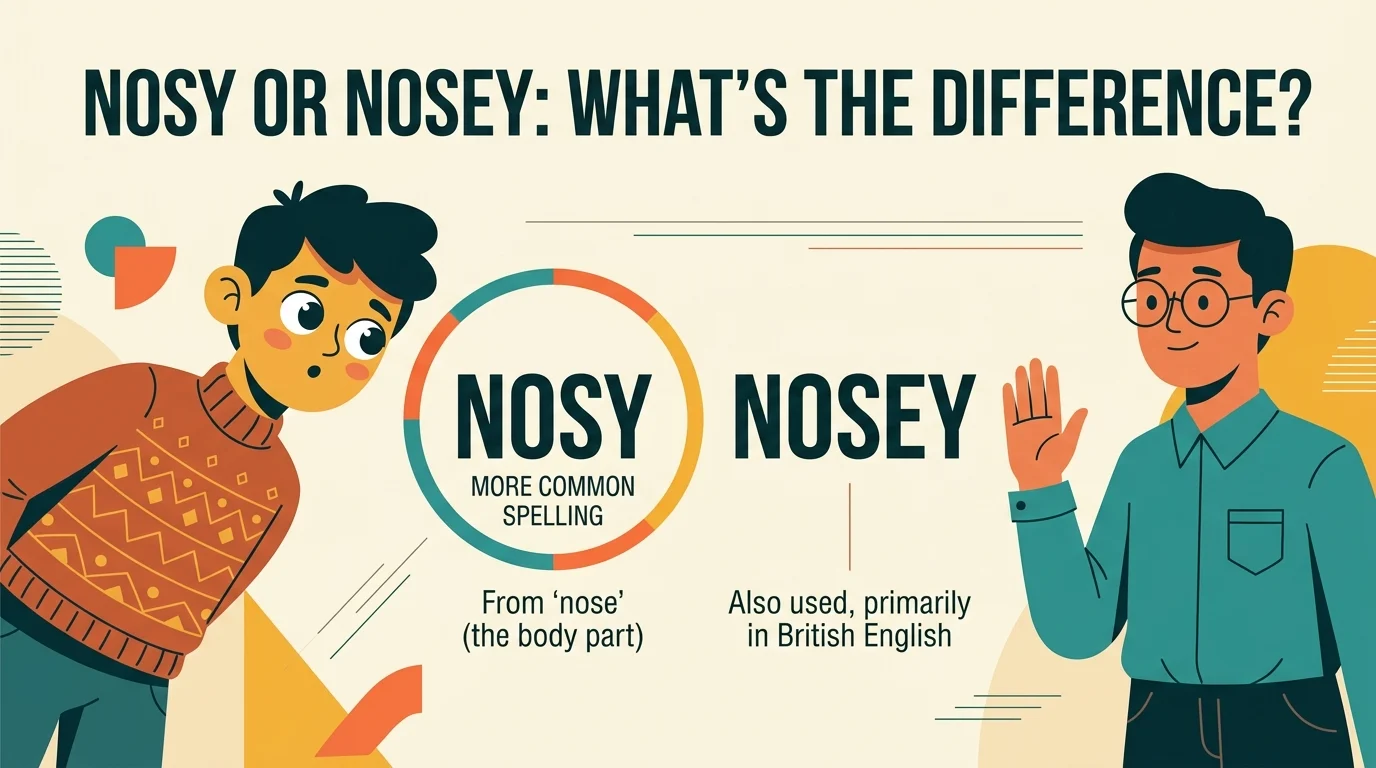
Quick Ans: Nosy and nosey are both accepted spellings of the same adjective meaning too interested in other people’s private matters. However, “nosy” is the more common spelling, especially in American English. Both forms describe someone who asks too many personal questions or tries to discover information that does not concern them.
Are you confused about whether to use nosy or nosey? Many English learners and writers wonder if one spelling is correct and whether the two words have different meanings.
Both nosy and nosey describe someone who is overly curious about other people’s lives. The word often has a negative meaning because it suggests that a person is asking questions or seeking information that should remain private.
The confusion happens because both spellings look natural. Adding an extra “e” after “nos” seems reasonable because the word comes from “nose,” but modern English commonly uses the shorter form nosy.
You may see both versions in books, articles, and conversations. However, choosing the most widely recognized spelling can make your writing look more polished and professional.
Understanding the difference between these two forms helps you write clearly in emails, stories, social media posts, and everyday communication.
Quick Answer and Key Takeaway
| Word | Meaning | Usage | Example |
|---|---|---|---|
| Nosy | Too curious about other people’s affairs | Most common spelling | My nosy neighbor asked many questions. |
| Nosey | Same meaning | Less common spelling | She is known as a nosey person. |
Key takeaway: Both spellings are correct, but nosy is the standard and more common choice.
Definition and Explanation
Nosy
“Nosy” is an adjective that describes someone who is too interested in other people’s personal information.
Example: My nosy coworker asked about my salary.
The word usually has a negative tone because it suggests a lack of respect for privacy.
Nosey
“Nosey” is an alternative spelling of the same adjective.
Example: The nosey child wanted to know everything.
Although it is accepted, many writers prefer nosy because it is shorter and more common.
| Word | Part of Speech | Meaning | Example |
|---|---|---|---|
| Nosy | Adjective | Too curious about others | He is a nosy neighbor. |
| Nosey | Adjective | Same meaning | She can be nosey sometimes. |
The two words do not have different definitions. The difference is only spelling preference.
Is This a Grammar, Usage, or Vocabulary Issue?
The difference between nosy and nosey is mainly a spelling and usage issue.
Neither form changes the meaning. Both describe someone who asks unwanted questions or tries to learn private details.
However, nosy appears more often in modern writing. Dictionaries commonly list it as the main spelling, while nosey is usually shown as a variation.
For formal writing, professional communication, or educational content, nosy is often the safer choice because more readers recognize it immediately.
Real World Usage Examples
Workplace Examples
“My nosy coworker kept asking about my personal plans.”
The word suggests the coworker asked questions that were too personal.
Recap: Use nosy when describing unwanted curiosity at work.
Academic Examples
“The article discusses how nosy behavior can affect relationships.”
The word works when discussing social behavior or communication.
Recap: Writers may use nosy in essays about human behavior.
Everyday Examples
“Don’t be nosy. It’s a private conversation.”
This is a common informal use.
Recap: Nosy often appears in everyday speech when someone crosses personal boundaries.
Regional or Global Usage Differences
The spelling difference is not a major regional issue, but nosy is more widely used internationally.
In American English, nosy is the preferred spelling in most modern writing.
British English also uses nosy, although nosey may appear as an alternative spelling.
Because the meaning stays the same, readers usually understand both forms.
When NOT to Use It
Do not use nosy or nosey when you simply mean “curious” in a positive way.
Avoid saying someone is nosy if they are asking normal questions for a good reason.
Do not use the word in professional situations where a more neutral term works better.
Avoid spelling it as noisy, because noisy means loud.
Do not assume the word refers to someone’s nose. It describes behavior, not appearance.
Do not use nosey if you want the most common modern spelling.
Common Mistakes and Corrections
| Correct Sentence | Incorrect Sentence | Why |
|---|---|---|
| She is a nosy neighbor. | She is a noisy neighbor. | Noisy means loud, not overly curious. |
| My nosy friend asked many questions. | My nosey friend asked many questions. | Nosey is accepted, but nosy is more common. |
| Stop being nosy about my plans. | Stop being curious about my plans. | Curious does not always have a negative meaning. |
| He has a nosy personality. | He has a nosey personality. | Both work, but nosy is preferred. |
Decision Rule: Use nosy in most situations. Choose nosey only when matching a source or style that already uses that spelling.
Exercises With Answers
Choose the correct spelling.
- My _____ neighbor always watches what people do.
- Don’t be so _____ about their private life.
- The story includes a _____ character.
- She asked too many personal questions because she was _____.
- A _____ person may not respect privacy.
Answer Key
- nosy
- nosy
- nosy
- nosy
- nosy
Related Concepts and Comparisons
Readers searching for nosy or nosey may also want to learn about curious vs nosy, noisy vs nosy, intrusive meaning, privacy vocabulary, inquisitive meaning, interested vs curious, and common spelling variations.
FAQs
Is nosy or nosey the correct spelling?
Both spellings are correct, but nosy is the more common and widely preferred form. It means someone who is too interested in other people’s private matters.
Does nosy mean curious?
Nosy can mean curious, but it usually has a negative meaning. A nosy person often asks questions that are too personal.
Is nosey a spelling mistake?
No. Nosey is an accepted spelling variation. However, many writers prefer nosy because it is more common.
Why is nosy spelled without an e?
The spelling nosy became the standard form in modern English. Although the word relates to “nose,” it does not need the extra e.
What is the difference between nosy and noisy?
Nosy means overly curious about others. Noisy means loud or making a lot of sound. They have completely different meanings.
Can I use nosey in formal writing?
You can, but nosy is usually a better choice because it is more common and recognized by most readers.
Is nosy a negative word?
Usually, yes. Nosy often suggests that someone does not respect another person’s privacy.
How do you use nosy in a sentence?
You can say, “My nosy neighbor always asks personal questions.” The word describes unwanted curiosity.
Conclusion
The difference between nosy or nosey is simple. Both spellings describe someone who is too interested in other people’s private information, and both are accepted in English.
However, nosy is the more common spelling and the better choice for most writing. It appears more often in dictionaries, articles, and everyday communication.
Remember that nosy is not the same as being curious. Curiosity can be positive, while nosy usually suggests that someone is crossing a personal boundary.
When writing professionally or creating educational content, choosing the more common spelling helps readers understand your message quickly.
Practical tip: Use nosy as your default spelling unless you are following a specific style that uses nosey.