
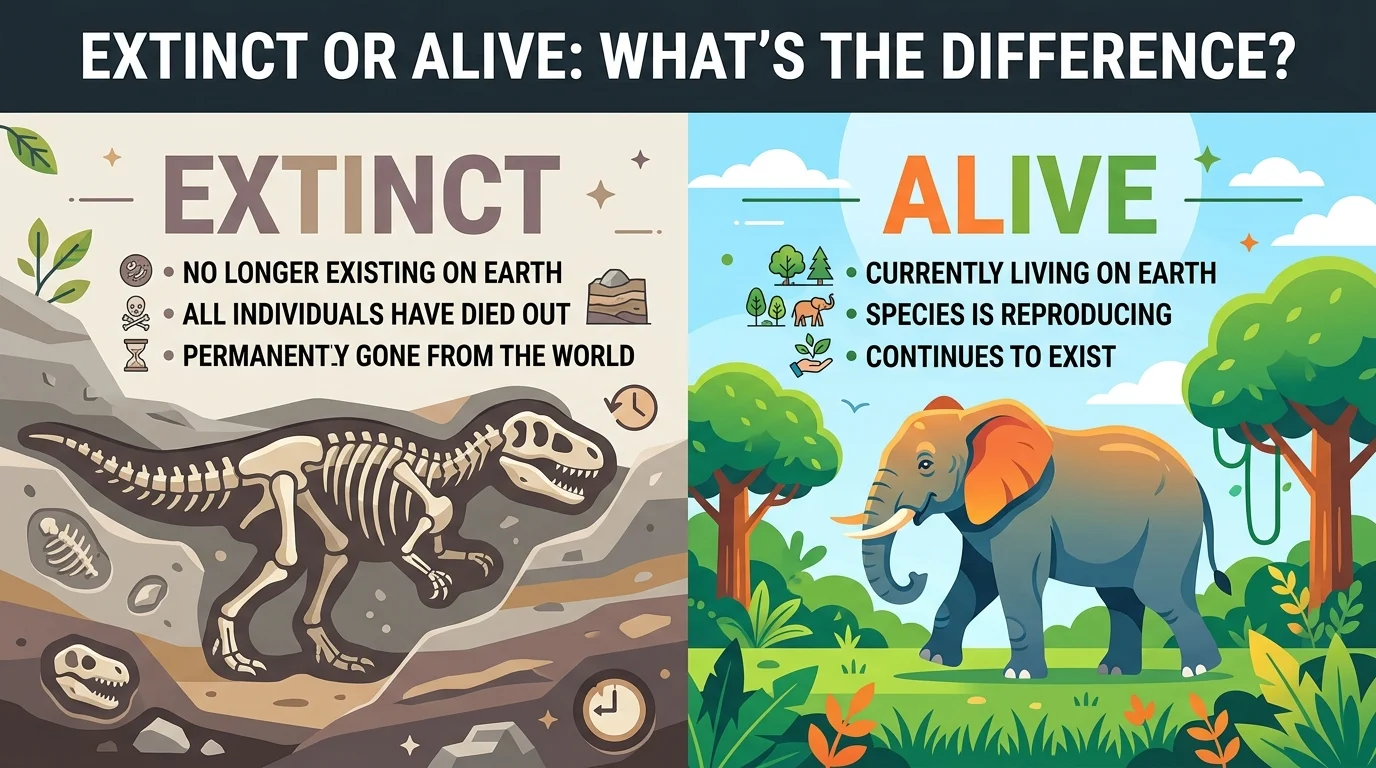
Quick Ans: Extinct means a species, language, tradition, or thing no longer exists. Alive means it still exists or continues to function. The phrase “extinct or alive” is used to compare whether something has disappeared completely or is still present today.
Are you wondering about the difference between extinct or alive? These two words describe opposite situations. One refers to something that has disappeared, while the other describes something that continues to exist.
People often use this phrase when discussing animals, plants, languages, cultures, and historical topics. For example, scientists may ask whether a species is extinct or alive when studying wildlife. Similarly, researchers may discuss whether an old language is still alive or has become extinct.
Understanding these words is useful because they appear in science, history, education, and everyday conversations. Although the meanings seem simple, many learners confuse how to use them correctly.
The word “extinct” usually refers to something that has completely disappeared. In contrast, “alive” means something still exists or remains active.
Quick Answer and Key Takeaway
| Word | Meaning | Example |
|---|---|---|
| Extinct | No longer existing | Dinosaurs are extinct. |
| Alive | Still existing or living | Many rare animals are still alive. |
Key takeaway: Use extinct for something that no longer exists and alive for something that continues to exist.
Definition and Explanation
Extinct
“Extinct” is an adjective that describes a species, language, or object that has completely disappeared.
Example: The dodo bird is extinct.
When a species becomes extinct, no living members of that species remain.
The word can also describe other things:
Example: Some ancient languages are extinct.
Alive
“Alive” is an adjective that means living, existing, active, or continuing.
Example: The animal is still alive.
The word does not only describe living creatures. It can also describe ideas, traditions, or activities that continue.
Example: The tradition is still alive today.
| Term | Part of Speech | Meaning | Example |
|---|---|---|---|
| Extinct | Adjective | Completely gone or disappeared | The species is extinct. |
| Alive | Adjective | Still existing or active | The species is alive. |
The main difference is simple. Extinct means something has ended completely. Alive means something continues.
Is This a Grammar, Usage, or Vocabulary Issue?
This is mainly a vocabulary issue because the two words have opposite meanings.
However, correct usage depends on context. “Extinct” is commonly used for species, languages, and traditions. “Alive” is used for living things and anything that continues.
For example:
Correct: The animal is extinct.
Correct: The animal is still alive.
Incorrect: The extinct animal is alive.
These words cannot usually describe the same thing at the same time because their meanings contradict each other.
Real World Usage Examples
Workplace Example
“The company studied whether the old technology was extinct or alive in modern markets.”
Here, “alive” means still useful or active.
Recap: Extinct and alive can describe whether an idea or system continues.
Academic Example
“Scientists studied whether the species was extinct or alive.”
Researchers use these terms when investigating biodiversity.
Recap: The words are common in science and research writing.
Everyday Example
“Is this old tradition extinct or alive?”
The speaker wants to know whether people still follow the tradition.
Recap: The phrase can describe customs, habits, and practices.
Regional or Global Usage Differences
The meanings of extinct and alive are the same in American English, British English, and other major English varieties.
The words are widely used in science, education, and general communication.
However, some languages or cultures may use different expressions when describing traditions or practices that continue over time.
When NOT to Use It
Do not use “extinct” when something is simply rare or uncommon.
Do not say a species is extinct unless there is evidence that no living members remain.
Avoid using “alive” only for people and animals because it can also describe ideas and traditions.
Do not confuse “extinct” with “endangered.” An endangered species still exists but faces a high risk of extinction.
Avoid using “alive” when you only mean popular. Something can be popular without being literally alive.
Common Mistakes and Corrections
| Correct Sentence | Incorrect Sentence | Why |
|---|---|---|
| Dinosaurs are extinct. | Dinosaurs are endangered. | Dinosaurs no longer exist. |
| The tradition is still alive. | The tradition is still extinct. | A continuing tradition cannot be extinct. |
| The animal is endangered, not extinct. | The animal is extinct because it is rare. | Rare does not always mean extinct. |
| The language is still alive today. | The language is still dead and alive. | Use one clear meaning. |
Decision Rule: If nothing remains, use extinct. If something continues to exist or function, use alive.
Exercises With Answers
Choose extinct or alive.
- The dodo bird is ______.
- Many species in the ocean are still ______.
- Scientists discovered that the language is no longer spoken and is ______.
- The cultural tradition is still ______ today.
- Dinosaurs are ______ animals.
Answer Key
- extinct
- alive
- extinct
- alive
- extinct
Related Concepts and Comparisons
Readers may also search for extinct vs endangered, dead or alive meaning, endangered species, extinct animals, living languages, rare vs extinct, and historical vocabulary.
FAQs
What does extinct or alive mean?
“Extinct or alive” asks whether something no longer exists or still continues. The phrase is commonly used when discussing species, languages, and traditions.
What is the difference between extinct and alive?
Extinct means completely gone, while alive means still existing. They describe opposite conditions.
Can a language be extinct or alive?
Yes. A language is extinct when no one speaks it anymore. A living language still has active speakers.
Is extinct the same as dead?
Not always. Extinct usually refers to species, languages, or things that no longer exist. Dead can have broader meanings depending on context.
Are endangered animals extinct?
No. Endangered animals still exist but face a risk of becoming extinct in the future.
Can traditions become extinct?
Yes. A tradition can become extinct if people completely stop practicing it.
What does alive mean in “keeping history alive”?
In this phrase, alive means continuing or being remembered. It does not refer to biological life.
Why do scientists study extinct species?
Scientists study extinct species to understand evolution, ecosystems, and how environments have changed over time.
Conclusion
The difference between extinct and alive is simple. Extinct means something has completely disappeared, while alive means it still exists or continues.
These words are often used in discussions about animals, plants, languages, cultures, and history. However, remember that extinct does not mean rare. A rare species may still have living members, while an extinct species has none.
The phrase “extinct or alive” helps people compare whether something has disappeared or remains present. It is commonly used in educational, scientific, and everyday contexts.
Practical tip: ask one simple question: “Does anything still exist?” If the answer is no, use extinct. If the answer is yes, use alive.