
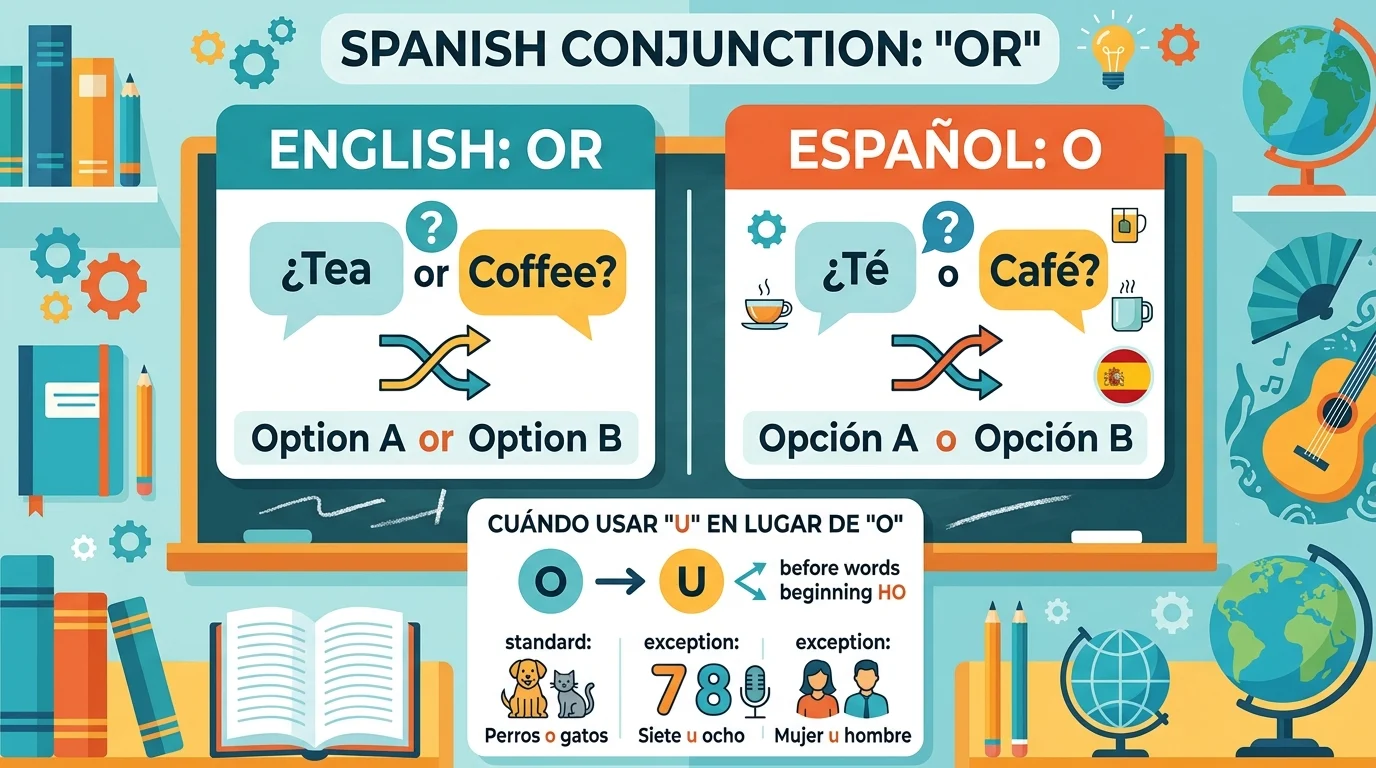
Quick Ans: “Or” in Spanish is usually translated as “o.” It connects two or more choices, alternatives, or possibilities. For example, “Do you want tea or coffee?” becomes “¿Quieres té o café?” Spanish also uses “u” instead of “o” in certain cases to make pronunciation easier.
If you are learning Spanish, you may wonder how to say “or” in Spanish and when to use it correctly. The most common translation is o, which works much like “or” in English. You use it when presenting a choice, giving alternatives, or connecting possibilities.
For example, “Would you like coffee or tea?” translates to “¿Quieres café o té?” The basic rule is simple, but there is one important exception. Spanish changes o to u before certain words that begin with an “o” sound. This helps avoid an awkward repeated sound.
Understanding this small difference can make your Spanish sound more natural and grammatically correct. In this guide, you’ll learn the meaning of “or” in Spanish, how to use o and u, common mistakes, examples, and easy rules to remember.
Quick Answer and Key Takeaway
The Spanish word for or is usually o.
English: Do you want tea or coffee?
Spanish: ¿Quieres té o café?
However, o changes to u before words beginning with the sound o or ho.
Example:
¿Son siete u ocho?
Are there seven or eight?
Easy rule: Use o normally, but use u before an “o” sound.
Definition and Explanation
What Does “Or” Mean in Spanish?
The word o is a Spanish conjunction used to connect alternatives. It can appear between nouns, verbs, adjectives, phrases, or complete ideas.
Examples:
- ¿Quieres pizza o pasta?
Do you want pizza or pasta? - ¿Vas a estudiar o trabajar?
Are you going to study or work? - Podemos ir hoy o mañana.
We can go today or tomorrow.
The meaning is generally the same as English “or.”
When Does O Change to U?
Spanish changes o to u before a word beginning with the sound “o.”
Examples:
- siete u ocho
seven or eight - uno u otro
one or the other - mujeres u hombres
women or men
This change is mainly for pronunciation. It prevents two similar sounds from appearing next to each other.
Is This a Grammar, Usage, or Vocabulary Issue?
This is mainly a grammar and usage issue involving Spanish conjunctions.
The basic vocabulary word is o, but learners also need to know the pronunciation rule that changes o to u.
| Situation | Correct Form | Example |
|---|---|---|
| Normal use | o | ¿Café o té? |
| Before an “o” sound | u | ¿Siete u ocho? |
| Before an “ho” sound | u | Uno u otro |
The key is the sound, not simply the spelling of the next word.
Real World Usage Examples
Everyday Conversation
¿Quieres agua o jugo?
Do you want water or juice?
¿Vamos en autobús o caminamos?
Are we taking the bus or walking?
¿Es tu hermano o tu primo?
Is he your brother or your cousin?
Recap: Use o when giving ordinary choices in conversation.
Workplace Usage
¿Prefieres trabajar el lunes o el martes?
Do you prefer to work Monday or Tuesday?
¿Enviamos el informe hoy u otro día?
Should we send the report today or another day?
Recap: The same o and u rule applies in professional Spanish.
Academic Usage
¿El examen es escrito o oral?
Is the exam written or oral?
¿Son seis u ocho capítulos?
Are there six or eight chapters?
Recap: Formal and academic Spanish follows the same pronunciation rule.
Regional or Global Usage Differences
The word o is standard throughout the Spanish speaking world. Spanish speakers in Spain, Mexico, Argentina, Colombia, and other Spanish speaking regions use o for “or.”
The change from o to u is also a standard grammatical rule across Spanish varieties. Regional accents may differ, but this conjunction rule remains consistent.
When NOT to Use It
Avoid these common mistakes:
- Do not always use o before a word beginning with an “o” sound.
- Do not use u randomly between ordinary words.
- Do not confuse o with ó. Modern Spanish does not normally use an accent on the conjunction o.
- Do not translate every English “or” mechanically without considering the sentence.
- Do not assume u is a completely different word. It is a pronunciation based form of o.
- Do not choose based only on spelling. Listen for the beginning sound of the following word.
Common Mistakes and Corrections
| Correct Sentence | Incorrect Sentence | Why |
|---|---|---|
| ¿Siete u ocho? | ¿Siete o ocho? | O changes to u before an “o” sound. |
| Uno u otro | Uno o otro | Use u to avoid repeated sounds. |
| ¿Café o té? | ¿Café u té? | Té does not begin with an “o” sound. |
| ¿Agua o leche? | ¿Agua u leche? | Leche does not require u. |
Simple Decision Rule
Ask yourself: Does the next word begin with an “o” sound?
If no, use o.
If yes, use u.
Exercises With Answers
Choose o or u.
- ¿Quieres café ___ té?
- ¿Son siete ___ ocho?
- Uno ___ otro.
- ¿Prefieres estudiar ___ trabajar?
- ¿Hay diez ___ once estudiantes?
Answers:
- o
- u
- u
- o
- u
Related Concepts and Comparisons
O vs U
O is the normal Spanish word for “or.”
U is used instead of o before a following word that begins with the “o” sound.
Spanish O vs English Or
English uses or for alternatives. Spanish normally uses the shorter conjunction o.
English: Tea or coffee?
Spanish: ¿Té o café?
O vs Ó
Do not confuse the conjunction o with an accented form. In modern standard Spanish, the conjunction is written o without an accent.
FAQs
What is “or” in Spanish?
The usual Spanish translation of “or” is o. It connects alternatives and choices.
How do you say “or” in Spanish between two choices?
Use o, such as ¿Quieres té o café? This means “Do you want tea or coffee?”
When does Spanish use u instead of o?
Spanish uses u before a word beginning with the “o” sound. For example, siete u ocho means “seven or eight.”
Is u another Spanish word for or?
Not exactly. U is a form of the conjunction o used to make pronunciation smoother.
Is “o” used in all Spanish speaking countries?
Yes. O is a standard Spanish conjunction used across Spanish speaking regions.
Do you use o or u before ocho?
Use u because ocho begins with an “o” sound. The correct phrase is siete u ocho.
What is the difference between o and u in Spanish?
Both express the idea of “or.” The difference is that u appears before certain words beginning with an “o” sound.
Does Spanish “o” mean either or both?
In most basic sentences, o expresses alternatives or choices. The exact meaning depends on context.
Is the Spanish word o pronounced like the English letter O?
Yes, the Spanish o has a vowel sound similar to the “o” in English, although its pronunciation is more consistent.
Conclusion
Learning how to say or in Spanish is simple because the standard word is o. You’ll use it whenever you connect choices, alternatives, or possibilities, such as té o café or estudiar o trabajar.
The main rule to remember is the change from o to u. When the following word begins with an “o” sound, Spanish normally uses u to make pronunciation smoother. That is why siete u ocho is correct instead of siete o ocho.
This rule may seem small, but it helps your Spanish sound more natural and polished. It also appears in everyday conversations, academic writing, and professional communication.
Practical tip: Whenever you need to say “or,” start with o. Then check the next word. If it begins with an “o” sound, change o to u.
1 thought on “Or in Spanish: Meaning, Translation, Examples & Easy Rules”