
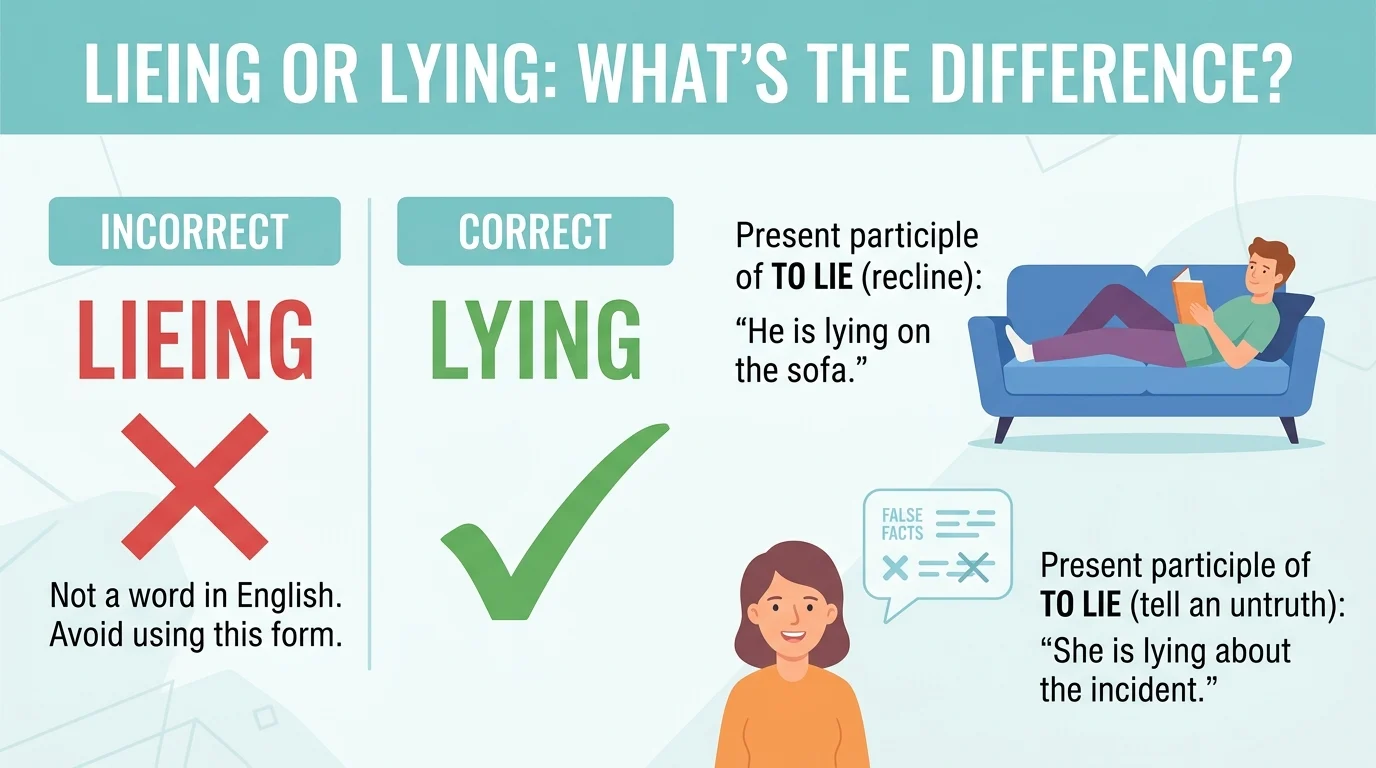
Quick Ans: Lying is the correct spelling when you add the ending “ing” to lie. Lieing is incorrect in standard English. The final e in lie is dropped before adding ing, giving us lying. Use lying when describing someone resting, being in a position, or telling something untrue.
Lieing or lying is a common spelling confusion because the word lie changes its spelling when the ending “ing” is added. At first glance, it may seem logical to write lieing because the base word is lie. However, English spelling rules do not always work by simply adding letters to a word.
The correct form is lying. The spelling lieing is incorrect in standard English.
Understanding this change can help you avoid mistakes in emails, school assignments, professional writing, and everyday communication. The confusion becomes even more important because lie has more than one meaning. It can mean resting in a particular position, or it can mean saying something that isn’t true.
In this guide, we’ll explain why lying is correct, how the spelling changes, and how to use it naturally in different sentences.
Quick Answer and Key Takeaway
Lying is correct.
Lieing is incorrect.
When the verb lie becomes its present participle, the final e is removed before adding ing:
lie + ing = lying
Examples:
- She is lying on the sofa.
- He is lying about what happened.
- The dog is lying under the table.
Easy rule: When lie means to rest or tell something untrue, use lying, not lieing.
Definition and Explanation
What Does Lying Mean?
Lying is the present participle of lie. It can have two main meanings.
First, it can describe being in a resting or horizontal position.
The baby is lying on the bed.
Second, it can describe telling something that isn’t true.
He is lying about his age.
The spelling remains lying in both cases.
Why Is Lieing Wrong?
The word lie ends with the letter e. When certain verbs ending in silent e take the ending ing, the final e is usually dropped.
For example:
- make → making
- take → taking
- write → writing
- lie → lying
So we don’t write lieing. The correct spelling is lying.
Is This a Grammar, Usage, or Vocabulary Issue?
The main problem is spelling and verb formation.
The meaning of lie determines how the word is used, but the spelling rule determines why lying is correct.
| Form | Correct? | Example |
|---|---|---|
| lie | Yes | I lie down after work. |
| lying | Yes | She is lying down. |
| lieing | No | She is lieing down. |
| lied | Yes | He lied to me. |
One important point is that lying is different from laying. Lying comes from lie, while laying comes from lay.
Real World Usage Examples
Workplace
Correct: The report is lying on my desk.
Correct: He is lying about the figures.
Recap: Use lying when describing a position or an untruth.
Academic
Correct: The student admitted that he was lying about the results.
Correct: Several books were lying on the table.
Recap: Academic writing also uses lying, never lieing.
Everyday
Correct: I’m lying on the couch.
Correct: Don’t believe him. He’s lying.
Recap: Whether you mean resting or telling an untruth, lying is the correct spelling.
Regional or Global Usage Differences
There is no standard regional difference between lying and lieing. English speakers around the world use lying as the standard spelling.
You may occasionally see lieing as a spelling mistake online, in informal messages, or in user generated content. It isn’t an accepted standard spelling.
When NOT to Use Lieing
Avoid lieing in:
- School assignments
- Professional emails
- Resumes and applications
- Academic writing
- Formal reports
- Business communication
- Published content
- Edited articles
Instead, always use lying.
Be especially careful with sentences such as:
She is lying on the floor.
Not:
She is lieing on the floor.
And:
He is lying to his parents.
Not:
He is lieing to his parents.
Common Mistakes and Corrections
| Correct Sentence | Incorrect Sentence | Why |
|---|---|---|
| She is lying on the bed. | She is lieing on the bed. | Drop the final e before adding ing. |
| He is lying to me. | He is lieing to me. | Lying is the correct participle of lie. |
| They were lying outside. | They were lieing outside. | The spelling rule still applies with were. |
| I found him lying on the sofa. | I found him lieing on the sofa. | Use lying after found him. |
| Stop lying about it. | Stop lieing about it. | Lying is the standard spelling. |
Easy Decision Rule
Remember:
lie + ing = lying
Never add ing directly to lie as lieing.
Exercises With Answers
Choose the correct spelling.
- She is lying / lieing on the grass.
- Stop lying / lieing to your parents.
- The cat was lying / lieing under the chair.
- He is lying / lieing about the incident.
- I saw her lying / lieing on the floor.
Answer Key
- lying
- lying
- lying
- lying
- lying
Related Concepts and Comparisons
Lying vs Laying
Lying comes from lie, meaning to rest or recline.
She is lying on the bed.
Laying comes from lay, meaning to put or place something somewhere.
She is laying the book on the desk.
A useful memory trick is:
Lie = you rest yourself.
Lay = you place something.
Lying vs Lied
Lying describes an ongoing action.
He is lying to me.
Lied describes a completed action.
He lied to me yesterday.
FAQs
Is lieing a word?
Lieing is not the standard spelling of the present participle of lie. The correct form is lying.
Is lying the correct spelling?
Yes. Lying is the correct spelling when lie takes the ending ing.
Why is lying spelled without e?
The final e in lie is dropped before the ending ing is added. This gives us lying.
Is it lying down or lieing down?
The correct phrase is lying down. For example, “She is lying down on the sofa.”
What is the past tense of lie?
The past tense of lie is lay when lie means to rest. For example, “She lay on the bed.” When lie means to tell something untrue, the past tense is lied.
What is the difference between lying and laying?
Lying comes from lie and means resting or being in a position. Laying comes from lay and means putting something somewhere.
Can I use lieing in informal writing?
You may see lieing as a spelling mistake in informal online writing, but it should be avoided. Use lying in both formal and standard everyday English.
How do you spell lying correctly?
Spell it L Y I N G. The correct form is lying, not lieing.
Conclusion
The correct spelling is lying, while lieing is incorrect in standard English. Although adding “ing” to lie may seem like it should produce lieing, English spelling rules require the final e to be removed.
This gives us:
lie + ing = lying
The word lying can describe someone resting in a position, such as “She is lying on the sofa,” or someone saying something untrue, such as “He is lying to his friend.”
It’s also useful to distinguish lying from laying and lied because these forms come from different uses and verb forms.
The easiest way to remember the spelling is to memorize lying as the standard form. Whenever you’re tempted to write lieing, stop and remember that the final e disappears before ing. This simple rule will help you avoid the mistake in school, work, and everyday writing.
1 thought on “Lieing or Lying: What’s the Difference? Easy Spelling Rules & Examples”