
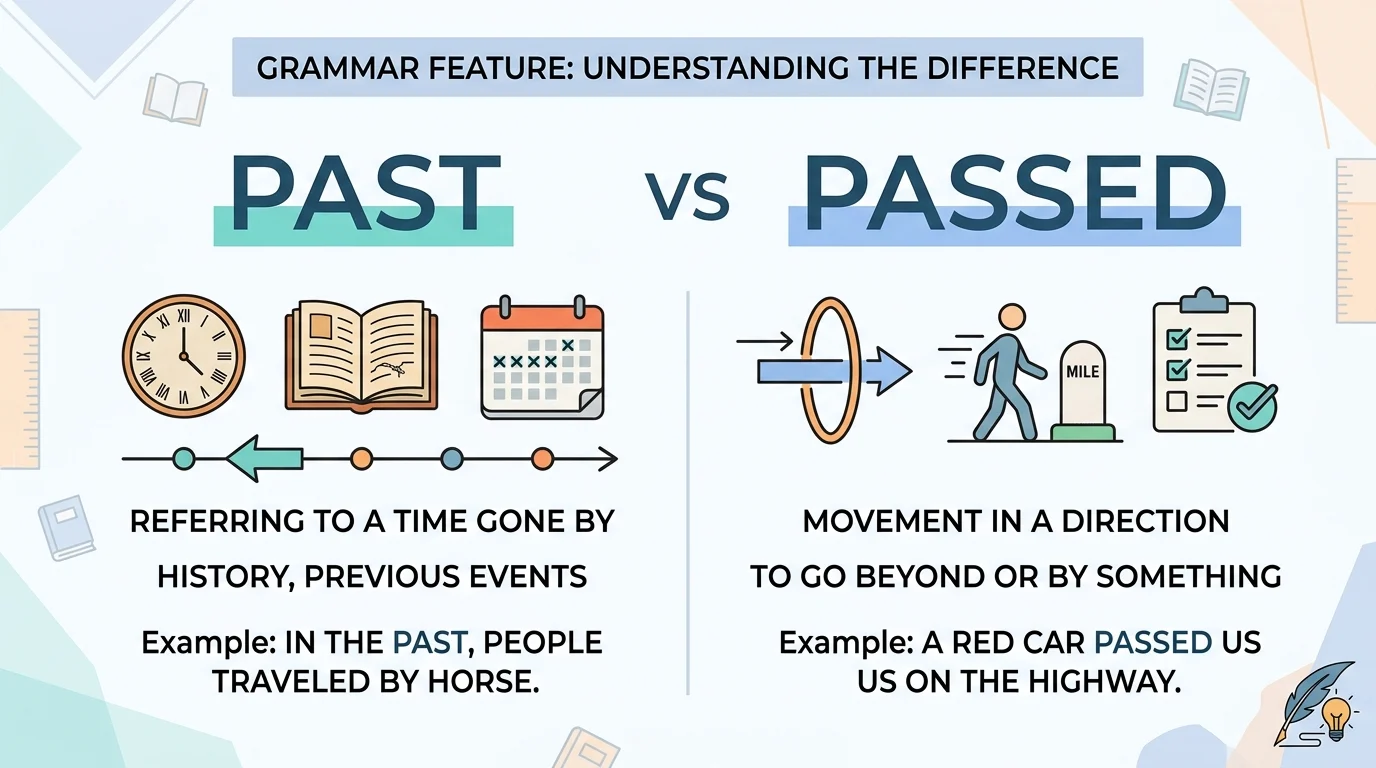
Quick Ans: Past and passed are different words with different grammatical roles. Past usually refers to an earlier time, position, or direction, while passed is the past tense of the verb pass. Use past for time or location, and use passed when describing an action that happened or was completed.
Past or passed can be confusing because the two words sound exactly the same but have different meanings and uses. This confusion often appears in writing because both words can relate to time, movement, or something that has already happened.
The key difference is simple. Past usually works as a noun, adjective, adverb, or preposition. It refers to an earlier time or something beyond a particular point. Passed is a verb. It is the past tense and past participle of pass.
Knowing when to use each word helps you avoid common spelling and grammar mistakes. In this guide, you’ll learn the difference between past and passed, see practical examples, understand common errors, and test your knowledge with simple exercises.
Quick Answer and Key Takeaway
| Word | Main Use | Example |
|---|---|---|
| Past | Earlier time, position, or direction | We talked about the past. |
| Passed | Past tense of the verb pass | She passed the exam. |
Easy rule: If you are describing an action of moving, succeeding, handing, or going by, use passed. If you mean an earlier time or something beyond a point, use past.
Definition and Explanation
What Does Past Mean?
Past can describe a time before now.
- I learned a lot from my past.
- We discussed past mistakes.
- The past few years have been challenging.
It can also describe movement beyond a particular place or point.
- She walked past the library.
- The car drove past our house.
What Does Passed Mean?
Passed is the past form of pass. It describes an action that has already happened.
- He passed the test.
- She passed me the ball.
- The train passed the station.
- They passed through the security check.
A useful test is to replace the word with another verb. If the sentence describes an action, passed is often correct.
Is This a Grammar, Usage, or Vocabulary Issue?
Past and passed create both grammar and vocabulary problems.
Past can function as a noun, adjective, adverb, or preposition.
Passed functions as a verb form.
For example:
- I walked past the store.
- I passed the store on my way home.
The first sentence focuses on location or direction. The second describes the action of passing.
Real World Usage Examples
Workplace
Correct: The deadline has passed.
Here, passed describes the action of the deadline going by.
Correct: We reviewed the company’s past performance.
Here, past refers to an earlier period.
Workplace recap: Use passed for an action and past for an earlier period.
Academic
Correct: She passed her final exam.
Correct: Researchers studied past experiments.
Academic recap: Passing an exam takes passed, while earlier experiments take past.
Everyday
Correct: We walked past the restaurant.
Correct: He passed me the keys.
Everyday recap: Use past for moving beyond something and passed for the action of passing or handing something.
Regional or Global Usage Differences
There is no major regional difference in the basic distinction between past and passed. Both forms are standard in varieties of English around the world.
The pronunciation can make the words difficult because past and passed commonly sound alike in everyday speech. Their spelling and grammatical roles, however, remain different.
When NOT to Use It
Avoid passed when you mean an earlier period or location.
- Incorrect: We talked about the passed.
- Correct: We talked about the past.
Avoid past when you need the verb pass in the past tense.
- Incorrect: She past the exam.
- Correct: She passed the exam.
Other common situations include:
- Talking about previous experiences: use past.
- Describing success in an exam: use passed.
- Describing movement beyond a place: usually use past.
- Describing someone handing something over: use passed.
- Referring to an earlier year: use past.
- Describing an action that has already happened: use passed.
Common Mistakes and Corrections
| Correct Sentence | Incorrect Sentence | Why |
|---|---|---|
| She passed the test. | She past the test. | Passed is the verb. |
| We walked past the bank. | We walked passed the bank. | Past shows direction. |
| Think about your past. | Think about your passed. | Past means earlier time. |
| He passed the ball. | He past the ball. | Passed describes the action. |
| The train went past us. | The train went passed us. | Past follows the movement. |
Simple Decision Rule
Ask yourself: Am I describing an action of pass?
If yes, use passed.
If you’re talking about an earlier time, a previous situation, or something beyond a location, use past.
Exercises With Answers
Choose past or passed.
- She walked ___ the school.
- He ___ his driving test.
- We talked about the ___.
- The bus ___ us quickly.
- I drove ___ your house.
- They have ___ the deadline.
Answer Key
- past
- passed
- past
- passed
- past
- passed
Related Concepts and Comparisons
Past and passed are often confused with other commonly mixed up words.
- Past vs present: Past refers to an earlier time, while present refers to now.
- Passed vs pass: Passed is the past form of the verb pass.
- Past vs previous: Both can refer to earlier time, but they aren’t always interchangeable.
- Passed vs completed: Passed can describe successfully completing a test or moving beyond something.
The easiest comparison remains this: past describes time, position, or direction, while passed describes an action.
FAQs
What is the difference between past and passed?
Past usually refers to an earlier time, position, or direction. Passed is the past tense of the verb pass.
Is it passed or past the house?
Use past when describing movement beyond the house. For example, “We walked past the house.”
Is it past or passed the exam?
Use passed because passing an exam is an action. The correct sentence is “She passed the exam.”
Can past and passed sound the same?
Yes. They are commonly pronounced alike, which is why they are easy to confuse in writing.
Which is correct, passed time or past time?
Usually, past time refers to an earlier period. However, passed time can occur when passed is the verb, as in “The hours passed quickly.”
Is past a verb?
Usually, no. Past can function as a noun, adjective, adverb, or preposition, but passed is the verb form of pass.
How do I remember past or passed?
Remember that passed contains the word pass. If someone or something performed the action of passing, use passed.
Is “walked passed” correct?
No. The correct expression is “walked past.” Past describes the direction or position beyond something.
Conclusion
Understanding past or passed becomes much easier when you focus on their grammatical roles. Past usually refers to an earlier time, a previous situation, or movement beyond a particular point. Passed, on the other hand, is the past tense of pass and describes an action that has already happened.
For example, you can walk past a building, but you can pass a building. You can also pass an exam, so the correct past tense is “passed the exam.” When discussing previous experiences, use past, as in “my past experiences.”
The most useful rule is simple: past is generally about time, position, or direction, while passed is about the action of passing. If you’re unsure, check whether the word is functioning as a verb. If it is, passed is usually the right choice. With this quick test, you’ll avoid one of the most common spelling mistakes in English.
Practical tip: Remember passed = pass + ed, while past = earlier time or beyond a point.