
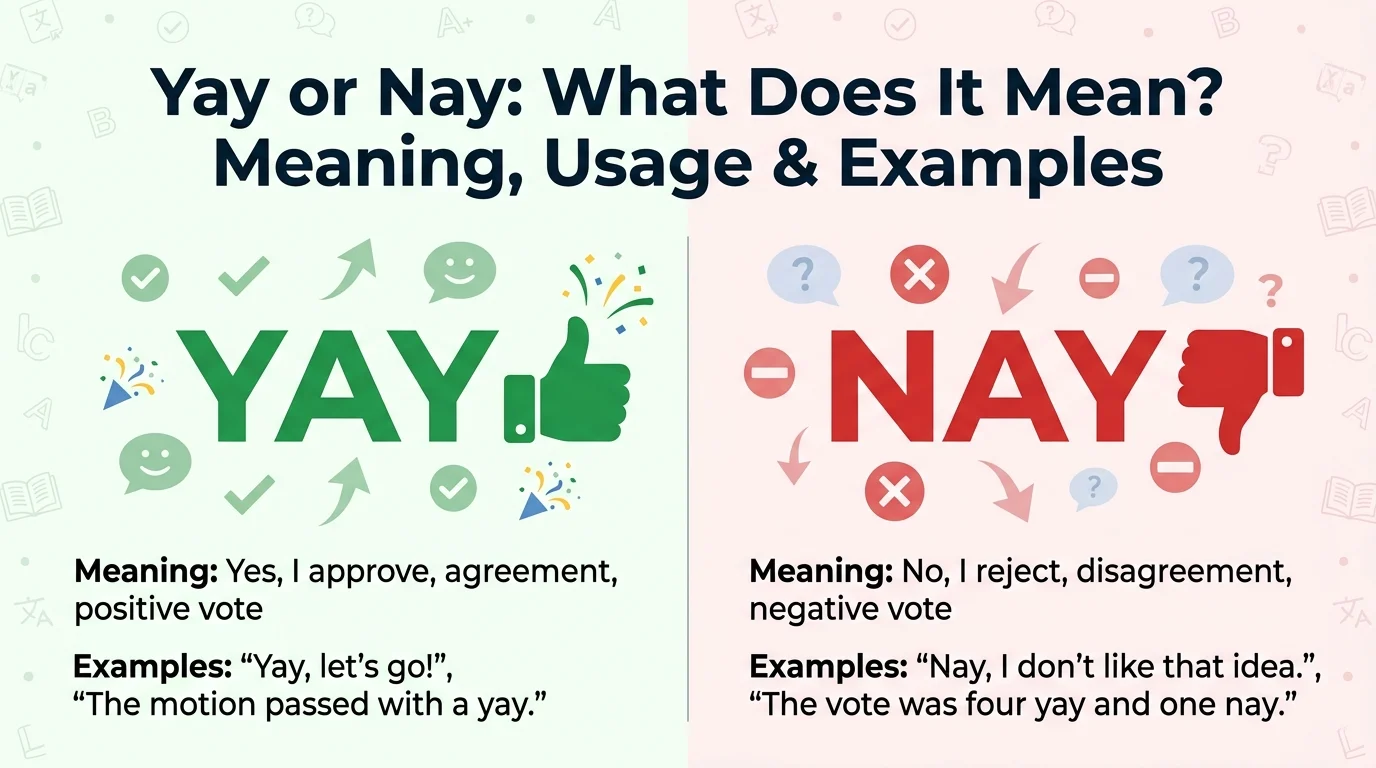
Quick Ans: Yay or nay is a casual expression used to ask whether someone agrees with, approves of, or supports something. “Yay” means yes or approval, while “nay” means no or disapproval. The phrase is common in voting, discussions, decisions, and informal conversations.
Yay or nay is a common phrase you may hear when someone wants a quick opinion or decision. For example, a friend might ask, “New haircut, yay or nay?” A team leader might also ask, “Yay or nay on this proposal?”
The two words are simple, but learners sometimes wonder whether they are interchangeable with yes and no. They may also be unsure about the correct spelling, meaning, or level of formality.
The good news is that the difference is straightforward. Yay expresses approval, agreement, or excitement. Nay expresses disapproval, rejection, or disagreement. Together, “yay or nay” simply means “yes or no” or “approve or reject.”
This guide explains the meaning of yay and nay, shows how to use them correctly, and provides practical examples for everyday, academic, and workplace situations.
Quick Answer and Key Takeaway
Yay means yes, approval, or support. Nay means no, rejection, or opposition. When someone asks “Yay or nay?”, they are asking for a quick decision or opinion.
A simple rule is:
Yay = approve or agree
Nay = reject or disagree
Definition and Explanation
What Does Yay Mean?
“Yay” is an informal word used to express approval, agreement, or enthusiasm.
Examples:
- “Yay! We won the competition.”
- “Yay or nay on this outfit?”
- “I vote yay for the new design.”
In modern conversation, “yay” can also express happiness or excitement.
What Does Nay Mean?
“Nay” means no, especially when someone rejects or opposes something. It is more formal or old fashioned when used alone, but it remains common in the phrase “yay or nay.”
Examples:
- “My vote is nay.”
- “The committee voted nay on the proposal.”
- “Yay or nay? Should we order pizza?”
Is This a Grammar, Usage, or Vocabulary Issue?
The difference between yay and nay is mainly a vocabulary and usage issue.
Both words can function as informal responses or voting terms. They are not different forms of the same word.
There is also an important distinction between nay and neigh. “Nay” means no, while “neigh” is the sound made by a horse.
Real World Usage Examples
Workplace
Example: “Yay or nay on moving the meeting to Friday?”
Here, the speaker wants a quick decision.
Recap: Use “yay” for approval and “nay” for rejection.
Academic
Example: “The students voted yay on the proposed study schedule.”
The word indicates agreement with the suggestion.
Recap: “Yay” can describe a positive vote.
Everyday Conversation
Example: “New shoes, yay or nay?”
This asks whether the listener likes or approves of the shoes.
Recap: “Yay or nay” is especially natural in casual conversations.
Regional or Global Usage Differences
“Yay” and “nay” are widely understood in English, especially in informal conversations and voting contexts.
“Yay” is strongly associated with casual modern speech and can also express excitement. “Nay” has a more traditional or formal history, but the phrase “yay or nay” remains familiar in modern English.
In formal writing, alternatives such as approve or reject, for or against, and yes or no may sound more appropriate.
When NOT to Use Yay or Nay
Avoid “yay or nay” when a formal or precise expression is required.
| Situation | Better Choice |
|---|---|
| Formal business report | Approve or reject |
| Academic paper | For or against |
| Legal document | Accept or reject |
| Casual conversation | Yay or nay |
| Social media poll | Yay or nay |
| Informal team discussion | Yay or nay |
Common Mistakes and Corrections
| Correct Sentence | Incorrect Sentence | Why |
|---|---|---|
| “Yay or nay on this idea?” | “Yea or nay on this idea?” | “Yea” is a different traditional voting word. |
| “My vote is yay.” | “My vote is neigh.” | “Neigh” refers to a horse’s sound. |
| “Yay! We passed.” | “Nay! We passed.” | “Nay” expresses rejection or opposition. |
| “I vote nay.” | “I vote yay” when rejecting it | The meaning must match your decision. |
Decision Rule
Ask yourself: Am I showing approval or rejection?
If you approve, choose yay. If you reject or oppose something, choose nay.
Exercises With Answers
Choose yay or nay.
- You love the proposed vacation plan. You vote ___.
- You strongly dislike the new rule. You vote ___.
- Your friend asks, “New hairstyle, ___ or nay?”
- You support the team’s suggestion. You say ___.
- You reject the proposal. You vote ___.
Answer Key
- Yay
- Nay
- Yay
- Yay
- Nay
Related Concepts and Comparisons
Yay vs Yes
“Yay” is more casual and can express enthusiasm. “Yes” is neutral and works in both formal and informal situations.
Nay vs No
“Nay” can mean no or opposition, particularly in voting. “No” is much more common in everyday English.
Yay vs Yea
“Yay” is the common modern expression for approval or excitement. “Yea” is traditionally used to mean yes, especially in formal voting contexts.
Nay vs Neigh
“Nay” means no or opposition. “Neigh” describes the sound made by a horse.
FAQs
What does yay or nay mean?
“Yay or nay” means “yes or no” or “approve or reject.” It is commonly used when asking for a quick opinion or decision.
Is yay or nay grammatically correct?
Yes. “Yay or nay” is a standard informal expression. It is especially common in conversations, polls, and casual discussions.
Is yay a real word?
Yes. “Yay” is an established English word used to express approval, agreement, or excitement.
What is the opposite of yay?
“Nay” is the traditional opposite in the expression “yay or nay.” In ordinary conversation, “no” is the more common opposite of “yes.”
Should I use yay or nay in formal writing?
Usually, no. In formal writing, phrases such as “approve or reject” or “for or against” are often clearer and more professional.
What is the difference between yay and yea?
“Yay” commonly expresses approval or excitement. “Yea” is traditionally used as an affirmative voting term and can also mean yes.
Does nay mean no?
Yes. “Nay” can mean no, especially when expressing opposition or casting a negative vote.
Can yay mean excitement?
Yes. “Yay!” is often used to show happiness, excitement, or celebration, as in “Yay! We are going on vacation.”
Conclusion
Understanding yay or nay is easy once you remember the basic meaning of each word. Yay shows approval, agreement, or excitement, while nay shows rejection, disagreement, or opposition. Together, the phrase is a quick and informal way to ask someone for a decision or opinion.
The expression works especially well in casual conversations, social media polls, informal meetings, and everyday discussions. However, it may sound too informal for academic papers, legal documents, or highly professional writing. In those situations, choose clearer alternatives such as “yes or no,” “approve or reject,” or “for or against.”
Also remember that nay is not the same as neigh, and yay is different from yea. These small spelling differences can change the meaning completely.
Practical tip: Whenever you need a quick casual way to ask whether someone supports an idea, use “yay or nay?” Think yay = approve and nay = reject.
1 thought on “Yay or Nay: What’s the Difference? Easy Rules, Examples & Tips”