
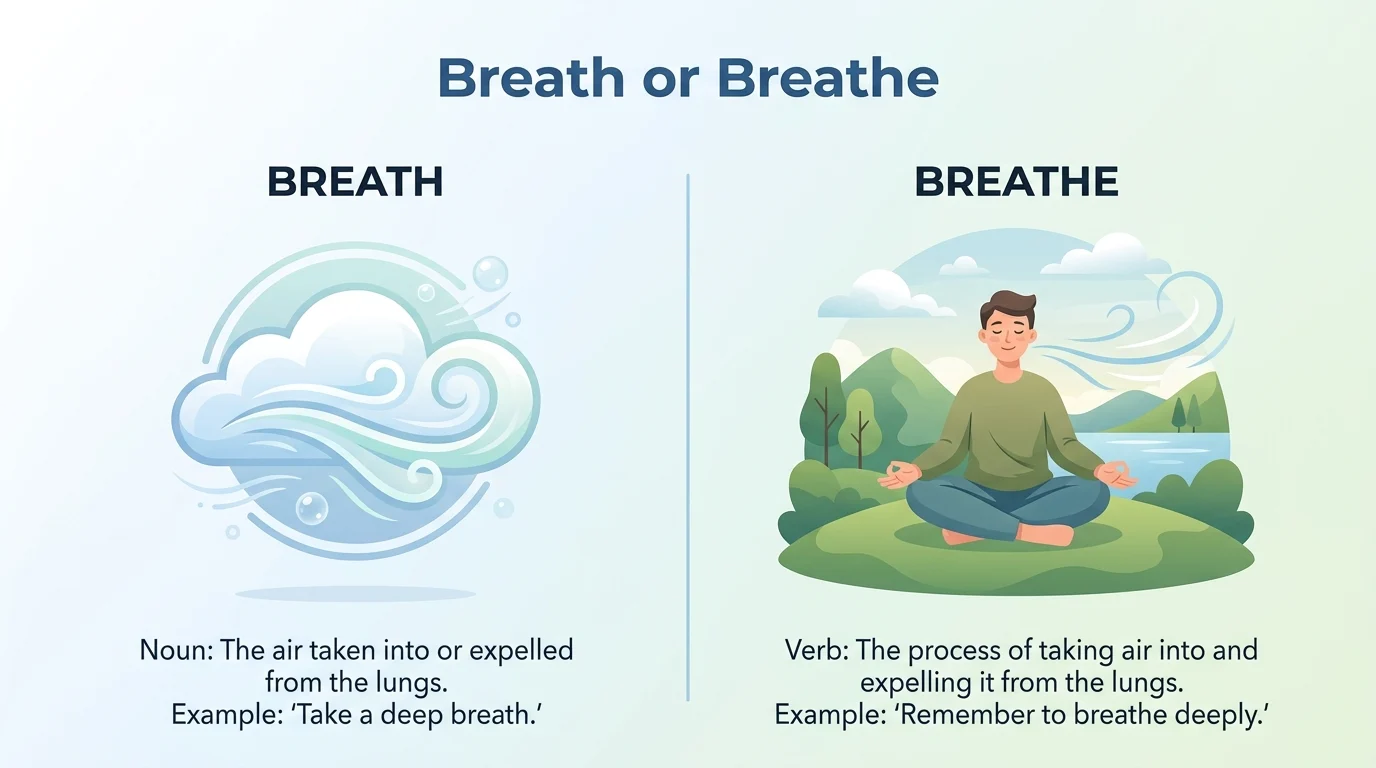
Quick Ans: Breath and breathe have different meanings and grammatical uses. Breath is a noun that refers to the air you inhale or exhale, while breathe is a verb that means to take air into and release it from your lungs. For example, “Take a deep breath” is correct, and “Remember to breathe” is also correct.
Breath or breathe is a common spelling confusion because both words relate to the same physical action. They look almost identical, but the final sound and grammatical role are different. Knowing when to use each word can help you avoid mistakes in everyday conversations, emails, school assignments, and professional writing.
The main difference is simple: breath is a thing, while breathe is an action. You take a breath, but you breathe slowly. The words also sound slightly different. Breath ends with a soft “th” sound, while breathe ends with a “th” sound that involves your voice.
Although the difference may seem small, choosing the wrong word can change how natural and grammatically correct your sentence sounds. Fortunately, you do not need to memorize complicated grammar rules to use them correctly.
In this guide, you will learn the meanings of breath and breathe, see practical examples, understand common mistakes, and practice choosing the correct word.
Quick Answer and Key Takeaway
Breath is a noun meaning the air you inhale or exhale. Breathe is a verb meaning to inhale and exhale air.
| Word | Part of Speech | Meaning | Example |
|---|---|---|---|
| Breath | Noun | Air taken in or released | Take a deep breath. |
| Breathe | Verb | To inhale and exhale | Try to breathe slowly. |
Easy rule: If you can replace the word with “air,” use breath. If you mean the action of taking air in and out, use breathe.
Breath vs Breathe: Definition and Explanation
What Does Breath Mean?
Breath is a noun. It refers to the air that enters or leaves your lungs when you breathe. It can also describe a single cycle of breathing or a small amount of air.
Examples:
- She took a deep breath before speaking.
- His breath smelled like mint.
- I could see my breath in the cold air.
- He finished the race and was out of breath.
In these sentences, breath names something rather than describing an action.
What Does Breathe Mean?
Breathe is a verb. It describes the process of taking air into your lungs and releasing it.
Examples:
- Remember to breathe slowly.
- The doctor told him to breathe deeply.
- Plants need suitable conditions to grow and breathe.
- She could hardly breathe after running.
In each example, breathe expresses an action or process.
Is This a Grammar, Usage, or Vocabulary Issue?
Breath or breathe is both a spelling and grammar issue. The words have related meanings, but they belong to different parts of speech.
Use breath when a sentence needs a noun. Use breathe when it needs a verb.
For example:
Incorrect: Take a deep breathe.
Correct: Take a deep breath.
Incorrect: Just breath and relax.
Correct: Just breathe and relax.
Real World Usage Examples
Everyday Conversations
- Take a breath before you answer.
- Breathe slowly when you feel nervous.
- I need to catch my breath.
- It is difficult to breathe in this room.
Recap: Use breath for the air or a breathing cycle, and breathe for the action.
Academic and Workplace Writing
- The athlete took a breath before starting the test.
- Employees should breathe calmly during relaxation exercises.
- The patient complained of shortness of breath.
- Please breathe normally during the examination.
Recap: Identify whether the sentence describes a thing or an action.
Expressions and Common Phrases
- Take a deep breath.
- Hold your breath.
- Breathe a sigh of relief.
- Out of breath.
- Breathe new life into something.
Recap: Learning common expressions makes it easier to remember the correct spelling.
Regional or Global Usage Differences
The distinction between breath and breathe is consistent in standard British English and American English. Both varieties use breath as a noun and breathe as a verb.
Pronunciation may vary slightly by accent, but the grammatical difference remains the same. Neither spelling is a regional alternative to the other.
When NOT to Use Breath or Breathe
Avoid using breath when your sentence needs an action.
Incorrect: She tried to breath deeply.
Correct: She tried to breathe deeply.
Avoid using breathe when your sentence needs a noun.
Incorrect: He took a deep breathe.
Correct: He took a deep breath.
Remember that phrases such as “out of breath” and “take a breath” need the noun. Phrases such as “breathe deeply” and “breathe normally” need the verb.
Common Mistakes and Corrections
| Correct Sentence | Incorrect Sentence | Why |
|---|---|---|
| Take a deep breath. | Take a deep breathe. | A noun is needed after “a.” |
| Remember to breathe. | Remember to breath. | “To” is followed by the verb here. |
| I am out of breath. | I am out of breathe. | The expression requires a noun. |
| She could barely breathe. | She could barely breath. | The sentence describes an action. |
| He held his breath. | He held his breathe. | “His” is followed by a noun. |
Easy Decision Rule
Ask yourself: Am I naming air, or describing an action?
If you are naming air or a breathing cycle, choose breath.
If you are describing the act of inhaling and exhaling, choose breathe.
Exercises With Answers
Fill in each blank with breath or breathe.
- Take a deep ______ before you begin.
- Try to ______ slowly.
- I was out of ______ after climbing the stairs.
- It was hard to ______ in the smoky room.
- She held her ______ underwater.
- Remember to ______ and stay calm.
Answer Key
- breath
- breathe
- breath
- breathe
- breath
- breathe
Related Concepts and Comparisons
Breath vs Breathing
Breath is a noun referring to air or a breathing cycle. Breathing can function as a noun or as the “ing” form of the verb breathe.
Example: “Her breathing was steady.”
Breath vs Breathe in Expressions
“Take a breath” refers to taking in air, while “breathe deeply” describes how someone performs the action.
Breathe vs Breathes
Breathe is the base form of the verb. Breathes is used with singular third person subjects in the present tense.
Example: “She breathes slowly when she meditates.”
FAQs
What is the main difference between breath and breathe?
Breath is a noun that refers to air inhaled or exhaled. Breathe is a verb that means to inhale and exhale.
Is it take a breath or take a breathe?
The correct phrase is “take a breath.” The article “a” requires the noun breath in this expression.
Is it hard to breath or hard to breathe?
The correct phrase is “hard to breathe.” In this sentence, breathe is a verb that describes the action.
How do you remember breath vs breathe?
Remember that breath is a thing and breathe is an action. You take a breath, but you breathe.
Is breathe a verb or a noun?
Breathe is a verb. It describes the action of taking air into the lungs and releasing it.
Is breath pronounced differently from breathe?
Yes. Breath typically ends with an unvoiced “th” sound, while breathe ends with a voiced “th” sound.
Is it hold your breath or hold your breathe?
The correct phrase is “hold your breath.” Breath is the noun describing the air being held.
Is it out of breath or out of breathe?
The correct expression is “out of breath.” It describes someone who is breathing hard or needs to recover after physical activity.
What is the plural of breath?
The plural of breath is breaths. For example, “Take three slow breaths.”
Conclusion
Understanding breath or breathe becomes much easier when you remember the difference between a noun and a verb. Breath refers to the air you inhale or exhale, while breathe describes the action of inhaling and exhaling.
Use breath in phrases such as “take a deep breath,” “hold your breath,” and “out of breath.” Use breathe in sentences such as “breathe slowly,” “try to breathe,” and “she could barely breathe.”
Both words are used in British and American English, so the choice does not depend on your region. Instead, focus on the role the word plays in the sentence.
When you are unsure, check whether you are naming something or describing an action. If you are naming the air, choose breath. If you are describing the action, choose breathe. Practice this simple rule with everyday sentences, and you will be much less likely to confuse the two.