
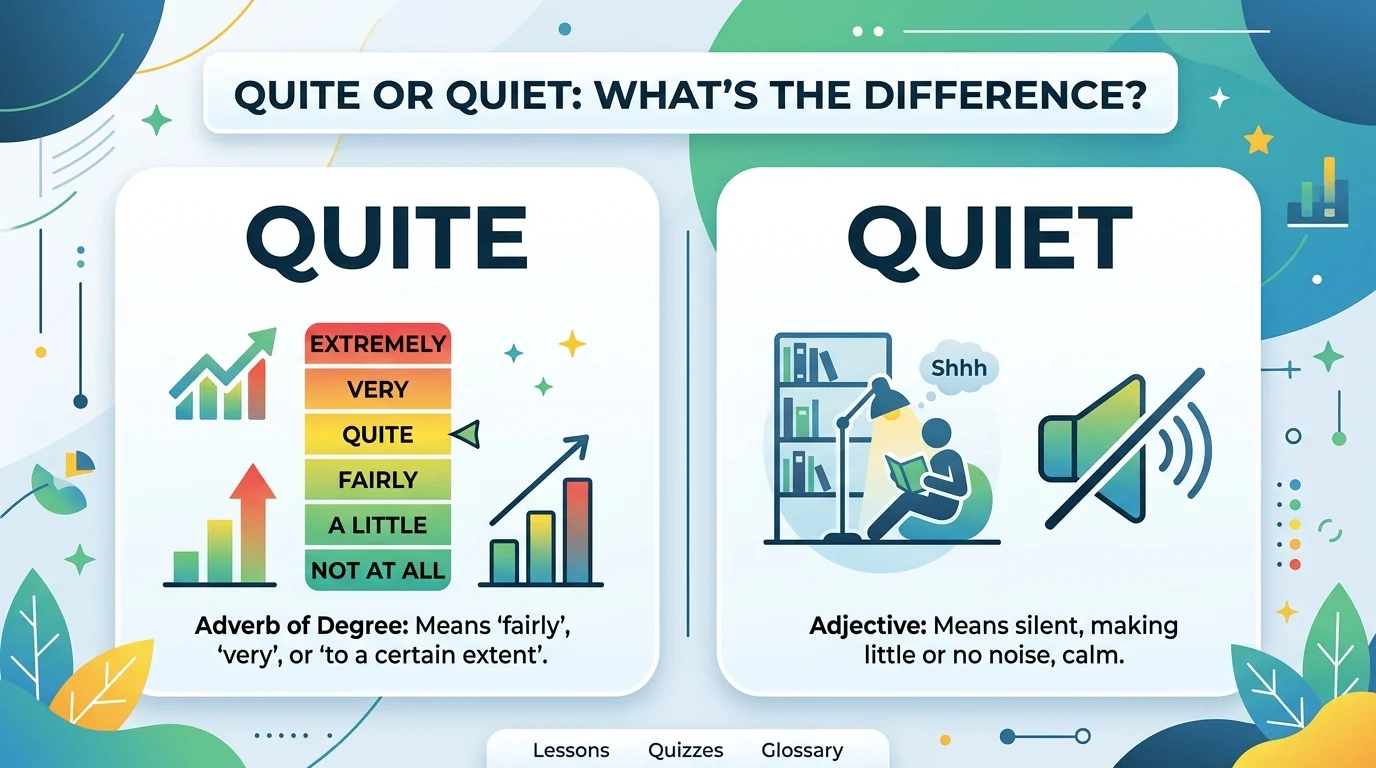
Quick Ans: “Quite” and “quiet” are both correct English words, but they have completely different meanings. “Quite” usually means fairly, rather, or completely, depending on the context. “Quiet” describes something with little or no noise. Knowing the difference helps you avoid a common spelling and vocabulary mistake.
Are you confused about whether to use “quite or quiet”? These words look and sound similar, so it is easy to mix them up.
The good news is that their meanings are very different. “Quite” usually modifies an adjective, adverb, or verb and tells us about degree or extent. For example, “The movie was quite interesting” means the movie was fairly or very interesting, depending on context.
“Quiet,” on the other hand, describes a lack of noise or activity. You might say, “The library is quiet” or “Please be quiet.”
The confusion often happens when people type quickly or hear the words in conversation. However, once you connect each word with its meaning, choosing the correct spelling becomes simple.
Whether you’re writing an email, completing an assignment, or speaking English, understanding quite vs quiet will make your writing clearer.
Quick Answer: Quite or Quiet?
| Word | Meaning | Example |
|---|---|---|
| Quite | Fairly, rather, or completely | The test was quite easy. |
| Quiet | Making little or no noise | The room is quiet. |
Quick rule: “Quite” relates to degree. “Quiet” relates to sound or noise.
Definition and Explanation
Quite
“Quite” is an adverb. It can mean fairly, rather, very, or completely, depending on the sentence and context.
Example: The book is quite interesting.
It can also strengthen another word.
Example: I’m quite sure about the answer.
The exact meaning can change slightly depending on context and variety of English.
Quiet
“Quiet” is usually an adjective. It describes someone or something that makes little or no noise.
Example: The classroom is quiet.
“Quiet” can also describe someone who does not talk much.
Example: She is a quiet student.
As a verb, “quiet” can mean to make something less noisy or calm.
Example: The teacher quieted the class.
| Word | Part of Speech | Meaning | Example |
|---|---|---|---|
| Quite | Adverb | Fairly, rather, or completely | It is quite cold. |
| Quiet | Adjective | Having little noise | The street is quiet. |
| Quiet | Verb | To make calm or less noisy | She quieted the children. |
In short, “quite” describes degree or extent. “Quiet” describes silence, low noise, or calmness.
Is This a Grammar, Usage, or Vocabulary Issue?
The difference between quite and quiet involves spelling, pronunciation, grammar, and vocabulary.
“Quite” is normally an adverb, while “quiet” is most often an adjective. Therefore, they usually appear in different parts of a sentence.
Correct: The room is quite comfortable.
Correct: The room is quiet.
Incorrect: The room is quite.
Incorrect: The room is quiet comfortable.
Remember that “quite” modifies words such as adjectives and adverbs, while “quiet” commonly describes people, places, or things.
Real World Usage Examples
Workplace Examples
“The office is quite busy today.”
Here, “quite” describes the degree of how busy the office is.
“Please keep the meeting room quiet.”
Here, “quiet” refers to low noise.
Recap: Use “quite” for degree and “quiet” for noise.
Academic Examples
“The assignment was quite difficult.”
“Quite” shows the degree of difficulty.
“The library remained quiet during the exam.”
“Quiet” describes the lack of noise.
Recap: Academic writing uses both words, but their roles are different.
Everyday Examples
“That restaurant is quite expensive.”
“The neighborhood is very quiet at night.”
The first sentence describes degree. The second describes sound.
Recap: Ask yourself whether you mean “how much” or “how noisy.”
Regional or Global Usage Differences
Both “quite” and “quiet” are used in American and British English. However, “quite” can have slightly different strength depending on the variety of English and context.
In some British English contexts, “quite good” can mean fairly good rather than extremely good. In other situations, “quite” can mean completely or very.
“Quiet” keeps the same basic meaning across major English varieties.
When NOT to Use It
Do not use “quiet” when you mean “fairly” or “rather.”
Do not use “quite” when you mean that a place has little noise.
Avoid writing “Please be quite.” The correct sentence is “Please be quiet.”
Do not write “The movie was quiet interesting.” Use “quite interesting.”
Avoid choosing the word simply because it looks or sounds similar to the other one.
When the sentence describes silence or low noise, “quiet” is normally the correct choice.
Common Mistakes and Corrections
| Correct Sentence | Incorrect Sentence | Why |
|---|---|---|
| Please be quiet. | Please be quite. | “Quiet” means little or no noise. |
| The movie was quite good. | The movie was quiet good. | “Quite” expresses degree. |
| She lives in a quiet neighborhood. | She lives in a quite neighborhood. | “Quiet” describes the neighborhood. |
| I’m quite tired. | I’m quiet tired. | “Quite” modifies the adjective “tired.” |
| The room is quiet. | The room is quite. | “Quiet” works as the adjective here. |
Decision Rule: If you mean “fairly,” “rather,” or “very,” choose quite. If you mean “not noisy,” choose quiet.
Exercises With Answers
Choose quite or quiet.
- Please keep the classroom _____.
- The test was _____ easy.
- She is a very _____ person.
- I’m _____ certain about the answer.
- The neighborhood becomes _____ at night.
- That restaurant is _____ popular.
Answer Key
- quiet
- quite
- quiet
- quite
- quiet
- quite
Related Concepts and Comparisons
Readers who search for quite vs quiet may also want to learn about affect vs effect, accept vs except, advice vs advise, loose vs lose, then vs than, their vs there, and your vs you’re.
FAQs
What is the difference between quite and quiet?
“Quite” is an adverb that usually expresses degree, while “quiet” usually describes a lack of noise. For example, “The movie is quite good” and “The room is quiet.”
Is it quite or quiet a place?
Use “quiet” when describing a place with little noise. For example, “It is a quiet place.”
Is quite an adjective or adverb?
“Quite” is an adverb. It commonly modifies an adjective, adverb, or sometimes a verb.
Is quiet an adjective?
Yes. “Quiet” is commonly an adjective that describes someone or something with little noise. For example, “The library is quiet.”
How do you remember quite vs quiet?
Connect “quiet” with silence and low noise. Remember “quite” as a word that describes degree, such as “quite easy” or “quite difficult.”
Does quite mean very?
Sometimes. Depending on the context, “quite” can mean fairly, rather, very, or completely. The exact strength depends on the sentence and variety of English.
Why do people confuse quite and quiet?
The words have similar spelling and pronunciation, which makes them easy to mix up. Their meanings, however, are clearly different.
Is “Please be quite” correct?
No. The correct sentence is “Please be quiet.” Here, “quiet” means not making noise.
Conclusion
The difference between quite and quiet is simple once you remember what each word describes. “Quite” is an adverb that expresses degree. It can mean fairly, rather, very, or completely depending on context.
“Quiet” usually works as an adjective and describes something with little or no noise. You can say, “The library is quiet,” but you should say, “The book is quite interesting.”
These words are common in everyday conversations, workplace communication, and academic writing. Therefore, learning the difference is useful for both English learners and native speakers.
A quick memory trick can help. Think of the extra “e” in “quite” as part of a word that tells you how much. Think of “quiet” as the word connected with silence.
Practical tip: before choosing the spelling, ask yourself one question: Am I talking about degree, or am I talking about noise? Choose “quite” for degree and “quiet” for silence or low noise.