
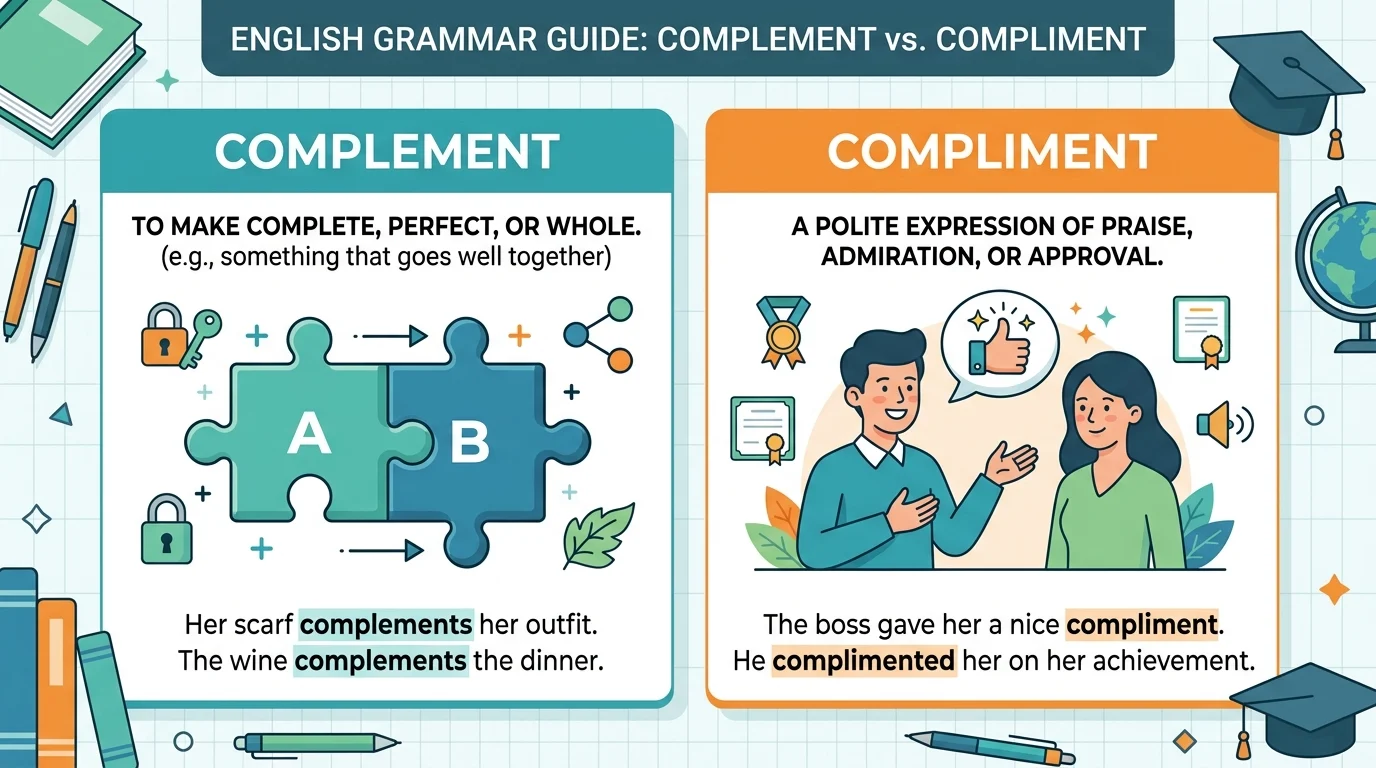
Quick Ans: Complement or compliment are two different words that sound alike but have different meanings. Complement means something that completes, improves, or goes well with something else. Compliment means a positive remark or expression of praise. Remember: complement completes, while compliment praises.
Complement or compliment is a common word choice problem because both words sound exactly the same in everyday speech. However, their meanings are completely different. Using the wrong spelling can change the meaning of a sentence and make your writing look careless.
The easiest way to remember the difference is to connect complement with the idea of completion. Something complements another thing when it makes it better, more complete, or more suitable. Compliment, on the other hand, is related to praise. If you say something nice about someone’s appearance, work, personality, or achievement, you are giving a compliment.
This simple distinction can help you avoid one of the most common homophone mistakes in English. Whether you’re writing an email, completing an academic assignment, or having a casual conversation, knowing when to use each word will make your writing clearer and more accurate.
Quick Answer and Key Takeaway
| Word | Meaning | Example |
|---|---|---|
| Complement | Something that completes or enhances something else | The shoes complement her dress. |
| Compliment | A positive comment or praise | She gave me a compliment. |
Easy Memory Trick
Complement = Complete
Both words contain the idea of something being complete or improved.
Compliment = Praise
A compliment is something nice you say about someone or something.
Definition and Explanation
What Does Complement Mean?
Complement means something that completes, matches, or improves another thing.
It can be used as both a noun and a verb.
As a noun:
The sauce is a perfect complement to the meal.
Here, the sauce adds something that makes the meal better.
As a verb:
Her blue shoes complement her outfit.
Here, the shoes match and enhance the outfit.
What Does Compliment Mean?
Compliment means a positive statement, expression of admiration, or praise.
It can also be used as both a noun and a verb.
As a noun:
He gave me a compliment about my presentation.
As a verb:
My teacher complimented me on my research.
In both examples, the word is connected to praise.
Is This a Grammar, Usage, or Vocabulary Issue?
The confusion between complement and compliment is mainly a vocabulary and spelling issue involving homophones.
Homophones are words that sound alike but have different meanings and spellings. Because complement and compliment sound the same, writers sometimes choose the wrong word.
The grammar of the sentence may be perfectly correct while the vocabulary is wrong.
For example:
Your necklace complements your dress. ✅
Your necklace compliments your dress. ❌
The second sentence incorrectly suggests that the necklace is giving praise to the dress.
Real World Usage Examples
Workplace
Her communication skills complement her technical knowledge.
This means the two skills work well together.
My manager complimented me on my performance.
This means the manager praised the employee.
Workplace recap: Use complement for things that work well together and compliment for praise.
Academic
The practical experiment complements the theoretical discussion.
The experiment adds value to the discussion.
The professor complimented the student on her detailed analysis.
The professor praised the student’s work.
Academic recap: Complement describes enhancement, while compliment describes praise.
Everyday
These curtains complement the color of the walls.
The curtains match the walls well.
She complimented me on my new haircut.
She praised the haircut.
Everyday recap: Think complete or match for complement and praise for compliment.
Regional or Global Usage Differences
There is no major difference in meaning between British English and American English for these two words. Complement and compliment have the same basic meanings and spellings across major varieties of English.
The confusion happens because they are pronounced similarly. Their different spellings must therefore be learned through context and memory.
When NOT to Use It
Use complement when:
- Something completes another thing.
- Two things work well together.
- One thing improves another.
- Colors, clothes, skills, or features match well.
- Something adds value to another thing.
Use compliment when:
- Someone praises you.
- You praise someone’s appearance.
- You praise someone’s work.
- You make a positive remark.
- Someone says something nice about you.
Common Mistakes and Corrections
| Correct Sentence | Incorrect Sentence | Why |
|---|---|---|
| Her shoes complement her dress. | Her shoes compliment her dress. | The shoes match the dress. |
| He complimented my work. | He complemented my work. | He praised the work. |
| The sauce complements the dish. | The sauce compliments the dish. | The sauce improves the dish. |
| She gave me a compliment. | She gave me a complement. | She gave praise. |
| Their skills complement each other. | Their skills compliment each other. | The skills work well together. |
Simple Decision Rule
Ask yourself:
Does it mean “praise”? Use compliment.
Does it mean “complete, match, or improve”? Use complement.
Exercises With Answers
Choose complement or compliment.
- The scarf really ________ her coat.
- She gave me a lovely ________.
- His skills ________ those of his colleague.
- My supervisor ________ me on my presentation.
- The vegetables are a perfect ________ to the main dish.
- I received several ________ after my speech.
Answer Key
- complement
- compliment
- complement
- complimented
- complement
- compliments
Related Concepts and Comparisons
Complement and compliment are often confused with other commonly mixed up words because they sound similar or have related meanings.
| Word | Meaning |
|---|---|
| Complement | Complete, match, or enhance |
| Compliment | Praise |
| Praise | Express approval or admiration |
| Complete | Finish or make whole |
| Admire | Regard someone or something positively |
The key difference is simple: complement describes a relationship between things, while compliment usually involves praise.
FAQs
What is the difference between complement and compliment?
Complement means to complete, match, or improve something. Compliment means to praise someone or something.
How do I remember complement vs compliment?
Think complement = complete. Think compliment = praise.
Is it a compliment or complement to a person?
If you are praising the person, use compliment. For example, “She gave me a compliment.”
Is it correct to say colors complement each other?
Yes. Use complement when colors look good together or enhance each other.
What does compliment mean in a sentence?
Compliment means to praise someone or something. For example, “He complimented her on her excellent presentation.”
Can complement be a verb?
Yes. As a verb, complement means to complete, improve, or match something. For example, “The blue curtains complement the room.”
Can compliment be a verb?
Yes. Compliment can mean to praise someone. For example, “She complimented him on his new suit.”
Are complement and compliment homophones?
Yes. They are pronounced alike but have different spellings and meanings.
Which is correct: complement each other or compliment each other?
Complement each other is correct when two things work well together. For example, “Their personalities complement each other.”
Conclusion
The difference between complement or compliment becomes easy once you connect each word with its meaning. Complement refers to something that completes, matches, supports, or improves another thing. Compliment refers to praise or a positive remark.
Remember the simple trick: complement = complete, while compliment = praise. If you’re talking about clothes, colors, food, skills, designs, or qualities that work well together, choose complement. If you’re talking about saying something nice about someone’s appearance, work, personality, or achievement, choose compliment.
Both words are useful in everyday, academic, and professional writing. The main challenge is remembering their spelling because they sound alike. When you’re unsure, ask yourself whether you mean “complete or enhance” or “praise.” That quick question will usually give you the correct answer.
2 thoughts on “Complement or Compliment: What’s the Difference? Easy Rules, Examples & Tips”