
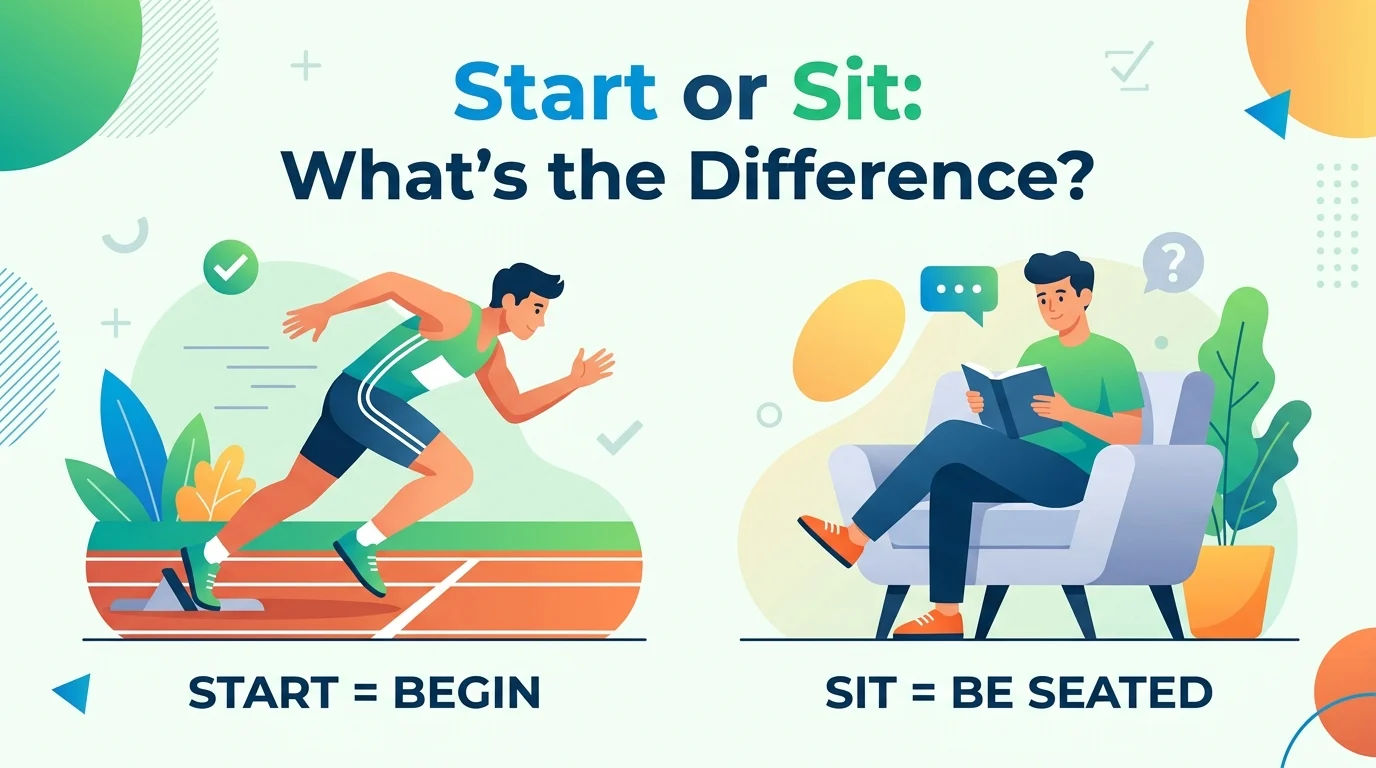
Quick Ans: “Start” and “sit” are both common English verbs, but they have completely different meanings. “Start” means to begin something or cause something to begin, while “sit” means to rest in a seated position. Choosing the right word depends on what action you want to describe.
Are you confused about whether to use “start or sit”? These words may sound simple, but English learners sometimes mix them up, especially when speaking quickly.
“Start” usually refers to beginning an action, activity, event, or process. For example, “The movie will start at 8 p.m.” You can also use it when someone begins doing something, such as “I started my homework.”
“Sit,” on the other hand, describes a person’s position. If you sit, you place your body in a seated position. For example, “Please sit here.”
The two verbs can appear together in some sentences, which can make the difference even more confusing. You might say, “Sit down and start your work.” Here, “sit” describes the position, while “start” describes the beginning of an activity.
Once you understand what each verb means, the choice becomes much easier.
Quick Answer and Key Takeaway
| Word | Meaning | Example |
|---|---|---|
| Start | Begin something | Let’s start the lesson. |
| Sit | Rest in a seated position | Please sit here. |
| Started | Past tense of start | We started at noon. |
| Sat | Past tense of sit | She sat on the chair. |
Quick rule: Use “start” for beginning something and “sit” for being in a seated position.
Definition and Explanation
Start
“Start” is a verb meaning to begin something or cause something to begin.
Example: The class starts at nine.
It can also mean beginning an activity.
Example: I need to start my assignment.
The past tense is “started.”
Example: We started the meeting at ten.
Sit
“Sit” is a verb meaning to rest your body in a seated position.
Example: Please sit on the chair.
Its past tense is “sat.”
Example: She sat beside me.
Its past participle is “sat.”
Example: He has sat there for an hour.
| Verb | Meaning | Past Tense | Example |
|---|---|---|---|
| Start | Begin | Started | We started the class. |
| Sit | Take a seated position | Sat | We sat in the classroom. |
The meanings are very different. “Start” relates to beginning, while “sit” relates to physical position.
Is This a Grammar, Usage, or Vocabulary Issue?
This is mainly a vocabulary and verb usage issue. Both “start” and “sit” are standard English verbs, but you cannot normally substitute one for the other.
For example, “Start down” and “sit down” do not mean the same thing. “Sit down” asks someone to take a seated position. “Start” usually needs an activity, process, or event as its object.
Correct: Please sit down.
Correct: Please start the lesson.
The past forms are also different. The past tense of “start” is “started,” while the past tense of “sit” is “sat.”
Real World Usage Examples
Workplace Examples
“Let’s start the meeting at 10 a.m.”
Here, “start” means begin.
“Please sit in the conference room.”
Here, “sit” describes the person’s position.
Recap: Use “start” for beginning work and “sit” for a seated position.
Academic Examples
“The teacher started the lesson at nine.”
The lesson began at nine.
“The students sat quietly during the lesson.”
The students remained in a seated position.
Recap: Academic writing can use both verbs, but their meanings remain different.
Everyday Examples
“Sit here while I start dinner.”
This sentence uses both words correctly. “Sit” describes where someone should position themselves, while “start” means begin.
Recap: One sentence can contain both verbs when they describe different actions.
Regional or Global Usage Differences
“Start” and “sit” have the same basic meanings in American, British, Canadian, and Australian English.
There is no major regional difference in their spelling or basic grammar.
Some related expressions can vary between regions, but the verbs themselves are widely understood and used in the same way.
When NOT to Use It
Do not use “sit” when you mean “begin.” Say, “The movie will start,” not “The movie will sit.”
Do not use “start” when you mean taking a seated position. Say, “Please sit down.”
Do not confuse “sat” with “started.” “Sat” is the past tense of “sit.”
Avoid saying “I started on the chair” when you mean that you took a seated position.
Do not say “I sat my homework” when you mean that you began your homework. Say, “I started my homework.”
Common Mistakes and Corrections
| Correct Sentence | Incorrect Sentence | Why |
|---|---|---|
| Please sit down. | Please start down. | “Sit down” means take a seated position. |
| Let’s start the meeting. | Let’s sit the meeting. | “Start” means begin. |
| She sat on the chair. | She started on the chair. | “Sat” is the past tense of “sit.” |
| I started my homework. | I sat my homework. | “Started” means began the activity. |
Decision Rule: Ask yourself what you mean. If something is beginning, use “start.” If someone is taking or staying in a seated position, use “sit.”
Exercises With Answers
Choose the correct word.
- Please _____ down.
- The movie will _____ soon.
- We _____ the meeting at nine.
- She _____ beside her friend.
- I need to _____ my homework.
- He _____ on the sofa yesterday.
Answer Key
- sit
- start
- started
- sat
- start
- sat
Related Concepts and Comparisons
Readers may also search for sit vs set, sit vs seat, start vs begin, sit past tense, start past tense, sat vs sit, common English verbs, and confusing English words.
FAQs
What is the difference between start and sit?
“Start” means to begin something, while “sit” means to rest in a seated position. For example, “Start the car” means begin operating it, while “Sit in the car” describes your position.
Is start a verb?
Yes. “Start” is commonly used as a verb meaning to begin something. For example, “We will start the meeting soon.”
Is sit a verb?
Yes. “Sit” is a verb that describes taking or remaining in a seated position. For example, “Please sit here.”
What is the past tense of start?
The past tense of “start” is “started.” For example, “The class started at nine.”
What is the past tense of sit?
The past tense of “sit” is “sat.” For example, “She sat on the sofa.”
Can start and sit be used in the same sentence?
Yes. They can describe two different actions. For example, “Sit down and start your work.”
Is sit down or start down correct?
“Sit down” is correct when you mean taking a seated position. “Start down” does not normally have this meaning.
Should I say start my homework or sit my homework?
Say “start my homework.” “Start” means begin the activity, while “sit” refers to your physical position.
Conclusion
The difference between “start or sit” is simple once you focus on the action each verb describes. “Start” means to begin an activity, event, process, or task. “Sit” means to take or remain in a seated position.
For example, you can “start a meeting,” “start your homework,” or “start the car.” In contrast, you can “sit on a chair,” “sit beside someone,” or “sit down.”
Their past forms are different too. The past tense of “start” is “started,” while the past tense of “sit” is “sat.” So, “We started the class” and “We sat in the classroom” are both correct, but they describe different actions.
The two verbs can also appear together. “Sit down and start your work” is a perfect example.
Practical tip: if you mean “begin,” choose “start.” If you mean “take a seated position,” choose “sit.”
1 thought on “Start or Sit: What’s the Difference? Easy Rules, Examples & Tips”