
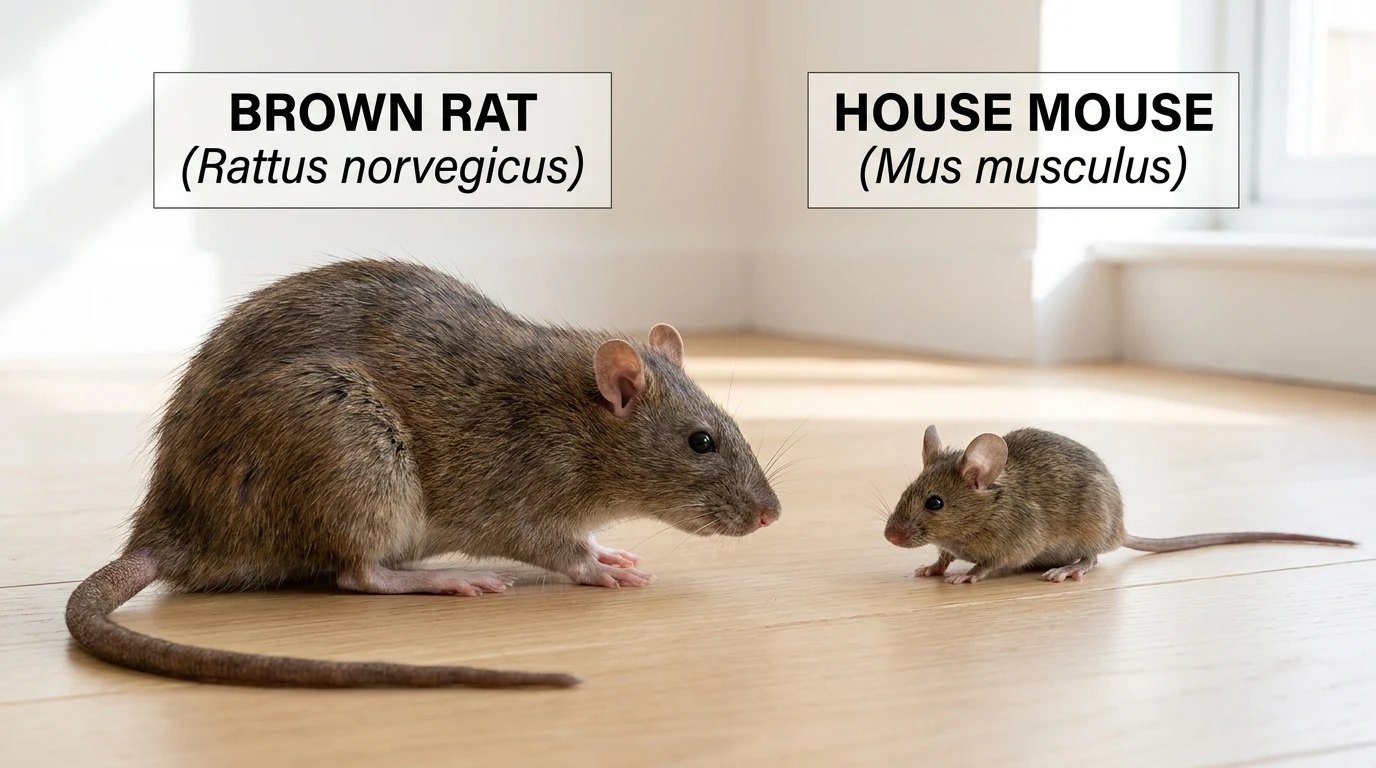
Quick Ans: The main difference between a rat and a mouse is their size. Rats usually have larger bodies, thicker tails, bigger feet, and broader snouts. In contrast, mice are smaller, with delicate features, large ears relative to their heads, and slender tails. Both rodents can enter homes, contaminate food, and cause damage.
Rats and mice may look similar at first, but several features help you tell them apart. Both are rodents with sharp teeth, long tails, and a habit of searching for food indoors. However, they differ in size, appearance, behavior, and the signs they leave behind.
Knowing the difference between a rat and a mouse can help you identify which pest has entered your home. For example, a large rodent with a thick tail may be a rat, while a tiny animal with prominent ears may be a mouse.
Moreover, identifying the pest correctly helps you choose suitable prevention and control methods. Although both animals can spread germs and damage property, their size and nesting habits may affect where you find them.
In this guide, you will learn the key differences between rats and mice, how to recognize their droppings, and which signs to look for around your home.
Rat vs Mouse: Key Differences
| Feature | Rat | Mouse |
|---|---|---|
| Body size | Larger and heavier | Smaller and lighter |
| Snout | Usually broader or blunter | Usually pointed |
| Ears | Smaller relative to the head | Larger relative to the head |
| Feet | Larger and sturdier | Small and delicate |
| Tail | Generally thicker | Generally thinner |
| Droppings | Usually larger and thicker | Smaller and rice-shaped |
| Movement | Often cautious and deliberate | Often quick and curious |
These features are useful clues, although the exact appearance varies by species.
1. Size and Appearance
The easiest way to distinguish a rat from a mouse is to compare their overall size.
Rats typically have heavier bodies, thicker tails, and larger feet. Depending on the species, their bodies may measure several inches long, excluding the tail.
Mice, especially common house mice, have small, lightweight bodies and delicate features. Their ears often look large compared with their heads.
For example, if you spot a chunky rodent near a trash bin, it may be a rat. On the other hand, a tiny rodent with prominent ears running along a kitchen wall may be a mouse.
2. Snout, Ears, and Tail
Facial features offer another useful clue. Many rats have broader heads and blunter snouts, while house mice tend to have narrower, pointed snouts.
In addition, mice usually have ears that appear large in proportion to their heads. Rat ears often look smaller relative to their overall size.
Their tails also differ. Rat tails are generally thicker and may look scaly, whereas mouse tails are usually thinner and more delicate. However, these traits can overlap, so consider several features rather than relying on one alone.
3. Droppings: Rat Poop vs Mouse Poop
Droppings can help you identify which rodent is present.
- Rat droppings: Usually larger, thicker, and capsule-shaped.
- Mouse droppings: Smaller, narrow, and often shaped like grains of rice.
Fresh droppings may look dark and moist, while older ones often become dry and dull. Still, droppings can vary depending on the animal’s size and diet.
Safety tip: Never sweep or vacuum rodent droppings while they are dry. Instead, ventilate the area, wear disposable gloves, apply an appropriate disinfectant according to its label, and follow public health guidance for safe cleanup.
4. Behavior and Habits
Rats and mice both search for food and shelter, but their behavior can differ.
Rats often move cautiously around unfamiliar objects. They may follow established routes along walls and hide in basements, crawl spaces, or other sheltered areas.
Meanwhile, house mice can squeeze through very small openings and explore cupboards, storage areas, and spaces behind appliances. They may build nests close to food sources.
However, neither behavior is absolute. Both rodents can adapt to different environments, especially when food and shelter are readily available.
5. Diet and Food Preferences
Both rats and mice are opportunistic feeders. They eat a variety of foods, including grains, seeds, discarded food, and other available materials.
Although people often associate mice with cheese, they do not rely on it as their main food. In fact, grains and other carbohydrate-rich foods can attract house mice.
Similarly, rats eat many types of food, depending on their species and surroundings. Therefore, keeping food sealed, cleaning crumbs, and securing garbage can help discourage both pests.
6. Where Rats and Mice Live
Rats often shelter in sewers, drains, burrows, basements, and outdoor areas near buildings. Some species, however, prefer elevated spaces such as attics or roof areas.
House mice commonly nest inside walls, cupboards, storage boxes, and other protected indoor spaces.
Consequently, the location of scratching sounds, droppings, or gnaw marks may provide clues. Nevertheless, location alone cannot confirm the species.
7. Which Is More Dangerous?
Both rats and mice can contaminate food, damage wiring and household materials, and carry pathogens. Neither should be handled with bare hands.
Rats may cause more extensive physical damage because of their larger size and stronger jaws. However, mice can also cause serious problems, particularly when they enter kitchens, food storage areas, or electrical spaces.
Therefore, do not ignore a rodent simply because it looks small. Seal entry points, store food securely, and address signs of infestation promptly.
Common Mistakes When Identifying Rats and Mice
- Assuming every small rodent is a mouse: Young rats may be small, too.
- Relying only on tail length: Tail proportions vary by species.
- Identifying a pest from droppings alone: Dropping size helps, but other evidence matters.
- Ignoring small openings: Mice can enter through surprisingly narrow gaps.
- Waiting for more sightings: One sighting may indicate a larger problem, although it does not prove an infestation.
Frequently Asked Questions
Is a rat bigger than a mouse?
Yes. Rats are generally larger and heavier than mice, with thicker tails and bigger feet.
Can a mouse turn into a rat?
No. Rats and mice are different animals. A mouse does not grow into a rat, although a young rat may initially look small.
Are rats smarter than mice?
Both rodents can learn and adapt. Rats often perform well in learning tasks, but intelligence depends on the task and how researchers measure it.
Do rats and mice live together?
They can occupy the same building, but they may compete for food and shelter. Their relationship depends on the species and environment.
What attracts rats and mice to a house?
Accessible food, water, clutter, garbage, and safe nesting spaces can attract both rodents.
Can mice fit through smaller holes than rats?
Generally, yes. Mice can squeeze through very small openings because of their small bodies. However, the opening’s shape and the animal’s size affect whether it can pass through.
How can I prevent rats and mice?
Store food in sealed containers, clean spills, secure garbage, reduce clutter, and seal gaps around pipes, doors, and foundations. If the problem continues, consider professional pest control.
Which is easier to get rid of, rats or mice?
Neither is always easier to control. Success depends on the size of the infestation, access to food, available hiding places, and the control methods used.
Conclusion
The main difference in rat vs mouse identification is size, but body shape, ears, tails, droppings, and behavior can also help. Rats are generally larger and sturdier, while mice are smaller and more delicate. If you find signs of either rodent, secure food, seal entry points, and take appropriate steps to prevent further activity.