
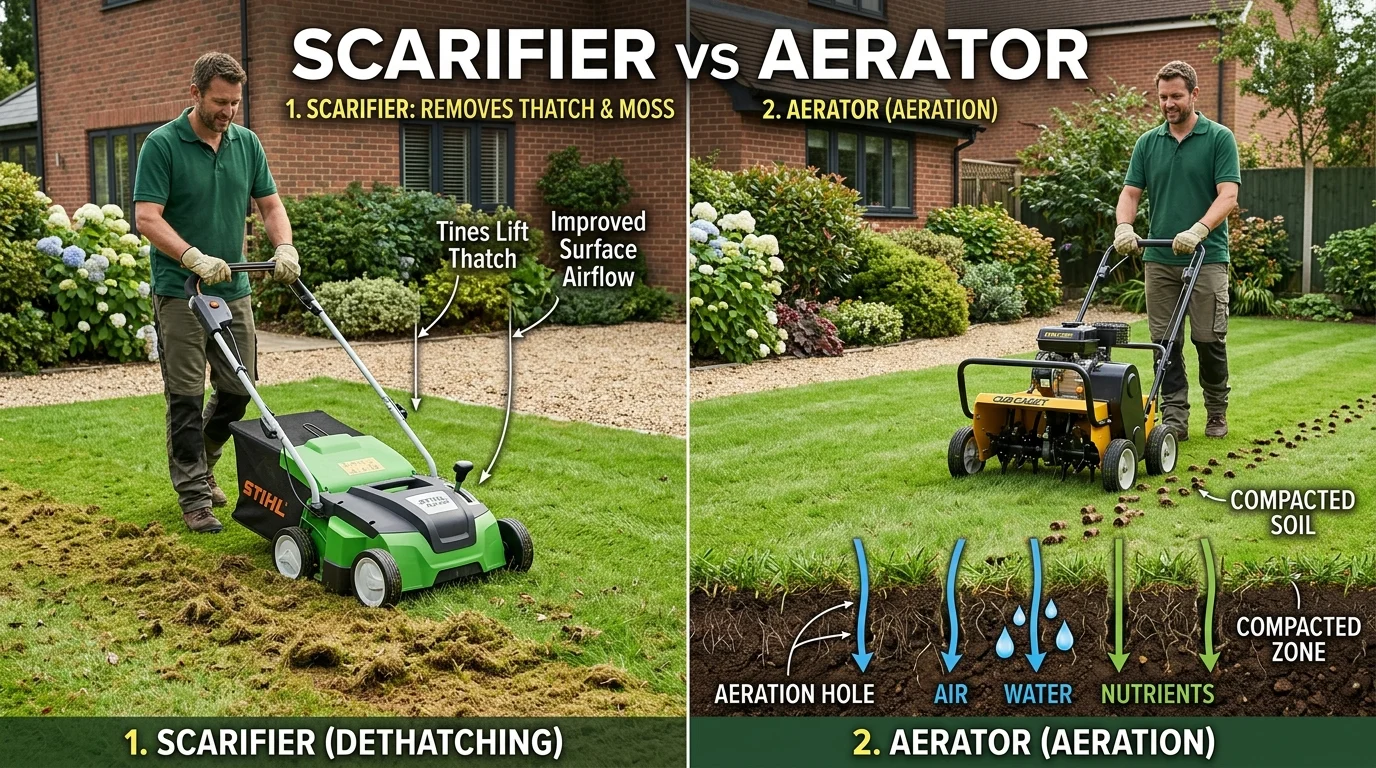
Quick Ans: A scarifier and an aerator both improve lawn health, but they solve different problems. A scarifier removes thatch, moss, and dead grass from the soil surface, while an aerator creates small holes in the soil to improve air, water, and nutrient movement. In simple terms, scarifying removes buildup, while aerating relieves soil compaction.
Scarifier vs aerator is an important comparison for anyone trying to maintain a healthy, thick, and green lawn. These two garden tools may look similar, but they perform different jobs.
A scarifier is designed to remove thatch, moss, dead grass, and other organic material that builds up near the surface of the lawn. Too much thatch can prevent water, air, and nutrients from reaching the soil properly.
An aerator works differently. It creates holes or channels in compacted soil, allowing air, water, and nutrients to reach grass roots more effectively. Aeration can also encourage deeper root growth and improve drainage.
Knowing the difference helps you choose the right lawn care tool. If your lawn has excessive thatch or moss, scarifying may be useful. If the soil feels hard and compacted, aeration may be the better approach.
Quick Answer and Key Takeaway
The main difference between a scarifier and an aerator is what they do to the lawn.
A scarifier removes thatch, moss, and dead organic material from the lawn surface, while an aerator creates holes in the soil to reduce compaction and improve air and water movement.
Easy rule:
Scarifier = removes thatch
Aerator = relieves soil compaction
Scarifier vs Aerator: Definition and Explanation
What Is a Scarifier?
A scarifier is a lawn care machine or tool that removes thatch and moss from the surface of a lawn. Its blades or tines work close to the soil surface and pull out unwanted organic material.
Thatch is a layer of dead grass, roots, stems, and other organic matter that can accumulate between the green grass and soil.
A small amount of thatch can be useful, but excessive buildup can interfere with lawn growth.
What Is an Aerator?
An aerator creates holes in the soil. These holes allow air, water, and nutrients to move more easily toward grass roots.
Aerators can use solid spikes, hollow tines, or other mechanisms depending on the type of equipment.
Core aeration, which removes small plugs of soil, is commonly used when soil has significant compaction.
Is This a Grammar, Usage, or Vocabulary Issue?
Scarifier vs aerator is primarily a vocabulary and product comparison.
The words describe different lawn care tools and processes. Although both can improve lawn condition, they should not be treated as interchangeable terms.
Use scarifier when talking about removing thatch or moss.
Use aerator when talking about creating holes in soil to improve air and water circulation.
Real World Usage Examples
Everyday Lawn Care
Scarifier:
We used a scarifier to remove the thick layer of thatch from the lawn.
Aerator:
I used an aerator because the soil had become hard and compacted.
Recap: Scarifiers remove surface buildup, while aerators open up compacted soil.
Gardening and Landscaping
Scarifier:
The landscaper scarified the lawn before reseeding it.
Aerator:
The gardener aerated the soil to help the grass roots receive more oxygen.
Recap: Scarifying focuses on the lawn surface, while aerating focuses mainly on soil conditions.
Lawn Maintenance
Scarifier:
Excessive moss made scarifying necessary.
Aerator:
Heavy foot traffic had compacted the soil, so we aerated the lawn.
Recap: Choose the tool based on the specific problem affecting your lawn.
Scarifier vs Aerator: Key Differences
| Feature | Scarifier | Aerator |
|---|---|---|
| Main purpose | Removes thatch and moss | Reduces soil compaction |
| Works on | Lawn surface | Soil |
| Removes material | Yes | Core aerators remove soil plugs |
| Creates holes | Not its main purpose | Yes |
| Helps air reach roots | Indirectly | Directly |
| Helps water movement | By removing thatch | By opening soil |
| Common reason for use | Excessive thatch or moss | Compacted soil |
| Common result | Cleaner lawn surface | Better soil access for roots |
Regional or Global Usage Differences
The basic meanings of scarifier and aerator remain similar across English speaking regions. However, gardening terminology can vary.
In some places, a scarifier may also be called a dethatcher, particularly when discussing equipment designed mainly to remove thatch.
The word aerator can refer to different types of lawn equipment, including spike and core aerators. Always check the specific tool before using it.
When NOT to Use a Scarifier or Aerator
Do not automatically scarify or aerate every lawn. Avoid unnecessary treatment when:
- The lawn has very little thatch.
- The soil is already loose and well drained.
- The grass is severely stressed or damaged.
- Weather conditions are unsuitable for lawn recovery.
- You are unsure which problem needs treatment.
- The equipment could damage the type of grass you have.
- The soil is too wet for the planned treatment.
The right timing depends on grass type, climate, soil condition, and lawn health.
Common Mistakes and Corrections
| Correct Sentence | Incorrect Sentence | Why |
|---|---|---|
| Use a scarifier to remove thatch. | Use an aerator to remove thatch. | Aerators are designed mainly to open compacted soil. |
| Use an aerator on compacted soil. | Use a scarifier to create soil holes. | Scarifiers primarily remove surface buildup. |
| Scarifying can remove moss. | Aerating removes moss. | Aeration does not primarily target moss. |
| Core aeration removes soil plugs. | Every aerator removes soil plugs. | Some aerators use solid spikes instead. |
Easy Decision Rule
Look at the lawn before choosing the tool.
Too much thatch or moss? Use a scarifier.
Hard or compacted soil? Use an aerator.
If the lawn has both problems, the two treatments may sometimes be used as part of a broader lawn care routine.
Exercises With Answers
Choose scarifier or aerator.
- The lawn has a thick layer of thatch, so we need a ______.
- Heavy traffic has compacted the soil, so we need an ______.
- A ______ removes moss and dead organic material.
- An ______ creates holes in the soil.
- Core ______ can remove small plugs of soil.
Answers
- scarifier
- aerator
- scarifier
- aerator
- aeration
Related Concepts and Comparisons
Scarifier vs Dethatcher
These terms are often used for similar lawn care equipment. A scarifier generally works more aggressively, while a dethatcher usually focuses specifically on removing thatch.
Aerator vs Cultivator
An aerator creates openings in established lawn soil. A cultivator is generally used to loosen or prepare soil in garden beds and planting areas.
Scarifying vs Aerating
Scarifying removes unwanted material from the lawn surface. Aerating creates openings in the soil below the surface.
FAQs
Is a scarifier the same as an aerator?
No. A scarifier removes thatch, moss, and dead organic material, while an aerator creates openings in the soil to reduce compaction.
Should I scarify or aerate my lawn first?
It depends on the lawn’s condition. If excessive thatch is the main problem, scarifying addresses that issue. If soil compaction is the main problem, aeration may be more appropriate.
Does a scarifier remove moss?
Yes. Removing moss and other surface buildup is one of the common purposes of scarifying.
Does aerating remove thatch?
No. Aeration is mainly intended to improve soil conditions by creating openings. It is not a substitute for removing excessive thatch.
What is the difference between a scarifier and a dethatcher?
The terms can overlap, but scarifiers generally work more aggressively and may remove moss and thatch from the lawn surface.
Is core aeration better than spike aeration?
They work differently. Core aeration removes small plugs of soil, while spike aeration creates holes without removing soil. The appropriate method depends on soil conditions.
Can I use a scarifier on a new lawn?
A newly established lawn may be more vulnerable to aggressive treatment. Follow the equipment manufacturer’s instructions and consider the grass’s stage of development before scarifying.
Can you scarify and aerate at the same time?
They are different treatments and are not literally the same process. Depending on lawn condition, both may be included in a broader maintenance plan.
Conclusion
Scarifier vs aerator becomes simple when you identify the problem your lawn has. A scarifier primarily removes thatch, moss, dead grass, and other organic buildup from the lawn surface. An aerator, meanwhile, creates openings in the soil to improve air, water, and nutrient movement around grass roots.
These tools can both support healthier lawns, but they should not be used interchangeably. Choosing the wrong tool may fail to address the underlying problem.
If you notice a thick layer of thatch or moss, a scarifier may be the tool to consider. If the soil feels hard, compacted, or difficult for water to penetrate, an aerator may be more suitable.
The easiest tip to remember is this: scarifying cleans the lawn surface, while aerating opens the soil. Check your lawn’s condition first, then choose the treatment that addresses the actual problem.